The Power Electronics Supercycle — Part 9 of 9 · Series index
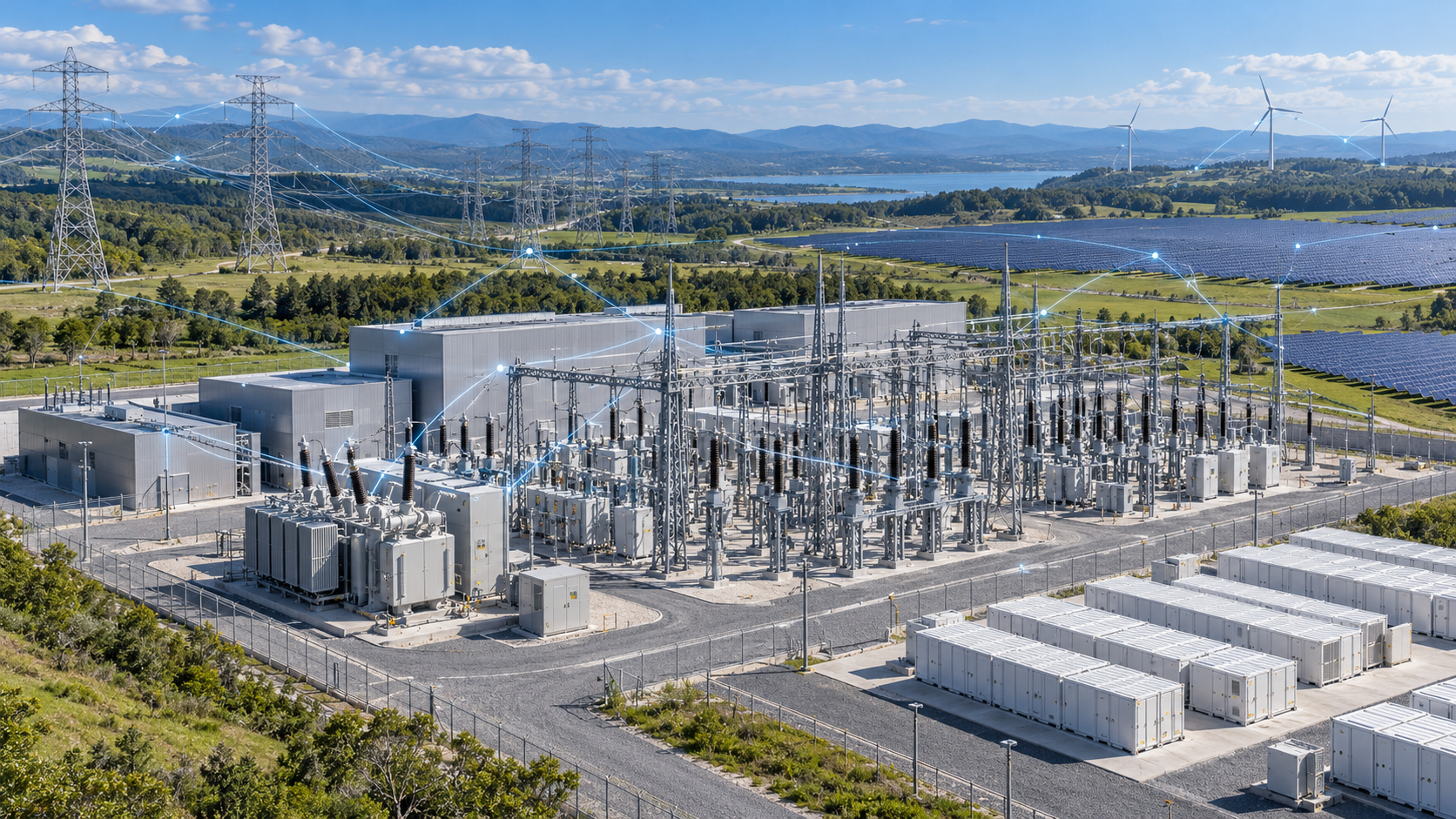
Conceptual editorial illustration of coordinated grid infrastructure; not a photograph of a particular installation. Digital traces are illustrative, not operating data.
Executive Summary
The electric grid has undergone several major transformations throughout history.
One way to describe that history is through overlapping developments: electrification, regional interconnection, and the expansion of digital monitoring, automation, and protection.
The next transformation is already underway.
The future grid will not simply be a larger version of today’s power system.
It could evolve toward a more coordinated network where power electronics, advanced sensors, digital controls, and carefully validated AI decision-support tools help manage electricity.
This is the ultimate vision of the Power Electronics Supercycle:
A transition from a grid dominated by mechanical machines to a grid increasingly supported and coordinated by intelligent electronic systems.
From Machine-Based Grid to Software-Defined Grid
For much of the twentieth century, grid reliability depended on synchronous-machine characteristics, network design, control systems, protection, and operating practices.
Large synchronous generators provided important contributions to:
- Inertia
- Frequency stability
- Voltage support
- Fault current
- System synchronization
These capabilities arise from different mechanisms: rotating mass stores kinetic energy, excitation and governor controls influence voltage and frequency, electromagnetic characteristics shape fault current, and synchronizing behavior couples machines through the network. Physics and engineered controls remain essential in every grid architecture.
The future grid will increasingly rely on:
- Power electronic converters
- Digital controls
- Advanced communications
- Real-time measurement
- Artificial intelligence
- Automated decision systems
A growing share of grid response is being shaped deliberately through converter controls, alongside machines and the physical electrical network. Here, “software-defined” describes an architectural direction, not independence from electrical laws.
The Grid Becomes More Like a Digital Platform
Modern electric systems are beginning to resemble complex digital networks.
A growing population of devices may participate in coordinated operation:
- Solar inverters
- Battery systems
- Electric vehicles
- Smart transformers
- Flexible loads
- Industrial facilities
- Data centers
- Transmission assets
Each device can potentially become an active participant in maintaining grid reliability, depending on its technical capabilities, connection arrangements and operating requirements.
The challenge is coordinating these resources at enormous scale.
This requires new approaches to planning, communications, control and operational coordination.
The Rise of the Grid Operating System
A useful way to describe a possible coordination architecture is a “grid operating system.”
This concept does not mean replacing utility control rooms with a single software platform.
Instead, it represents an integrated ecosystem of technologies that coordinate:
- Generation
- Transmission
- Distribution
- Storage
- Flexible demand
- Protection systems
- Market operations
A future grid operating system may combine:
- Advanced energy management systems
- Digital twins
- Artificial intelligence
- Predictive analytics
- Automated controls
- High-speed communications
The goal is a grid capable of adapting more effectively to changing conditions while maintaining the engineering safeguards required for reliable operation.
Artificial Intelligence Becomes a Grid Partner
The complexity of future power systems may exceed what traditional human analysis can manage alone.
AI has the potential to support operators through several important capabilities.
Predictive Maintenance
Helping identify developing equipment problems before failures occur.
Advanced Forecasting
Improving predictions for:
- Renewable generation
- Weather impacts
- Electricity demand
- Congestion
Real-Time Optimization
Helping engineers and operators evaluate options for coordinating:
- Battery charging
- Generator dispatch
- Transmission flows
- Flexible loads
Disturbance Analysis
Helping engineers identify event patterns and assess impacts, while causal explanations still require validation against operating records and engineering analysis.
In the decision-support role discussed here, engineers and operators retain responsibility for validated operating decisions. AI tools require testing, oversight and safeguards before use in critical functions.
The New Role of Power Electronics
Power electronics are a foundation connecting the physical and digital worlds.
They provide the ability to control electricity with precision and speed.
Important applications include:
- Grid-forming inverters supporting voltage and frequency behavior when appropriately designed and coordinated, within current and energy limits
- HVDC systems controlling power transfers
- STATCOMs regulating voltage
- Battery systems providing flexibility
- Advanced semiconductor devices enabling efficiency improvements
Fast electronic control actions will play an increasingly important role, but their value depends on coordinated and validated system performance.
Reliability in the New Grid
The transformation creates enormous opportunities but also new risks.
Future reliability challenges include:
- Cybersecurity threats
- Software failures
- Communication dependencies
- Converter interactions
- Complex protection requirements
- Workforce skill gaps
The industry must ensure that increased intelligence does not create new vulnerabilities.
Reliability will require combining:
- Strong engineering fundamentals
- Advanced technology
- Robust cybersecurity
- Human expertise
A New Era for Grid Engineers
The role of power engineers is changing.
Future engineers will increasingly combine traditional expertise with new disciplines:
- Power systems engineering
- Software development
- Data analytics
- Artificial intelligence
- Cybersecurity
- Semiconductor technology
The grid engineer of the future will not only understand generators and transmission lines.
They will also understand algorithms, communications, and digital control systems.
The Economic Impact
The Power Electronics Supercycle represents a major infrastructure transformation.
Potential investment areas include:
- Transmission expansion
- Grid modernization
- Battery storage
- Semiconductor manufacturing
- Digital infrastructure
- AI-enabled grid operations
- Engineering services
The transformation affects nearly every sector connected to electricity.
As electricity becomes increasingly important to transportation, industry, computing, and society, grid modernization becomes an important foundation for economic activity.
The Next Decade
The coming decade will be an important period for determining how successfully the industry manages this transition.
Developments to monitor include:
- Larger grid-forming deployments
- Expanded HVDC networks
- Increased battery integration
- AI-assisted grid operations
- Digital substation adoption
- Advanced protection systems
- Semiconductor innovation
Technology choices, engineering validation, investment and operating practices will influence how reliable and flexible future grids become.
Final Perspective
The electric grid has always evolved with technology.
From the first power plants to interconnected transmission networks, each generation has built upon the previous one.
The Power Electronics Supercycle represents another defining moment.
The future grid will not be powered only by generators.
Its coordination may increasingly draw on a combination of:
- Machines
- Electronics
- Software
- Data
- Artificial intelligence
The greatest transformation may not be the replacement of one technology with another.
It may be the creation of an entirely new operating model for electricity.
A grid that can sense.
A grid that can adapt.
A grid whose operation can be optimized through validated controls and accountable human decision-making.
The Power Electronics Supercycle is not simply about changing how electricity is produced.
It is about changing how the entire electric system thinks.
Series Conclusion: The Nine-Part Journey
Part 1 — The Biggest Transformation of the Electric Grid Since AC Power
Why power electronics are reshaping the industry.
Part 2 — Grid-Forming Inverters: Rebuilding the Functions Once Provided by Synchronous Machines
How converters can provide selected grid-support functions through different physical and control mechanisms.
Part 3 — Why AI Data Centers Are Reshaping Grid Planning
How digital infrastructure is accelerating electricity demand.
Part 4 — Inside the Global HVDC Expansion Boom
How controlled power transmission is enabling the future grid.
Part 5 — STATCOMs, SVCs, and the New Age of Voltage Control
How dynamic grid support is becoming essential.
Part 6 — Silicon Carbide: The Semiconductor Revolution Powering the Future Grid
The hardware foundation behind the transformation.
Part 7 — Protection Challenges in Inverter-Dominated Power Systems
How engineers are redesigning grid reliability.
Part 8 — Who Wins? Companies and Technologies Positioned for the Power Electronics Supercycle
The emerging industrial ecosystem.
Part 9 — The Future Grid: A New Operating System for Electricity
The vision of the next-generation power system.
End of Series — The Power Electronics Supercycle
Previous article: Part 8 — Who Wins? Companies and Technologies Positioned for the Power Electronics Supercycle