POWER ELECTRONICS SUPERCYCLE · PART 5 OF 9
For more than a century, voltage control has been one of the fundamental requirements of AC power systems.
Synchronous generators, capacitor banks, reactors, transformer tap changers, and synchronous condensers have traditionally provided much of the reactive-power capability needed to keep transmission voltages within acceptable limits.
That architecture is now changing.
Large conventional generating units are retiring in some regions. Wind, solar, batteries, HVDC converters, and other inverter-based resources are connecting through power electronics. Transmission corridors are carrying electricity across increasingly complex patterns of generation and demand.
At the same time, enormous new loads—including data centers—are appearing at particular points on the network.
The result is that voltage control is becoming one of the critical engineering problems of the changing grid.
And increasingly, power electronics are being asked to solve it.
Reactive Power Is Central to Voltage Control
Real power and reactive power perform different functions in an AC system.
Real power transfers energy that ultimately performs useful work.
Reactive power is associated with the electric and magnetic fields required by AC equipment and networks. Its production, absorption, and movement strongly influence voltage.
When reactive-power support is insufficient in a particular area, voltage can decline.
Under severe conditions, that decline can become self-reinforcing.
Loads, transmission lines, generators, transformers, and control systems interact. Reactive-power reserves can be depleted. Voltage can continue falling even though the wider power system remains synchronized.
The extreme outcome is voltage collapse.
That makes reactive power more than an accounting quantity measured in vars.
It is one of the mechanisms through which operators maintain usable voltage across the transmission system.
And unlike real power, reactive power generally cannot be transported efficiently across arbitrary distances.
Location matters.
The grid therefore needs reactive-power capability where the electrical system needs it.
Traditional Voltage-Control Equipment Is Still Essential
Not every voltage problem requires sophisticated power electronics.
Utilities continue to rely on equipment that has served power systems for decades.
Shunt capacitor banks can inject reactive power.
Shunt reactors can absorb it.
Transformer tap changers can adjust voltage ratios.
Synchronous condensers can provide dynamic reactive power along with short-circuit strength and rotating inertia.
These technologies remain important.
But many of them have limitations when the grid requires very fast and continuously adjustable response.
A switched capacitor bank, for example, changes reactive-power output in discrete steps.
A rapidly changing disturbance may demand something more dynamic.
That requirement helped produce an important class of transmission equipment:
FACTS — Flexible AC Transmission Systems.
Among the most important FACTS technologies are the SVC and the STATCOM.
The SVC Made Reactive Power Controllable
A Static Var Compensator, or SVC, uses power-electronic switching together with capacitors and reactors to provide rapidly adjustable reactive power.
Typical architectures combine devices such as thyristor-controlled reactors and thyristor-switched capacitors.
Instead of waiting for mechanical switching operations, the SVC controller can continuously regulate reactive-power behavior in response to system conditions.
That allows an SVC to help:
- regulate transmission voltage,
- improve voltage stability,
- increase usable transmission capability,
- damp certain power-system oscillations,
- and support voltage recovery following disturbances.
SVCs became an important step in the evolution of the transmission grid.
But semiconductor technology would eventually make another architecture practical.
The STATCOM Changes the Architecture
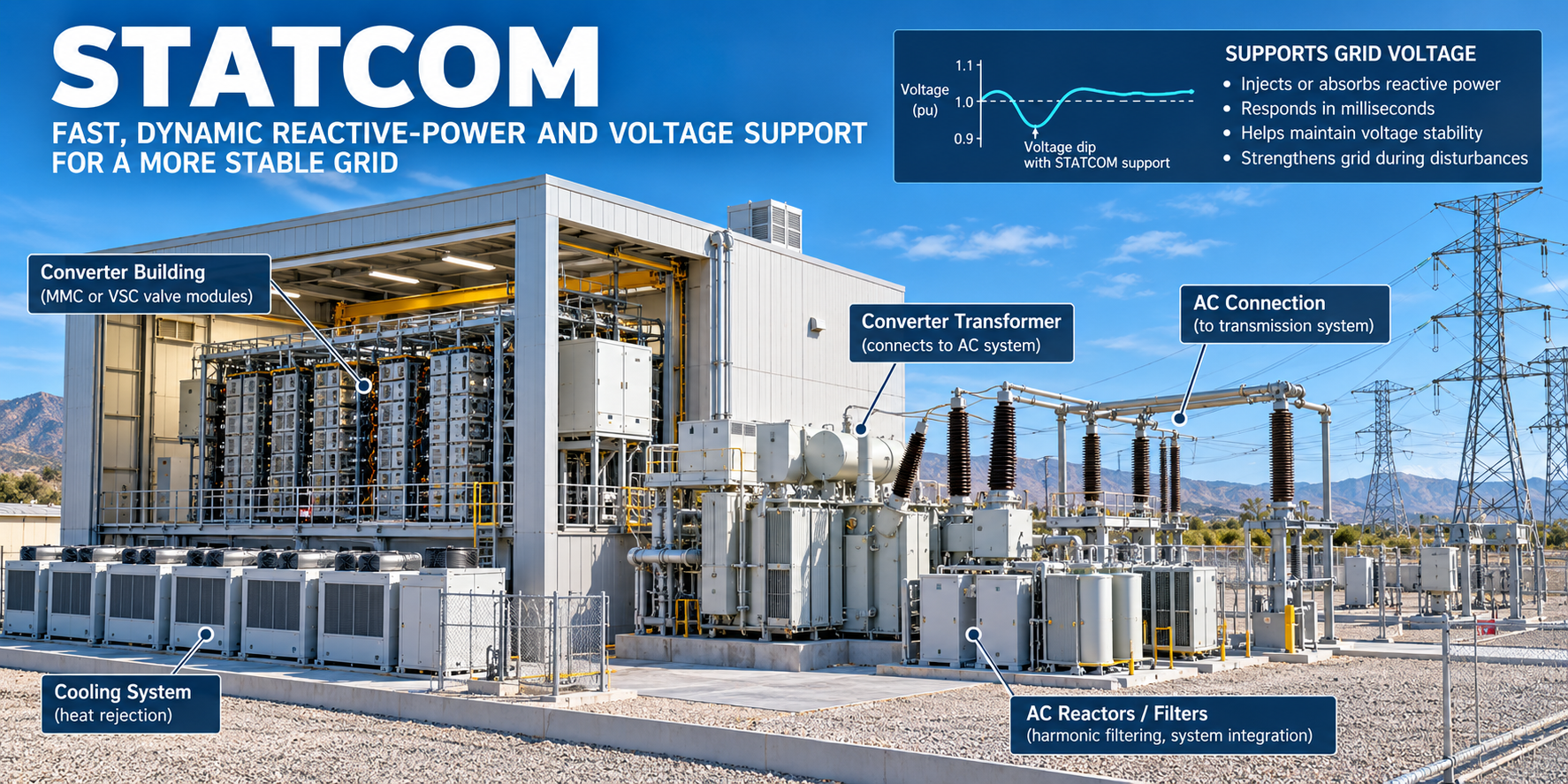
A Static Synchronous Compensator, or STATCOM, approaches the problem differently.
Instead of controlling reactive power primarily by switching reactors and capacitors, a modern STATCOM uses a voltage-source converter.
That converter synthesizes an AC voltage waveform from a DC-side electrical source.
By controlling the magnitude and phase relationship between the converter voltage and the grid voltage, the STATCOM can exchange reactive power with the AC system.
In simplified terms:
Grid voltage falls → STATCOM can inject reactive current
Grid voltage rises → STATCOM can absorb reactive current
The response can be extremely fast because it is governed largely by semiconductor switching and control algorithms rather than mechanical equipment.
This is another point where the Power Electronics Supercycle becomes visible.
The equipment supporting transmission voltage is becoming a controlled power-electronic system.
STATCOMs Have an Important Advantage During Low Voltage
SVCs and STATCOMs can both provide dynamic reactive-power support.
But their electrical characteristics differ.
An SVC behaves essentially as a controlled shunt susceptance. As system voltage falls, the reactive power it can provide falls approximately with the square of voltage.
That can become important during severe voltage depressions—precisely when dynamic support may be particularly valuable.
A STATCOM can generally maintain its reactive-current capability over a wider range of depressed voltages, subject to converter current and equipment limits.
Its reactive-power output still decreases as terminal voltage falls because reactive power depends on both voltage and current.
But the ability to maintain high reactive current at reduced voltage gives the STATCOM an important dynamic advantage in many applications.
That does not make STATCOMs universally superior.
SVCs remain effective and economically attractive in many installations.
The engineering choice depends on required dynamic performance, system strength, voltage range, footprint, losses, cost, harmonic performance, redundancy, and other project-specific factors.
The Grid Is Asking for Faster Voltage Response
The changing generation fleet makes these characteristics increasingly relevant.
Inverter-based resources do not automatically behave like synchronous generators.
Their voltage and reactive-power response depends on equipment capability, plant design, control modes, protection settings, and software.
NERC guidance recommends that bulk-power-system-connected inverter-based resources operate with closed-loop automatic voltage control to support voltage schedules, post-contingency voltage recovery, and voltage stability. It also emphasizes relatively fast reactive-power response.
This represents a broader change in reliability engineering.
Grid support increasingly cannot be assumed simply because generating equipment is electrically connected.
The desired behavior must be specified, modeled, configured, tested, and verified.
That principle applies to renewable plants.
It applies to battery systems.
And it applies to STATCOMs.
STATCOMs Are Beginning to Become Grid-Forming Devices
An especially important development is now emerging.
STATCOMs traditionally operate primarily as dynamic reactive-power and voltage-control devices.
But advanced control architectures are expanding their role.
At Amprion’s Opladen substation in Germany, Hitachi Energy has deployed a ±300 Mvar STATCOM with grid-forming functionality. The system is designed to provide dynamic reactive power even under very low local short-circuit strength and to behave as a controlled voltage source.
That distinction is significant.
A conventional grid-following converter generally measures an existing grid waveform and synchronizes its operation to it.
A grid-forming converter can establish its own controlled voltage reference and contribute to stabilizing the surrounding electrical system.
Applied to a transmission STATCOM, that concept begins to transform the device.
It is no longer only compensating reactive power.
It can become part of the mechanism through which the network establishes and stabilizes voltage.
Weak Grids Make the Problem More Difficult
Power-electronic systems become especially interesting in electrically weak areas.
A weak grid does not necessarily mean a physically small grid.
It generally refers to a location where the electrical system has relatively low short-circuit strength compared with the power-electronic equipment connected to it.
Under those conditions, voltage can be more sensitive to changes in current injection.
Converter controls can interact with the network.
Multiple nearby converters can also interact with one another.
The German grid-forming STATCOM project illustrates the direction of engineering development. Its control behavior was evaluated using electromagnetic-transient simulations and software-in-the-loop testing across a wide range of short-circuit conditions.
That testing points toward another recurring theme of the Power Electronics Supercycle:
More sophisticated controls require more sophisticated models.
Voltage Control Is Becoming a Coordinated System
The future grid will rarely rely on a single device for voltage support.
A transmission area might contain:
- synchronous generators,
- synchronous condensers,
- capacitor banks,
- reactors,
- SVCs,
- STATCOMs,
- HVDC converters,
- solar inverters,
- wind converters,
- battery inverters,
- transformer tap changers,
- and other controllable equipment.
Each device may have its own controller.
Each controller may respond on a different timescale.
And several devices may attempt to regulate the same electrical quantity.
That creates a coordination problem.
Poorly coordinated controls can fight one another, produce oscillatory behavior, or create unexpected operating conditions.
The engineering challenge therefore moves beyond asking:
Does the grid have enough reactive power?
A more difficult question emerges:
How will all of the devices providing reactive power and voltage control behave together during actual disturbances?
Solar and Battery Inverters Can Also Become Voltage Resources
Dedicated STATCOMs are not the only power-electronic devices capable of providing reactive power.
Utility-scale solar and battery inverters can also control reactive-power exchange within their equipment ratings.
That creates potentially important opportunities.
EPRI has demonstrated transmission-level voltage regulation using utility-scale photovoltaic inverters, including testing of nighttime reactive-power operation—sometimes described as providing “vars at night.”
In such operation, a solar plant that is not producing real power from sunlight may still use its inverter equipment to provide reactive-power support, provided the plant and equipment are designed and operated for that capability.
Battery energy-storage systems provide another flexible platform because their converters can control both real and reactive power within their operating limits.
This creates a future in which the distinction between a generation resource and a grid-support device becomes less rigid.
The same converter may perform several functions.
Reliability Standards Are Catching Up With Converter Behavior
The regulatory framework is evolving alongside the technology.
FERC Order No. 901 directed NERC to address reliability gaps associated with inverter-based resources, including data, modeling, studies, and performance requirements. FERC identified concerns involving inverter-based resources reducing output, entering momentary cessation, or tripping during voltage or frequency disturbances rather than providing the performance needed by the bulk power system.
That effort has continued.
NERC’s PRC-028-1 establishes disturbance-monitoring and reporting requirements for inverter-based resources, providing data needed to evaluate disturbance performance and validate models.
In February 2026, FERC approved another group of NERC standards addressing power-system modeling and model verification for generators and inverter-based resources.
NERC has also continued work on enhanced voltage- and frequency-ride-through requirements for inverter-based resources.
The direction is clear.
Converter behavior is becoming an explicit part of reliability engineering rather than an implementation detail hidden inside individual plants.
The New Voltage-Control Stack
The emerging grid therefore has something that earlier power systems possessed in a much simpler form:
a voltage-control stack.
At slower timescales, operators may use transformer taps, switched capacitors, reactors, generation redispatch, and network topology.
At faster timescales, excitation systems, SVCs, STATCOMs, HVDC converters, and inverter controls can respond dynamically.
Some of those devices may increasingly operate with grid-forming control.
The result is not the disappearance of traditional voltage-control equipment.
It is the creation of a hybrid architecture in which conventional electrical equipment and software-controlled power electronics operate together.
And as that architecture becomes more complicated, system performance depends increasingly on coordination among those layers.
Voltage Support Is Becoming Programmable Infrastructure
The importance of STATCOMs and SVCs is therefore larger than the equipment category itself.
They reveal how the nature of transmission infrastructure is changing.
A capacitor bank provides reactive power because of its physical electrical characteristics.
A synchronous condenser responds through electromagnetic and mechanical behavior.
A STATCOM combines electrical hardware with semiconductor switching, digital control, protection logic, communications, and software.
Change the control system and the same physical converter can behave differently.
Add grid-forming capability and its role can expand again.
This is the deeper transformation.
Grid stability functions that were once strongly tied to the inherent physics of rotating machines are increasingly being supplemented by engineered behavior implemented through power electronics and control systems.
That creates extraordinary flexibility.
It also creates new responsibilities for modeling, testing, control coordination, cybersecurity, commissioning, and lifecycle management.
The voltage-control system of the future will therefore not simply contain more reactive-power equipment.
It will contain more intelligence and controllability inside the equipment itself.
And that is precisely why STATCOMs, SVCs, and advanced inverter controls belong at the center of the Power Electronics Supercycle.
Previous in the Power Electronics Supercycle:
Part 4 — Inside the Global HVDC Expansion Boom
Explore the Power Electronics Supercycle series
Next in the Power Electronics Supercycle:
Part 6 — Silicon Carbide: The Semiconductor Revolution Powering the Future Grid