POWER ELECTRONICS SUPERCYCLE · PART 1 OF 9
For more than a century, the electric grid has been built around the behavior of synchronous machines.
Large generators did more than produce electricity. Their rotating mass contributed physical inertia. Their electromagnetic characteristics supplied substantial fault current. Their excitation and governor systems helped regulate voltage and frequency. And their synchronous operation provided many of the physical characteristics around which protection systems, stability studies, and operating practices were developed.
That foundation is changing.
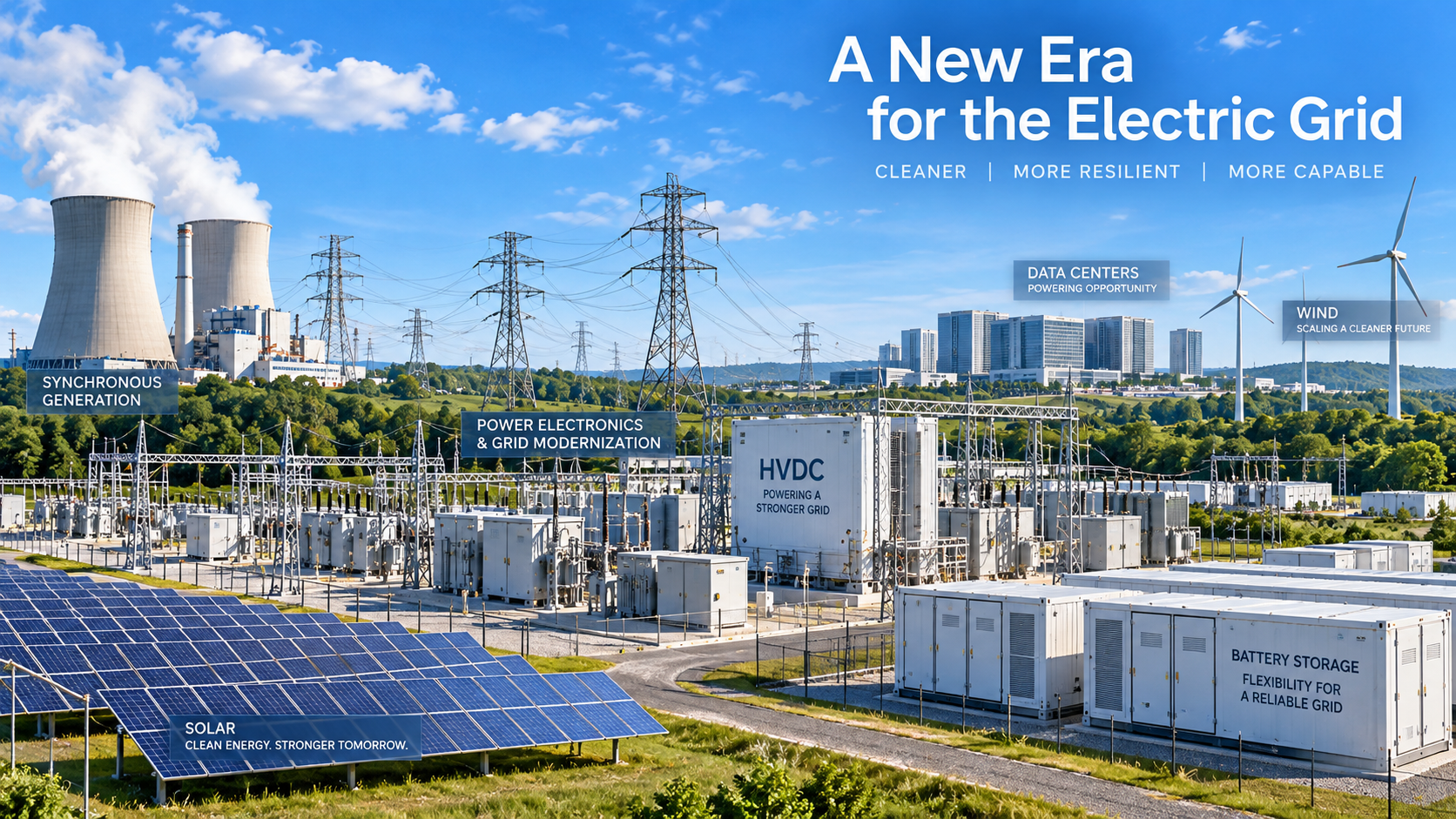
Solar generation, battery energy storage, many modern wind plants, HVDC transmission systems, and a growing range of grid-support technologies interface with the power system through power electronics.
At the same time, rapidly expanding electricity demand—including new data centers and other large loads—is increasing pressure to build generation, transmission, substations, storage, and control infrastructure.
These developments are converging into something larger than any single technology trend.
The electric grid is entering the Power Electronics Supercycle.
It is a multi-decade transformation in which semiconductor-based converters and their control systems are becoming increasingly important to how electrical energy is generated, transferred, stored, and controlled.
And unlike an infrastructure cycle based simply on building more capacity, this transition is changing the electrical behavior of the power system itself.
From Rotating Machines to Controlled Converters
Traditional power systems derive important characteristics from the physics of large rotating generators.
When a disturbance suddenly creates an imbalance between generation and load, kinetic energy stored in rotating machines initially resists rapid changes in frequency. Synchronous machines can also contribute substantial fault current, support voltage through excitation systems, and provide a strong electrical reference for other equipment connected to the network.
Inverter-based resources behave differently.
Solar photovoltaic plants and battery energy storage systems connect to the AC grid through semiconductor switching devices governed by control algorithms. Many modern wind turbines also use power-electronic converters as part of their grid interface.
That distinction matters.
The behavior of an inverter during a disturbance depends heavily on its control architecture, protection settings, current limits, software, and the characteristics of the surrounding power system.
Functions that emerged from the physical characteristics of synchronous machines may therefore need to be provided intentionally through converter controls, other grid equipment, or combinations of technologies.
This is one reason inverter-based-resource performance has become a major reliability issue.
FERC’s Order No. 901 initiated a broad effort to strengthen reliability standards covering IBR data, modeling, planning studies, operational studies, and performance. FERC subsequently approved standards addressing IBR disturbance ride-through and, in 2026, additional standards addressing data sharing and model validation.
The transition is no longer theoretical.
It is becoming part of the operating framework of the bulk power system.
A New Generation of Grid Infrastructure
The industry’s response extends far beyond adding more renewable generation.
A new collection of technologies is becoming increasingly important to power-system planning and operation:
- Grid-forming inverters capable of establishing voltage and frequency references and providing important grid-support functions.
- STATCOMs and other dynamic reactive-power devices capable of responding rapidly to changing voltage conditions.
- HVDC converter stations that provide highly controllable transfer of large amounts of power between regions and, depending on their design, between asynchronous systems.
- Battery energy storage systems capable of rapid active- and reactive-power response when equipped with appropriate controls.
- Wide-area synchrophasor systems that provide high-speed visibility into power-system dynamics.
- Digital protection and substation systems that allow increasingly sophisticated measurement, automation, and control.
- Electromagnetic transient simulation tools capable of representing fast converter behavior and interactions that may not be adequately captured by conventional positive-sequence stability models in some studies.
Grid-forming technology is particularly significant. DOE’s UNIFI Consortium is developing specifications, controls, interoperability methods, validation approaches, and demonstrations intended to enable reliable operation of power systems containing very high levels of inverter-based resources.
But no single technology solves the transition.
The future grid is likely to depend on combinations of synchronous machines, inverter-based generation, storage, transmission technologies, dynamic reactive support, sophisticated protection, advanced monitoring, and increasingly capable control systems.
Reliability Is Becoming More Dependent on Control Behavior
One of the most important consequences of this transformation is that software and control settings increasingly influence physical grid behavior.
A synchronous machine and an inverter do not respond to disturbances in the same way.
For an inverter-based resource, decisions embedded in controls and protection can influence whether the resource remains connected, limits current, injects reactive power, changes active power, or disconnects during abnormal voltage and frequency conditions.
The industry has already experienced the consequences when large numbers of inverter-based resources respond unexpectedly to grid disturbances.
NERC’s reliability assessments have documented cases in which solar facilities unexpectedly reduced output or disconnected during transmission-system faults. NERC has also identified deficiencies involving ride-through capability, protection settings, data availability, and dynamic models.
These experiences are changing the way engineers think about grid reliability.
It is no longer sufficient to know only how many megawatts a resource can produce.
Engineers increasingly need to understand how the resource behaves electrically during the milliseconds and seconds following a disturbance.
The Engineering Challenges Are Changing
As inverter-based resources become a larger part of the power system, engineers must address challenges that differ from those of the traditional synchronous grid.
Among them are:
- Lower levels of synchronous inertia in some systems and operating conditions
- Changing short-circuit strength and fault-current characteristics
- Protection coordination under converter-limited fault current
- Operation in electrically weak portions of the network
- Converter-control interactions
- Sub-synchronous and other oscillatory phenomena
- Voltage and frequency ride-through
- Accurate dynamic and electromagnetic-transient models
- Interoperability among equipment from different manufacturers
- Increasing dependence on communications, software, digital controls, and cybersecurity
Not every region faces these issues to the same degree, and increasing inverter penetration does not automatically make a power system unreliable.
The challenge is that the system must be planned, modeled, protected, and operated according to the actual characteristics of the resources connected to it.
NERC’s 2025 Long-Term Reliability Assessment reported that inverter-based resources represent 85% of new generation in development for connection to the North American bulk power system, making reliable IBR integration a central planning issue rather than a specialized engineering concern.
AI and Large Loads Are Accelerating the Infrastructure Challenge
The transition is occurring at the same time electricity demand is beginning to grow again in many parts of the United States.
Data centers are one important contributor.
DOE and Lawrence Berkeley National Laboratory estimate that U.S. data centers consumed approximately 4.4% of total U.S. electricity in 2023. Their scenario analysis projects that share could reach approximately 6.7% to 12% by 2028, although the ultimate trajectory remains uncertain.
AI is only part of this growth. Manufacturing, electrification, and other large loads are contributing as well. DOE identifies data-center expansion and AI applications among the major drivers of rising electricity demand.
The significance for the Power Electronics Supercycle is not simply that more electricity will be required.
Large new loads can require:
- New generation
- Transmission expansion
- Substations and transformers
- Battery storage
- Reactive-power support
- Protection and control upgrades
- Power-quality equipment
- More detailed system modeling and monitoring
Inside the data center itself, power electronics are also pervasive—from UPS systems and battery storage to rectifiers, power supplies, variable-speed drives, and increasingly sophisticated electrical controls.
The growth of digital infrastructure therefore intersects with the transformation already taking place on the generation and transmission sides of the grid.
Modeling the Grid Is Becoming More Important
As more of the system becomes converter-based, simulation becomes increasingly important.
Traditional stability models remain essential for studying large interconnected systems. But some converter interactions occur on timescales or involve control behavior that requires more detailed representation.
That is increasing the importance of electromagnetic transient studies for certain interconnection and stability problems.
It is also raising a deeper issue:
A power system can only be modeled as accurately as the models supplied for the equipment connected to it.
This is why model validation has become part of the regulatory response to inverter-based resources.
In February 2026, FERC approved additional reliability standards addressing IBR data sharing and model validation—another indication that accurate representation of converter behavior is becoming fundamental to bulk-system reliability.
A New Infrastructure Cycle
The consequences extend across the electric-power supply chain.
Utilities and system operators are investing in or evaluating transmission expansion, converter stations, dynamic reactive-power equipment, energy storage, protection modernization, advanced monitoring, and new analytical capabilities.
Equipment manufacturers are developing increasingly sophisticated power semiconductors, converter platforms, control systems, transformers, protection equipment, and digital substations.
Engineering organizations are being asked to solve problems involving inverter integration, electromagnetic transients, system strength, large-load interconnection, wide-area dynamics, and increasingly complex interactions between hardware and software.
The result is not a single technology boom.
It is an infrastructure transition spanning power electronics, transmission, generation, storage, semiconductors, controls, protection, modeling, and engineering expertise.
That is the Power Electronics Supercycle.
The Grid Will Not Simply Become an Electronic Version of the Old One
It is tempting to describe this transition as replacing synchronous generators with inverters.
The reality is more complicated.
Synchronous machines will remain important in many power systems. Some regions will deploy synchronous condensers. Others will rely increasingly on grid-forming converters, batteries, STATCOMs, HVDC systems, and new control strategies. Many networks will operate as hybrid systems containing several of these technologies simultaneously.
The engineering challenge is therefore not to reproduce the old grid component by component.
It is to determine which electrical characteristics the future power system requires—and then design the combination of machines, converters, controls, protection systems, and network infrastructure capable of providing them.
That distinction matters.
The grid of the future may perform many familiar functions through fundamentally different technologies.
The Transformation Is Already Underway
Every major era of electric-power development has changed what engineers were asked to build.
Large interconnected AC systems allowed electricity to move across regions.
Extra-high-voltage transmission expanded the scale of power networks.
Digital protection changed how faults were detected and isolated.
Synchrophasors gave operators unprecedented visibility into wide-area dynamics.
Power electronics may represent another transformation of comparable engineering significance.
But this transition reaches deeper than the introduction of a new piece of equipment.
It changes the relationship between physics and control inside the power system.
Increasingly, grid behavior will depend not only on steel, copper, rotating mass, and electromagnetic fields, but also on semiconductors, control algorithms, models, software, communications, and the engineering decisions embedded within them.
The Power Electronics Supercycle is therefore not simply about installing more inverters.
It is about redesigning how the electric grid maintains stability, transfers energy, responds to disturbances, and ultimately operates.
And that transformation has already begun.
Explore the Power Electronics Supercycle series
Next in the Power Electronics Supercycle:
Part 2 — Grid-Forming Inverters: Rebuilding the Functions Once Provided by Synchronous Machines