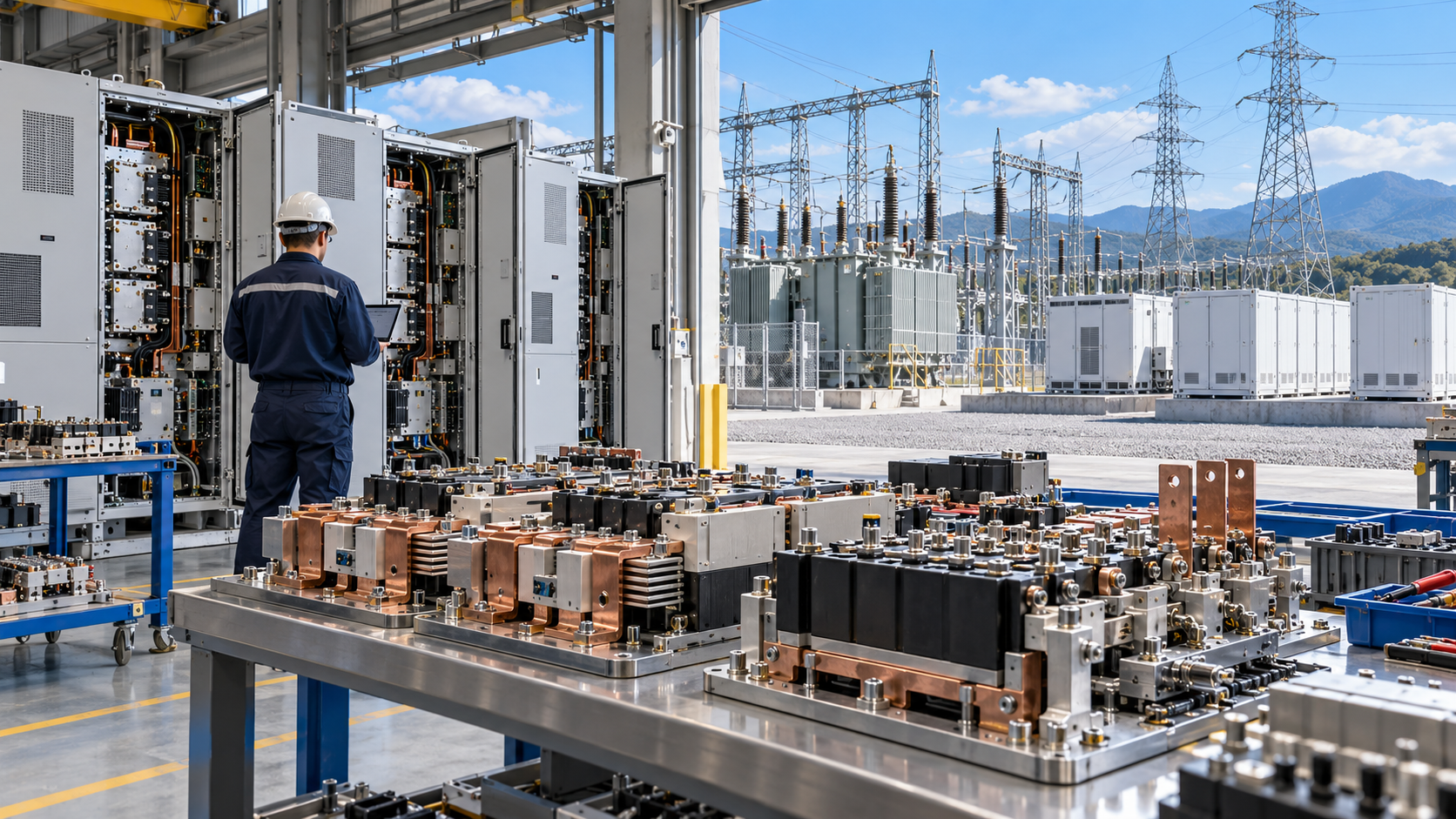
POWER ELECTRONICS SUPERCYCLE · PART 8 OF 9
Every major transformation of the electric power industry creates a new generation of technologies, companies, and industrial capabilities that shape how electricity is produced, transmitted, and delivered.
The expansion of alternating-current power systems created enormous opportunities for transformer manufacturers, turbine suppliers, generator builders, and transmission-equipment companies.
The emergence of the digital grid introduced new markets for sensors, communications networks, automation, and software.
Now another transformation is underway.
Power electronics are moving from specialized applications toward the center of the electric power system. Solar inverters, battery energy storage, HVDC transmission, advanced voltage-control equipment, and digital protection systems are changing how electricity flows and how the grid responds to disturbances.
This transition is creating opportunities across an unusually broad industrial ecosystem.
Semiconductor manufacturers.
Converter suppliers.
Transmission-equipment producers.
Battery storage developers.
Engineering software companies.
Protection and automation specialists.
Utilities and infrastructure contractors.
The Power Electronics Supercycle is not a story about one company or one technology replacing everything that came before.
It is a transformation of the electric infrastructure supply chain—and a competition to provide the technologies that will make the next generation of power systems more controllable, flexible, and reliable.
The Electric Infrastructure Supply Chain Is Expanding
For much of the twentieth century, the electric power industry’s industrial foundation was relatively well defined.
Large generating stations depended on turbines, synchronous generators, boilers, transformers, switchgear, and conventional transmission equipment.
Utilities relied on specialized manufacturers and engineering contractors to build and maintain those systems.
These technologies remain essential.
But the modern grid requires an increasingly diverse set of capabilities.
Power semiconductors regulate electrical energy inside converters.
Advanced inverters connect renewable generation and battery storage.
HVDC systems control power transfers across long distances and between electrical networks.
STATCOMs and other flexible AC transmission technologies provide dynamic voltage and reactive-power support.
Digital substations integrate protection, measurement, communications, and automation.
Engineering software allows utilities to study interactions that were less prominent in traditional power systems.
The result is a much broader definition of grid infrastructure.
The future electric grid will be built not only from steel, copper, transformers, and rotating machinery, but also from semiconductors, embedded controls, software, and increasingly sophisticated engineering systems.
Understanding where industrial value may develop begins with examining the technologies enabling that transition.
Power Semiconductors: The Foundation of the Converter Grid
At the center of nearly every modern power-electronic converter is a semiconductor device.
These components control the switching and conversion of electrical energy.
Their characteristics influence converter efficiency, switching performance, thermal behavior, physical size, and reliability.
As more electricity passes through power-electronic interfaces, semiconductor technology becomes increasingly important to energy infrastructure.
Traditional silicon devices remain widely used, particularly in high-power applications.
At the same time, wide-bandgap materials such as silicon carbide (SiC) and gallium nitride (GaN) are expanding the range of available design options.
Silicon carbide can offer advantages in switching performance, temperature capability, and efficiency for suitable applications.
Gallium nitride offers benefits in selected high-frequency and power-conversion applications, although its suitability depends on voltage, power level, packaging, and system requirements.
The opportunity extends beyond the semiconductor die itself.
It includes high-voltage power modules, advanced packaging, gate drivers, thermal management, insulation systems, and manufacturing processes.
These supporting technologies can be critical to achieving reliable operation at utility and industrial scales.
For semiconductor companies, long-term competitiveness may depend on more than producing a technically superior device.
Manufacturing yield, cost, quality, qualification, and the ability to supply components over long infrastructure lifecycles are also important.
A utility-scale converter must satisfy very different reliability and service expectations from a consumer electronic product.
As the grid becomes more dependent on converters, semiconductor performance and manufacturing capability become increasingly important elements of power-system engineering.
Grid Technology Manufacturers: The Rise of Controllable Infrastructure
Some of the most consequential opportunities are emerging among companies that design and manufacture major grid equipment.
This includes HVDC systems, flexible AC transmission technologies, advanced substations, and grid automation.
HVDC Transmission
High-voltage direct current technology enables controlled power transfer over long distances and between systems that may not operate synchronously.
Important applications include long-distance bulk transmission, offshore wind connections, submarine cables, and interregional electricity exchange.
As transmission networks expand to connect remote generation and growing load centers, HVDC can provide important technical advantages in suitable applications.
Modern voltage-source converter HVDC systems also introduce capabilities for controlling active and reactive power.
However, HVDC projects require specialized engineering, converter stations, controls, insulation systems, and complex system integration.
Companies able to deliver complete HVDC solutions may benefit from growing demand for controllable transmission infrastructure.
Execution capability matters.
Large projects involve long development schedules, manufacturing requirements, permitting, construction, commissioning, and coordination with existing AC networks.
The ability to deliver a reliable system can be as important as the technology itself.
STATCOMs and Flexible AC Transmission
As inverter-based generation increases and traditional synchronous generation changes, voltage-control requirements are becoming more complex.
Static synchronous compensators, or STATCOMs, provide fast, controllable reactive-power support.
Other flexible AC transmission system technologies, including static VAR compensators, also remain important.
These systems can help utilities manage voltage, improve operating flexibility, and support transmission-system performance.
Their value may increase in networks experiencing changing generation patterns, weak-grid conditions, or growing demand for dynamic voltage support.
The opportunity includes power-electronic converters, transformers, controls, protection, cooling systems, and engineering services.
Digital Substations and Protection
Substations are also evolving.
Intelligent electronic devices, digital communications, advanced protective relays, and automation systems are expanding the capabilities of conventional substation infrastructure.
As discussed in Part 7, inverter-dominated power systems can produce fault behavior that differs from the characteristics protection engineers historically expected.
That creates demand for improved measurement, modeling, protection algorithms, and communications-assisted schemes.
Companies with expertise in protection, automation, and utility-grade communications may therefore play an increasingly important role in grid modernization.
The central requirement remains dependable operation.
Digital capability is valuable only when it improves protection, visibility, control, or maintainability without introducing unacceptable reliability risks.
Battery Storage: More Than an Energy Asset
Battery energy storage systems are becoming an increasingly important component of modern electricity infrastructure.
Their most visible role is storing energy when it is available and delivering it when needed.
But grid-scale batteries can provide additional services, depending on their design, controls, operating conditions, and market arrangements.
These include frequency response, energy shifting, renewable integration, voltage support, and certain resource-adequacy applications.
Grid-forming battery systems may also support islanded operation and selected restoration functions.
This creates an industrial opportunity extending well beyond battery cells.
A complete grid-scale storage installation depends on multiple systems:
- Battery modules and enclosures
- Battery management systems
- Power conversion equipment
- Thermal management and fire-safety systems
- Plant-level controls
- Energy management software
- Protection and communications
- Installation, commissioning, and maintenance
The performance of the complete system matters more than any individual component.
For example, a battery with substantial stored energy cannot provide useful grid support if its inverter, controls, or auxiliary systems are unavailable.
Likewise, the value of storage depends on how it is operated.
A system optimized for energy arbitrage may have different requirements from one providing fast frequency response or grid-forming capability.
The next stage of battery competition may increasingly depend on the ability to deliver reliable grid services—not simply on the cost of installed energy capacity.
Engineering and Simulation Software: The Invisible Infrastructure
As the electric grid becomes more dependent on converters and digital controls, engineering analysis is becoming more demanding.
Traditional power-system planning tools remain essential.
However, increasing numbers of inverter-based resources create additional requirements for studying fast control interactions, weak-grid performance, protection behavior, and electromagnetic transients.
Utilities, developers, equipment manufacturers, and engineering consultants need tools capable of representing these phenomena accurately.
Electromagnetic transient simulation is particularly important when detailed converter behavior and fast electrical interactions must be examined.
Real-time simulation platforms can also support controller testing, protection validation, and hardware-in-the-loop studies.
Other software capabilities include:
- Power-flow and stability analysis
- Protection coordination
- Converter modeling
- Grid monitoring and analytics
- Digital-twin applications
- Automated planning
- Renewable and load forecasting
- Operator decision support
Artificial intelligence and machine learning may expand some of these capabilities, particularly where large volumes of operating data must be analyzed.
However, advanced analytics do not replace the need for validated physical models, reliable measurements, and engineering judgment.
For software companies, a critical competitive advantage may be the ability to integrate detailed engineering models with practical utility workflows.
A powerful simulation tool has limited value if its results cannot be validated or translated into operational decisions.
The future grid will not only require more sophisticated equipment. It will require more sophisticated tools to design, test, protect, and operate that equipment.
Transmission Expansion: The Physical Foundation of the Supercycle
Despite the growing importance of software and semiconductors, one of the largest infrastructure opportunities may remain in the physical transmission network.
Electricity demand is changing.
Renewable generation is being developed in locations that may be distant from major load centers.
Large data centers and industrial facilities are creating new concentrations of demand.
Existing transmission assets are aging.
Electrification is increasing the importance of reliable electricity delivery across multiple sectors.
Together, these developments are placing greater pressure on transmission planning and expansion.
New projects require conductors, cables, transformers, substations, switchgear, protection systems, and construction services.
Some applications also require HVDC converters, advanced reactive-power compensation, or grid-enhancing technologies.
The opportunity is substantial, but so are the constraints.
Transmission projects often face long permitting processes, land-access challenges, equipment lead times, construction complexity, and regulatory uncertainty.
Manufacturing capacity and skilled labor can also limit how quickly infrastructure is delivered.
This creates a distinction between market demand and realized business opportunity.
A large pipeline of proposed projects does not automatically translate into immediate equipment orders or completed infrastructure.
Companies capable of scaling manufacturing and executing complex projects may be particularly well positioned.
The Power Electronics Supercycle cannot advance through converters and software alone. It still depends on the physical infrastructure required to move electricity where it is needed.
The AI Connection: Demand and Grid Intelligence
Artificial intelligence is influencing the power industry through two different pathways.
The first is electricity demand.
Large AI data centers can require substantial electrical capacity, creating new challenges for generation planning, transmission expansion, and grid interconnection.
In some regions, the scale and concentration of proposed demand are changing how utilities evaluate infrastructure requirements.
This can accelerate investment in generation, transmission, substations, transformers, and power-quality equipment.
The second pathway is the use of AI-related technologies within the electric power industry.
Potential applications include predictive maintenance, load forecasting, renewable-generation forecasting, fault analysis, asset monitoring, and operator decision support.
These applications may help utilities manage increasingly complex systems, although their benefits depend on data quality, validation, cybersecurity, and operational integration.
The relationship creates an important feedback effect.
Growing AI infrastructure requires a more capable electric grid, while increasingly complex electric grids create opportunities for more advanced analytical tools.
These two developments should not be confused.
The demand created by data centers is a physical infrastructure challenge.
The use of AI in grid operations is a separate technological opportunity.
Both may influence the next phase of grid investment.
What Separates Long-Term Winners?
Identifying important technologies is easier than identifying the companies that will capture the greatest long-term value.
A growing market does not guarantee that every participant will benefit equally.
Several capabilities may prove particularly important.
Technology Leadership
Companies developing critical enabling technologies may gain advantages in performance, reliability, efficiency, or system functionality.
But technical leadership must translate into products that utilities and industrial customers can deploy with confidence.
Manufacturing Scale
Grid infrastructure depends on complex global supply chains.
Companies that can manufacture equipment consistently, meet delivery commitments, and expand capacity without compromising quality may have important advantages.
This is especially relevant for transformers, high-voltage equipment, semiconductors, and specialized converter systems.
Utility and Grid Expertise
Electric utilities operate under demanding reliability and safety requirements.
Equipment must perform across a wide range of operating conditions, often over decades.
Companies with established engineering expertise, testing capabilities, and experience meeting utility requirements may be better positioned to compete for major projects.
Hardware and Software Integration
Modern grid equipment increasingly combines physical hardware with sophisticated control software.
The ability to design, validate, and support integrated systems may become a differentiating capability.
This is particularly important for HVDC, STATCOMs, grid-forming inverters, protection systems, and digital substations.
Global Project Execution
Large infrastructure projects require more than equipment manufacturing.
They involve system studies, permitting coordination, engineering, installation, commissioning, and long-term support.
Companies with demonstrated experience delivering complex projects may benefit from the growing scale of grid modernization.
Ultimately, the strongest participants may be those able to combine several of these capabilities rather than competing on a single technology alone.
The Risks Behind the Opportunity
The Power Electronics Supercycle presents significant industrial opportunities, but its development is unlikely to follow a smooth or predictable path.
Supply-chain constraints can delay projects.
Semiconductor manufacturing requires substantial investment.
Utility procurement cycles can be lengthy.
Permitting and regulatory decisions can change project schedules.
Workforce shortages may constrain engineering and construction capacity.
Technology competition can alter the economics of existing products.
Rapid growth can also attract new competitors and increase pressure on margins.
There is another important distinction.
A technology can become essential to the future grid without every company supplying that technology becoming a successful investment.
Commercial outcomes depend on execution, pricing, capital requirements, competition, and customer adoption.
The Power Electronics Supercycle should therefore be understood first as an industrial and engineering transformation—not as a guarantee of financial returns.
The Companies That Enable the Grid
The transformation now underway is broader than the expansion of renewable energy.
It involves a change in how electricity is controlled.
Synchronous machines will continue to play important roles in many power systems.
Transformers, transmission lines, breakers, and conventional substations will remain essential.
But a growing share of grid functionality will depend on converters, semiconductor devices, embedded controls, communications, and engineering software.
This creates opportunities across an unusually wide industrial ecosystem.
Semiconductor manufacturers enable the switching technology.
Converter manufacturers turn that technology into grid-scale equipment.
Battery companies provide flexible energy resources.
Transmission suppliers build the infrastructure connecting generation and demand.
Protection specialists help keep the system secure.
Engineering software providers help utilities understand increasingly complex interactions.
Infrastructure contractors turn plans into operating assets.
The strongest long-term positions may belong to companies that solve difficult problems at the intersection of these fields.
The ability to manufacture a converter is valuable.
The ability to integrate that converter into a weak transmission network, demonstrate stable performance, coordinate protection, satisfy utility requirements, and support reliable operation may be considerably more valuable.
That is where engineering capability becomes a competitive advantage.
The Next Generation of Electric Infrastructure
The Power Electronics Supercycle is changing the technologies required to build and operate the electric grid.
It is also changing the companies and industrial capabilities on which the grid depends.
The transformation will not be defined by a single semiconductor material, a single converter design, or one category of equipment.
It will be shaped by the interaction of power electronics, conventional infrastructure, advanced controls, storage, software, and engineering expertise.
Some established manufacturers will adapt and expand their capabilities.
Some specialized technology companies may become increasingly important.
New opportunities will emerge as utilities confront challenges involving grid strength, protection, voltage stability, transmission constraints, and large electrical loads.
The ultimate winners will not necessarily be the companies producing the greatest number of devices.
They may be the companies that make increasingly complex electrical systems work reliably together.
Because the defining challenge of the Power Electronics Supercycle is not simply converting more electricity through semiconductors.
It is building an electric grid capable of using those technologies to deliver power more efficiently, flexibly, and reliably at scale.
And the companies that help solve that challenge will play an important role in shaping the future of electric infrastructure.
Previous in the Power Electronics Supercycle:
Part 7 — Protection Challenges in Inverter-Dominated Power Systems
Explore the Power Electronics Supercycle series
Next in the Power Electronics Supercycle:
Part 9 — The Future Grid: A New Operating System for Electricity
Series finale · Published October 22, 2026.
The Power Electronics Supercycle is changing more than individual technologies. It is transforming how the entire power system is controlled, coordinated, and operated.
In the final installment, we examine how grid-forming inverters, HVDC transmission, advanced voltage control, digital protection, storage, and increasingly sophisticated software could come together to create a new operating architecture for the electric grid.