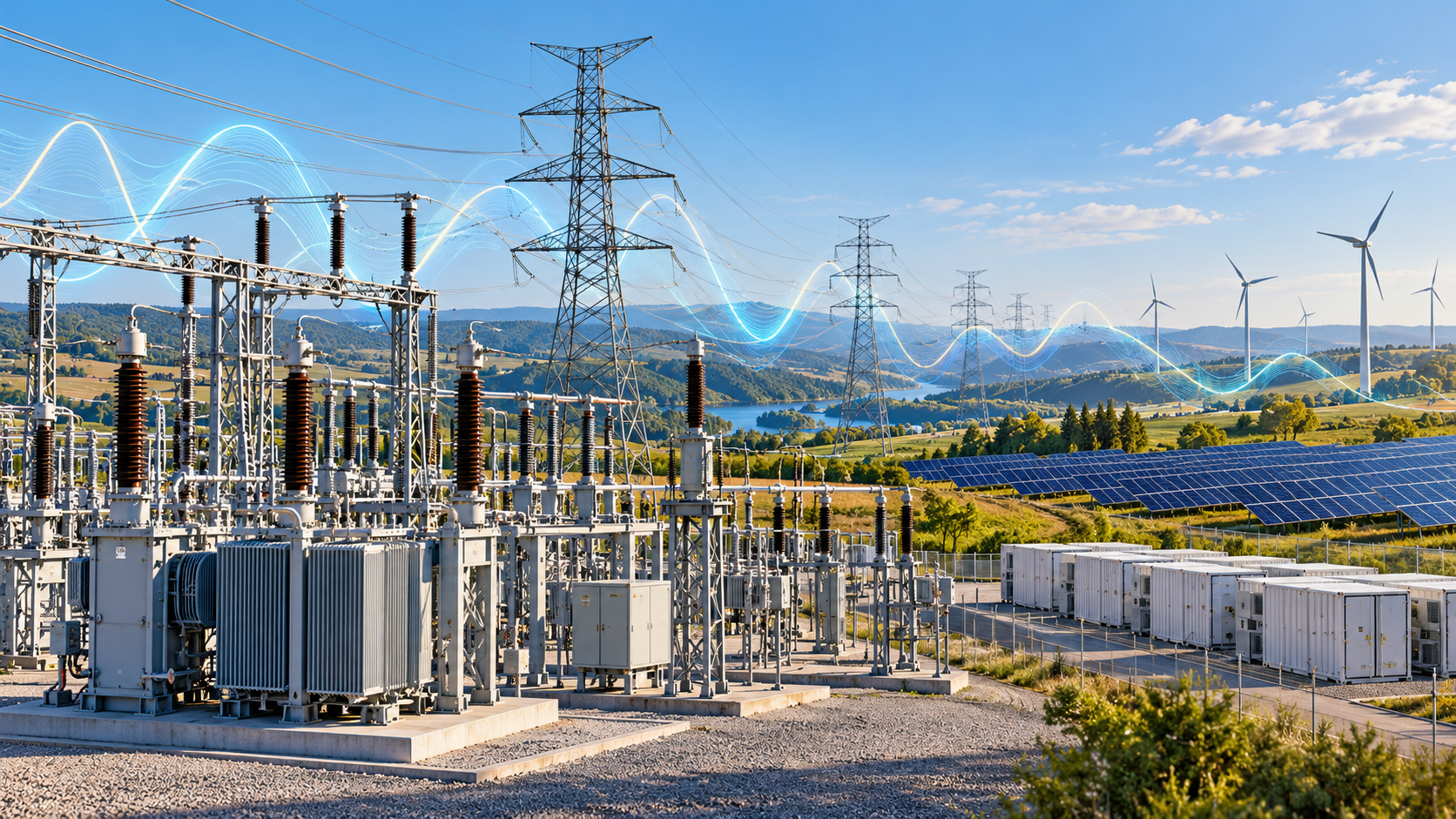
Editorial illustration. Waveforms are conceptual, not measured grid data.
The Invisible Battle Inside the Grid — Part 1 of 7
The electric grid has always oscillated. What is changing is the equipment creating those oscillations, the controls influencing them, and the engineering methods needed to keep them from becoming dangerous.
For more than a century, power-system engineers have confronted a fundamental challenge: keeping enormous interconnected electrical networks operating together while generation, demand, and transmission conditions constantly change.
A generator accelerates slightly.
Power flows shift across a transmission corridor.
A disturbance changes the balance between electrical and mechanical forces.
The interconnected system responds.
Sometimes that response includes oscillations—repeated variations in electrical power, rotor angle, voltage, or other system quantities.
When these oscillations are adequately damped, they decay and the grid returns toward a stable operating condition.
When damping is insufficient, oscillations may persist or grow, creating operating constraints, equipment stress, and potentially serious stability problems.
Engineers have spent decades developing methods to understand these phenomena.
But the electric grid is undergoing a transformation that introduces additional challenges.
Solar generation, modern wind turbines, battery storage, and other inverter-based resources increasingly connect to the network through sophisticated power-electronic controls.
Unlike traditional synchronous generators, these resources do not necessarily respond to disturbances through the same electromechanical processes.
Their behavior depends heavily on converter design, control algorithms, system strength, and interactions with surrounding equipment.
The stability problem is no longer only about how rotating machines swing against one another. It is also about how increasingly complex electrical controls interact across an interconnected power system.
A Grid Built Around Rotating Machines
For much of the electric grid’s history, large synchronous generators formed the foundation of bulk electricity production.
Coal-fired stations, gas turbines, nuclear plants, and hydroelectric facilities supplied electricity through rotating electrical machines connected to the transmission network.
These generators share important physical characteristics.
Their rotors store kinetic energy.
Their electrical output is linked to rotor position and electromagnetic torque.
Their behavior during disturbances is governed by the interaction of mechanical input, electrical output, machine characteristics, and control systems.
When a disturbance changes electrical power output, a generator’s rotor may accelerate or decelerate.
That change can produce oscillatory motion relative to other machines.
The stored kinetic energy of synchronous generators also helps resist rapid changes in system frequency.
However, rotating mass alone does not guarantee stable operation.
Excitation systems, turbine governors, power-system stabilizers, and network characteristics all influence the response.
The traditional grid was therefore never controlled by physics alone.
It was an engineered combination of physical equipment and control systems.
What distinguished it was that many of its most important dynamic characteristics originated in large rotating machines.
As the generation mix changes, that foundation is becoming less dominant in some power systems.
What Is a Power-System Oscillation?
A power-system oscillation is a repeated variation in one or more electrical or mechanical quantities.
In conventional synchronous-generator systems, many important oscillations arise from the exchange of energy among rotating machines through the transmission network.
Two familiar categories are local and inter-area electromechanical oscillations.
Local Oscillations
A local oscillation typically involves one generating unit or a group of nearby generators swinging against the surrounding power system.
These modes often occur at frequencies around 1–2 Hz, although actual values depend on the system.
Their behavior can be influenced by generator controls, operating conditions, and network configuration.
Inter-Area Oscillations
Inter-area oscillations involve groups of generators in different regions swinging relative to one another.
For example, generators in one geographic area may accelerate and decelerate relative to generators in another area connected through a major transmission corridor.
These modes commonly occur at lower frequencies, approximately 0.1–1 Hz.
Because they involve large regions, poorly damped inter-area oscillations can constrain power transfers and affect system-wide reliability.
The distinction between local and inter-area modes is important, but neither category captures every oscillatory phenomenon found in modern power systems.
Converter controls, network resonance, and interactions among power-electronic devices can produce additional modes with different physical mechanisms and frequency ranges.
The Real Objective Is Damping
Oscillations are not automatically evidence that the grid is unstable.
A stable power system can exhibit an oscillatory response following a disturbance.
The important question is whether that response decays.
Engineers evaluate oscillatory behavior using several concepts.
Oscillation frequency describes how quickly the oscillation repeats.
Damping ratio describes how rapidly an oscillatory mode decays or grows relative to its natural dynamics.
Mode shape helps identify how different parts of the system participate in a particular oscillation.
Participation factors help characterize the involvement of modeled states in a mode.
These concepts support stability studies, controller tuning, operating-limit assessments, and disturbance analysis.
A well-damped oscillation gradually disappears.
A poorly damped oscillation may persist for an extended period.
An unstable oscillatory mode can grow rather than decay.
The engineering objective is therefore not to eliminate every oscillation.
It is to ensure that the power system has sufficient damping and stability margin across the operating conditions it may encounter.
Why Inverter-Based Resources Change the Problem
The growth of renewable generation and battery storage introduces different dynamic characteristics into the power system.
A conventional synchronous generator converts mechanical energy into electrical energy through a rotating machine whose speed is closely linked to grid frequency.
An inverter-based resource uses power electronics to control the electrical energy delivered to the network.
Solar photovoltaic systems typically produce DC electricity that is converted to AC through an inverter.
Battery storage systems also use power conversion equipment to exchange energy with the grid.
Modern wind turbines commonly use power-electronic converters, although their generator and converter arrangements vary.
These interfaces allow precise and rapid control of electrical output.
But they also introduce new control dynamics.
Inverter behavior may depend on current controllers, voltage controllers, active- and reactive-power controls, synchronization systems, filters, and plant-level control settings.
These controls can respond much faster than many traditional mechanical processes.
That speed creates valuable capabilities.
It also creates the possibility of interactions among controllers and the surrounding electrical network.
In some operating conditions, control interactions can produce poorly damped or unstable oscillations.
The important distinction is that these phenomena cannot always be understood using models developed primarily for conventional generator rotor dynamics.
The Grid Is Becoming More Dependent on Control Software
Modern inverter-based resources operate through coordinated layers of electrical and digital control.
A grid-following inverter commonly uses a phase-locked loop, or PLL, to estimate the phase angle of the grid voltage.
Other control loops regulate current, active power, reactive power, and voltage-related behavior.
Plant controllers coordinate the output of multiple inverter units.
These systems must interact with the electrical network and with other connected resources.
Under favorable conditions, the controls operate together as intended.
Under less favorable conditions, interactions can become problematic.
A controller may respond to a voltage change.
That response changes current injection.
The changed current affects the network voltage.
Other controllers respond to the resulting change.
Depending on the characteristics of the system, this feedback can either help stabilize the network or contribute to oscillatory behavior.
Such interactions are especially important when the network is electrically weak or when multiple converter-based resources operate close together.
The grid is becoming a system in which stability depends not only on the physical properties of connected equipment, but increasingly on the way its control systems behave together.
Three Emerging Oscillation Challenges
The growth of inverter-based resources is drawing attention to several types of oscillatory behavior.
Converter-Control Interactions
Multiple inverter-based resources can interact through the electrical network.
Their controllers may have different response speeds, tuning parameters, and operating objectives.
In weak-grid conditions, changes in current injection can produce relatively large voltage variations.
Those voltage variations can then influence other connected converters.
The resulting interactions may create poorly damped oscillations or instability.
Understanding these effects requires models that represent the relevant converter and network dynamics.
Phase-Locked Loop Interactions
Phase-locked loops play an important role in many grid-following inverter designs.
They estimate the grid-voltage phase used by the inverter’s control system.
In electrically weak networks, the voltage waveform observed by an inverter can be strongly influenced by its own current injection and by nearby resources.
This creates the possibility of interaction between the PLL, current controls, and network dynamics.
Poorly coordinated control settings can contribute to oscillatory behavior or loss of stable synchronization.
These risks depend on equipment design, control tuning, operating conditions, and system characteristics.
They are not an inevitable consequence of using a PLL.
Subsynchronous and Other Converter-Driven Oscillations
Subsynchronous oscillations occur at frequencies below the fundamental power-system frequency.
They are not entirely new.
Traditional power systems have experienced subsynchronous resonance involving series-compensated transmission networks and turbine-generator shafts.
However, modern converter-based resources introduce additional mechanisms, including subsynchronous control interactions.
Power-electronic systems may also exhibit oscillations at frequencies outside traditional electromechanical ranges.
These phenomena can involve interactions among converter controls, filters, network impedance, and other connected equipment.
They require careful identification because different oscillation mechanisms demand different engineering solutions.
A control adjustment that improves one mode may not necessarily improve another.
Reduced Inertia Is Important—but It Is Not the Same as Poor Damping
One of the most widely discussed consequences of the changing generation mix is the reduction of synchronous inertia in some power systems.
Large synchronous generators store kinetic energy in their rotating masses.
When generation and demand suddenly become unbalanced, that stored energy helps resist rapid changes in system frequency.
As synchronous generation is displaced by inverter-based resources, the amount of naturally coupled rotational inertia can decrease.
This may increase the initial rate of change of frequency following a significant power imbalance.
However, inertia and oscillation damping are not interchangeable.
Inertia primarily influences aspects of frequency and rotor-angle dynamics.
Damping describes how oscillatory behavior decays.
A lower-inertia system is not automatically unstable, and greater inertia does not guarantee adequate damping of every mode.
Inverter-based technologies can also provide fast frequency response and other stability-supporting functions.
Grid-forming inverters are being developed and deployed for applications that require stronger voltage and frequency-control capabilities.
The engineering challenge is to ensure that these capabilities are appropriately designed, modeled, coordinated, and validated.
The goal is not simply to replace lost rotating mass. It is to provide the stability services required by a changing power system.
Synchrophasors Make the Invisible Visible
While the electric grid is becoming dynamically more complex, engineers also have better tools for observing its behavior.
Phasor Measurement Units, or PMUs, provide time-synchronized measurements of electrical quantities across geographically separated locations.
These measurements can include voltage and current phasors, frequency, and other derived quantities.
By comparing measurements from multiple locations, engineers can observe patterns that may be difficult to identify from individual substations.
Wide-area synchrophasor systems can support:
- Oscillation detection and characterization
- Modal-frequency and damping estimation
- Disturbance analysis
- Inter-area monitoring
- Identification of unusual dynamic behavior
- Post-event engineering investigations
For example, synchronized measurements can help reveal whether oscillations observed in two regions are moving together or in opposition.
They can also help engineers track changes in oscillatory behavior as system operating conditions evolve.
However, monitoring does not automatically identify the root cause.
An observed oscillation may require additional modeling, event analysis, and engineering investigation to determine which equipment or control interactions are responsible.
PMUs provide visibility.
Understanding and correcting the underlying problem still requires validated models and engineering judgment.
The Next Generation of Stability Studies
The growing importance of inverter-based resources is changing how engineers study power-system stability.
Traditional positive-sequence dynamic simulations remain essential for analyzing many electromechanical phenomena and system-level disturbances.
But some converter-control interactions require more detailed representations.
Electromagnetic transient simulation, or EMT simulation, can provide the modeling detail needed to investigate fast electrical and control-system behavior.
Other analytical methods, including small-signal analysis and impedance-based approaches, can help engineers identify interactions among converters and the surrounding network.
The appropriate method depends on the phenomenon being studied.
No single simulation technique is sufficient for every stability problem.
Utilities and developers increasingly need to combine classical stability analysis with detailed converter modeling, field measurements, and model validation.
This also creates new demands for engineering expertise.
Power-system engineers must understand both traditional synchronous-machine dynamics and the behavior of modern converter controls.
Protection engineers, planning engineers, equipment manufacturers, and system operators must work together to ensure that study assumptions accurately represent installed equipment.
As control software becomes more influential, model quality and configuration management become increasingly important.
A New Engineering Discipline Is Emerging
The transition toward converter-rich power systems is expanding the scope of stability engineering.
Traditional oscillation analysis focused heavily on generator dynamics, excitation systems, power-system stabilizers, and transmission-network characteristics.
Those subjects remain essential.
But the modern grid adds another layer of complexity.
Engineers must also evaluate converter controls, synchronization behavior, weak-grid interactions, plant-level control systems, communication dependencies, and the performance of increasingly sophisticated digital equipment.
Cybersecurity and communications reliability introduce additional concerns where monitoring or control functions depend on external information systems.
Advanced analytics and machine learning may eventually help detect unusual patterns or support operating decisions.
But these tools must be validated carefully before being relied upon for critical grid functions.
The stability problem is becoming more interdisciplinary.
Electrical engineering, control theory, power electronics, communications, and software engineering are increasingly connected.
The next generation of grid stability expertise will need to span these disciplines.
Preparing for an Inverter-Rich Grid
Utilities and system operators can respond to these challenges through a coordinated engineering strategy.
Expanding oscillation monitoring across important transmission corridors can improve awareness of developing problems.
Detailed inverter models can help identify control interactions before new resources enter service.
Electromagnetic transient studies can supplement conventional stability analysis where fast converter behavior is important.
Coordinated performance requirements can improve the consistency of inverter response during disturbances.
Grid-forming technologies may provide additional stability-supporting capabilities in suitable applications.
And engineering teams will need continuing training in both classical and converter-driven stability.
The common requirement is integration.
Better measurements are useful only when engineers can interpret them.
Better models are valuable only when they represent actual equipment behavior.
Advanced controls improve reliability only when they operate predictably within the larger network.
The future of power-system stability will depend on bringing measurement, modeling, and control together into a coordinated engineering framework.
The Invisible Battle Inside the Grid
The electric grid has always been dynamic.
Its generators, transmission lines, loads, and control systems continuously respond to changing conditions.
Oscillations have been part of that behavior since the earliest interconnected power systems.
What is changing is the range of mechanisms that can create or influence those oscillations.
The traditional grid relied heavily on synchronous machines whose electromechanical characteristics shaped system dynamics.
The emerging grid increasingly includes inverter-based resources whose behavior depends on sophisticated control systems.
These technologies provide valuable capabilities.
They can respond quickly, regulate electrical output precisely, and support new approaches to voltage and frequency control.
But they also require engineers to understand interactions that may occur on different timescales and through different physical mechanisms.
The central challenge is not that renewable energy makes the grid inherently unstable.
It is that the methods used to maintain stability must evolve alongside the equipment connected to the system.
The power industry has solved difficult stability problems before.
It developed excitation controls, power-system stabilizers, wide-area monitoring, and increasingly sophisticated simulation tools to address the challenges of interconnected synchronous-machine networks.
Now it must extend that engineering tradition into an era of widespread power electronics.
The next generation of grid reliability will depend not simply on producing enough electricity, but on understanding how thousands of interconnected machines and digital controllers respond together.
That is the invisible battle inside the modern electric grid.
Next in the Series
Part 2 — From Rotating Machines to Digital Controllers: Why Inverters Are Changing Grid Stability
The next installment examines the engineering differences between synchronous generators and inverter-based resources, including grid-following and grid-forming controls, phase-locked loops, virtual inertia, and the growing importance of control-system design in maintaining power-system stability.