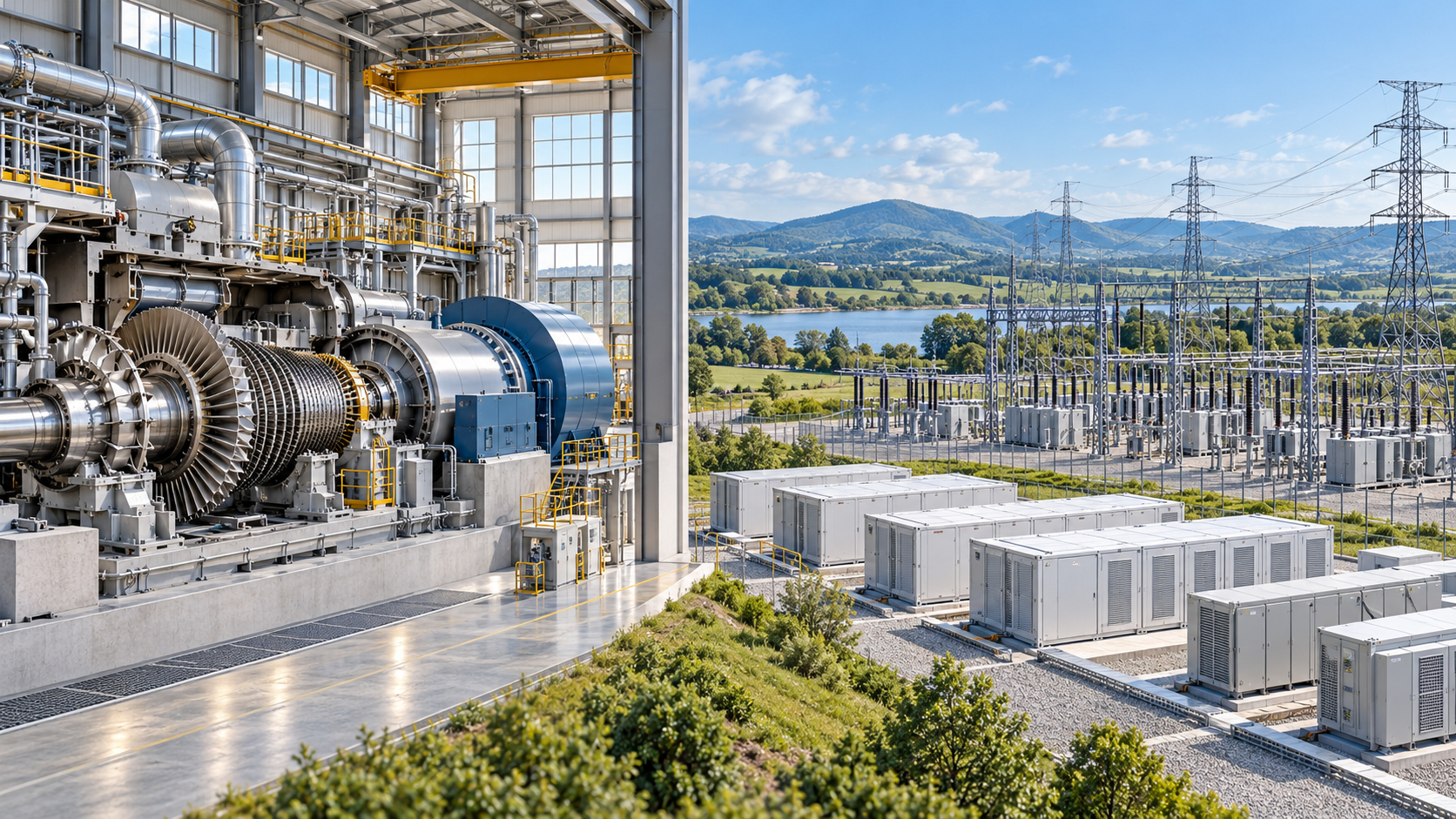
Editorial illustration. Conceptual composite of rotating generation and inverter-based grid infrastructure.
The Invisible Battle Inside the Grid — Part 2 of 7
For more than a century, the electric power system has depended on one remarkable machine: the synchronous generator.
Inside conventional power plants, massive turbines drive rotating electrical machines whose magnetic fields remain synchronized with the alternating-current network.
These generators do more than produce electricity.
Their rotating masses store kinetic energy. Their electromagnetic characteristics influence how the grid responds to disturbances. Their excitation systems regulate voltage, while governors and other controls help maintain stable operation.
Together, these physical properties and engineered controls have shaped the behavior of interconnected power systems for generations.
But the electrical grid is undergoing a fundamental transformation.
Solar power plants, battery energy storage systems, and many modern wind turbines connect to the network through power electronic converters known as inverters.
Unlike synchronous generators, these resources do not depend on a large rotating electrical machine directly coupled to the grid.
Instead, their electrical behavior is determined to a significant degree by semiconductor devices and control algorithms.
That difference is changing the way engineers must understand power-system stability.
The grid is moving from a system dominated by the electromechanical behavior of synchronous machines toward one increasingly shaped by the interaction of digital controllers.
And that transition introduces new opportunities—and new stability challenges.
The Traditional Grid: Stability Rooted in Rotating Machines
To understand why inverter-based resources are changing grid behavior, it helps to examine the characteristics of the machines around which traditional power systems were developed.
A synchronous generator converts mechanical energy into electrical energy through a rotating magnetic field.
Its rotor turns in synchronism with the electrical frequency of the network.
Across an interconnected system, many such machines operate together, connected through transmission lines and transformers.
Their collective behavior determines important aspects of system stability.
One of the most familiar characteristics is rotational inertia.
A large synchronous generator stores kinetic energy in its rotating mass. When a disturbance creates an imbalance between mechanical input and electrical output, the rotor initially accelerates or decelerates.
That stored energy helps resist rapid changes in system frequency.
Inertia does not eliminate the need for frequency control, nor does it guarantee that oscillations will be adequately damped.
But it provides an immediate physical response before slower control actions take effect.
Synchronous generators also exhibit electromagnetic synchronizing behavior.
Their electrical power output depends partly on the angular relationship between the generator’s internal voltage and the surrounding network.
This relationship creates the synchronizing forces that are central to classical rotor-angle stability.
During faults, synchronous machines can also contribute substantial short-circuit current.
That behavior influenced the design of protection systems, including overcurrent relays, distance protection and fault-detection methods.
These characteristics are not the entire story.
Traditional power systems have always relied on control systems, including excitation controls, turbine governors and power system stabilizers.
Nevertheless, the underlying electromechanical behavior of synchronous machines provided a relatively well-established foundation for system modeling and operation.
Inverter-based resources introduce a different foundation.
Electricity Through Power Electronics
In a conventional synchronous generator, the rotating machine produces alternating-current electricity directly.
An inverter-based resource uses power electronic equipment to control how electrical energy is exchanged with the grid.
Solar photovoltaic systems produce direct-current electricity that is converted into alternating current.
Battery energy storage systems use bidirectional converters to charge from or discharge into the network.
Modern wind turbines may use power electronic converters to control the electrical output of their generators. Full-converter wind turbines process the generator’s electrical output through a converter system, while other turbine designs use partial-scale converters.
Although these technologies differ, they share an important characteristic.
The electrical response seen by the grid is substantially influenced by the converter’s control system.
An inverter continuously measures electrical quantities, calculates the required response and commands semiconductor switches to produce the desired output.
These operations occur extremely quickly.
The converter may regulate current, active power, reactive power, voltage or frequency-related behavior, depending on its design and operating mode.
But unlike a synchronous generator, it does not inherently provide the same rotating-mass response or fault-current characteristics.
Those capabilities must be considered through the design of the converter, its controls and its supporting energy source.
This is why two inverter-based resources with similar power ratings can behave very differently during the same grid disturbance.
Their control architectures, parameters, equipment limits and operating conditions may not be the same.
Grid-Following Inverters: Synchronizing With an Existing Grid
Most conventional utility-scale inverter installations have historically used grid-following control.
The underlying principle is straightforward.
The inverter observes the electrical network, estimates its voltage phase and frequency, and regulates the current it injects.
In effect, it assumes that an external electrical reference already exists.
A common component of this architecture is the phase-locked loop, or PLL.
The PLL estimates the phase angle of the grid voltage so the inverter’s control system can align its operation with the network.
Under suitable operating conditions, this approach is effective.
The inverter can deliver active power, provide reactive-power support and respond to control commands while remaining synchronized with the grid.
However, its performance depends partly on the characteristics of the electrical system to which it is connected.
In a relatively strong network, the voltage at the connection point is less sensitive to changes in the inverter’s current.
In a weaker network, the same current change can produce a larger voltage response.
That response is then measured by the inverter’s controls.
The result is a feedback relationship between the converter and the surrounding electrical network.
Under some conditions, this interaction can reduce stability margins or produce oscillatory behavior.
The PLL is one possible contributor, but it is not the only one.
Current controllers, voltage regulators, plant-level controls, filters, network impedance and other nearby converters can all influence the result.
Understanding these interactions is becoming an increasingly important part of power-system engineering.
Why Weak Grids Make Control Interactions More Difficult
A weak grid is generally characterized by relatively low short-circuit strength or a strong sensitivity of voltage to changes in injected current.
Grid strength is not determined by a single universal measure, and engineers may use short-circuit ratios, impedance characteristics and more detailed studies to evaluate it.
The practical concern is that a weak electrical network provides a less rigid voltage reference for connected equipment.
Consider a large solar plant connected to a remote transmission system.
The plant’s inverters measure the voltage at their connection point and adjust their electrical output according to their control settings.
Those adjustments influence the voltage.
The changed voltage is then detected by the same controllers.
If the controls and network dynamics interact unfavorably, the resulting feedback can produce poorly damped or unstable behavior.
The problem may become more complex when several inverter-based plants operate electrically close to one another.
Each facility has its own control system.
Each responds to network disturbances.
And the response of one facility can affect the conditions observed by the others.
These interactions may involve multiple control loops operating on different timescales.
Remote renewable-energy locations can be particularly challenging because they may be connected through long transmission lines or networks with limited short-circuit strength.
But weak-grid behavior is not exclusive to renewable generation.
It can also arise in other systems containing power electronic converters, including HVDC installations and converter-connected industrial equipment.
The important engineering lesson is that converter stability cannot always be assessed by examining a single inverter in isolation.
The surrounding network—and the other equipment connected to it—must also be considered.
Grid-Forming Inverters: A Different Control Philosophy
Grid-forming inverters offer an alternative approach to converter control.
Rather than depending primarily on an externally established voltage phase reference, a grid-forming inverter is designed to establish and regulate an electrical voltage waveform through its own control behavior.
It can help support system voltage and frequency, subject to its operating conditions and physical limits.
This changes the relationship between the inverter and the network.
A grid-following converter generally synchronizes to an existing electrical reference and controls its injected current.
A grid-forming converter can behave more like a controlled voltage source, contributing to the establishment of the electrical reference itself.
That distinction is especially important in systems with declining synchronous generation.
Grid-forming controls can be designed to provide several useful functions.
They may support frequency regulation through rapid active-power adjustments.
They may provide voltage support through reactive-power control.
Some designs can emulate aspects of synchronous-machine behavior, including inertial-like frequency response.
Certain grid-forming systems can also support islanded operation or black-start and restoration functions when appropriately engineered.
But these capabilities are not automatic.
A converter cannot provide unlimited power simply because its controls request it.
Its output is constrained by semiconductor ratings, current limits, the connected energy source and the available stored energy.
A battery-based grid-forming inverter, for example, must have sufficient stored energy and appropriate operating headroom to provide sustained active-power support.
A solar inverter’s ability to increase active-power output depends on available solar energy or deliberately reserved capacity.
Grid-forming technology therefore introduces new capabilities without eliminating the physical limits of electrical equipment.
It also creates new control-coordination questions.
A network containing multiple grid-forming inverters must maintain stable operation as those devices respond to one another and to the surrounding system.
Grid-forming control is a powerful engineering approach, but it is not a universal solution to every stability problem.
When Controllers Begin to Interact
The most consequential change introduced by inverter-based resources may be the growing importance of interactions between control systems.
Traditional power-system stability studies have long examined oscillations between synchronous generators.
These electromechanical oscillations are influenced by rotor inertia, synchronizing torque, damping and the action of generator controls.
As converter-based resources become more prevalent, additional oscillatory mechanisms can appear.
Some arise from interactions between converter controls and the impedance of the surrounding network.
Others involve multiple converters whose control systems respond to one another.
Still others involve the interaction of inverter-based resources with synchronous machines, HVDC converters, compensation devices or other power electronic equipment.
These phenomena are often described under the broader category of converter-driven stability.
Their frequencies and characteristics can differ substantially from the familiar electromechanical modes of traditional power systems.
Some occur at relatively low frequencies associated with slower control loops.
Others arise at higher frequencies associated with fast converter controls and electrical-network dynamics.
There is no single frequency range that identifies every converter-driven oscillation.
Nor is there one universal cause.
A PLL may contribute to instability in one system.
A current-control loop may be important in another.
A plant-level controller or the interaction of multiple devices may dominate elsewhere.
The engineering challenge is to identify the actual mechanism rather than assume that every new oscillation has the same origin.
This requires accurate models, appropriate measurements and analysis methods capable of representing the relevant control dynamics.
A New Dimension of Power-System Stability Analysis
For generations, engineers have used established tools to study rotor-angle stability, frequency stability and voltage stability.
Those disciplines remain essential.
But the growing presence of power electronic converters requires additional analysis.
Traditional positive-sequence dynamic models are valuable for many system-level studies.
However, some fast converter interactions cannot be represented adequately by simplified models that omit important control or electromagnetic dynamics.
Electromagnetic transient simulations can provide a more detailed representation of converter behavior, electrical waveforms and fast interactions.
Impedance-based stability analysis offers another approach by examining how the dynamic characteristics of converters interact with network impedance.
Small-signal analysis can help identify oscillatory modes, damping characteristics and sensitivity to control parameters.
These methods are complementary rather than interchangeable.
The appropriate study depends on the question being investigated.
A regional electromechanical oscillation may be analyzed effectively using one modeling approach.
A fast converter-control interaction may require a different level of detail.
Model quality is therefore becoming a critical reliability issue.
Engineers need information about control architectures, operating limits and relevant parameters.
They also need confidence that the models reproduce the behavior of actual installed equipment.
Where models are inaccurate or incomplete, studies may fail to identify important interactions before a project is connected.
As converter penetration increases, the quality of inverter models and the coordination of control settings will become increasingly important to reliable grid operation.
Batteries as Stability Resources
Battery energy storage systems occupy a particularly interesting position in this transition.
They are often discussed in terms of storing surplus electricity and delivering it when demand increases.
But their power electronic interfaces also allow them to provide rapid electrical responses.
Depending on the equipment and control design, battery systems can support frequency regulation, voltage control and oscillation damping.
They can also operate with grid-forming controls.
This creates opportunities to use storage as part of the grid’s stability infrastructure.
A battery system can respond quickly to changes in network conditions because it does not need to change the mechanical output of a large turbine before adjusting converter power.
However, speed alone does not guarantee a beneficial response.
The control system must be designed and coordinated with the surrounding network.
A poorly tuned fast controller can contribute to instability rather than suppress it.
Battery state of charge, available power headroom and current limits also determine what support can be delivered.
For these reasons, battery energy storage should be evaluated not only by its energy capacity in megawatt-hours, but also by its power rating, control capabilities, dynamic performance and operating requirements.
The opportunity is significant.
Storage systems may increasingly contribute to the stability functions needed by power systems with high levels of inverter-based generation.
But their value depends on verified performance, not simply the presence of an inverter.
Engineering Stability Into the Future Grid
The transition from synchronous generation to converter-based resources changes an important engineering assumption.
Historically, many characteristics of grid behavior emerged from the physical properties of large rotating machines, supplemented by their control systems.
In inverter-dominated networks, a greater share of the electrical response must be deliberately established through converter design and control.
That creates flexibility.
Engineers can develop control strategies tailored to particular network requirements.
They can coordinate active-power and reactive-power responses.
They can design grid-forming functions and damping controls.
They can use advanced measurements and models to identify potential interactions before they become operational problems.
But flexibility also creates responsibility.
The performance of a converter depends on decisions made during equipment design, control tuning, interconnection studies and system operation.
As more devices are connected, those decisions increasingly affect the behavior of the wider network.
A utility cannot assume that every inverter will provide the same stability response.
Nor can it assume that a collection of individually compliant devices will necessarily operate without problematic interactions.
Reliable operation requires attention to the complete electrical system.
That includes detailed models, appropriate interconnection requirements, weak-grid assessment, control coordination and field performance validation.
It also requires closer collaboration between equipment manufacturers, project developers, utilities, system operators and research institutions.
The challenge is not simply to replace the functions of synchronous generators one by one.
It is to develop an electricity system in which rotating machines, power electronic converters, storage systems and network controls operate together reliably.
The Future Grid Will Be Both Physical and Digital
The electric grid has never been governed by physics alone.
Its stability has always depended on the interaction of physical equipment, control systems and operating decisions.
What is changing is the balance between them.
In a conventional power system, large synchronous generators provide a substantial portion of the electromechanical behavior around which stability practices developed.
In a converter-rich system, digital controls play a more direct role in shaping the electrical response of generation and storage resources.
That shift does not make stability less important.
It makes the design and coordination of stability functions more important than ever.
The future grid may include synchronous generators, grid-following inverters, grid-forming inverters, battery storage, HVDC systems and advanced voltage-control equipment operating together.
Each technology brings different capabilities and limitations.
Their collective performance will depend on how well those differences are understood and managed.
The fundamental question is no longer only how electrical machines remain synchronized.
It is how thousands of independently controlled power electronic devices can operate together as one stable electric power system.
Answering that question will be one of the defining engineering challenges of the modern grid.
Next in the Series
The New Oscillation Modes Nobody Designed For
Part 3 examines the oscillatory phenomena emerging in converter-rich power systems, including subsynchronous interactions, control-driven oscillations, weak-grid instability and the engineering methods used to identify their causes.