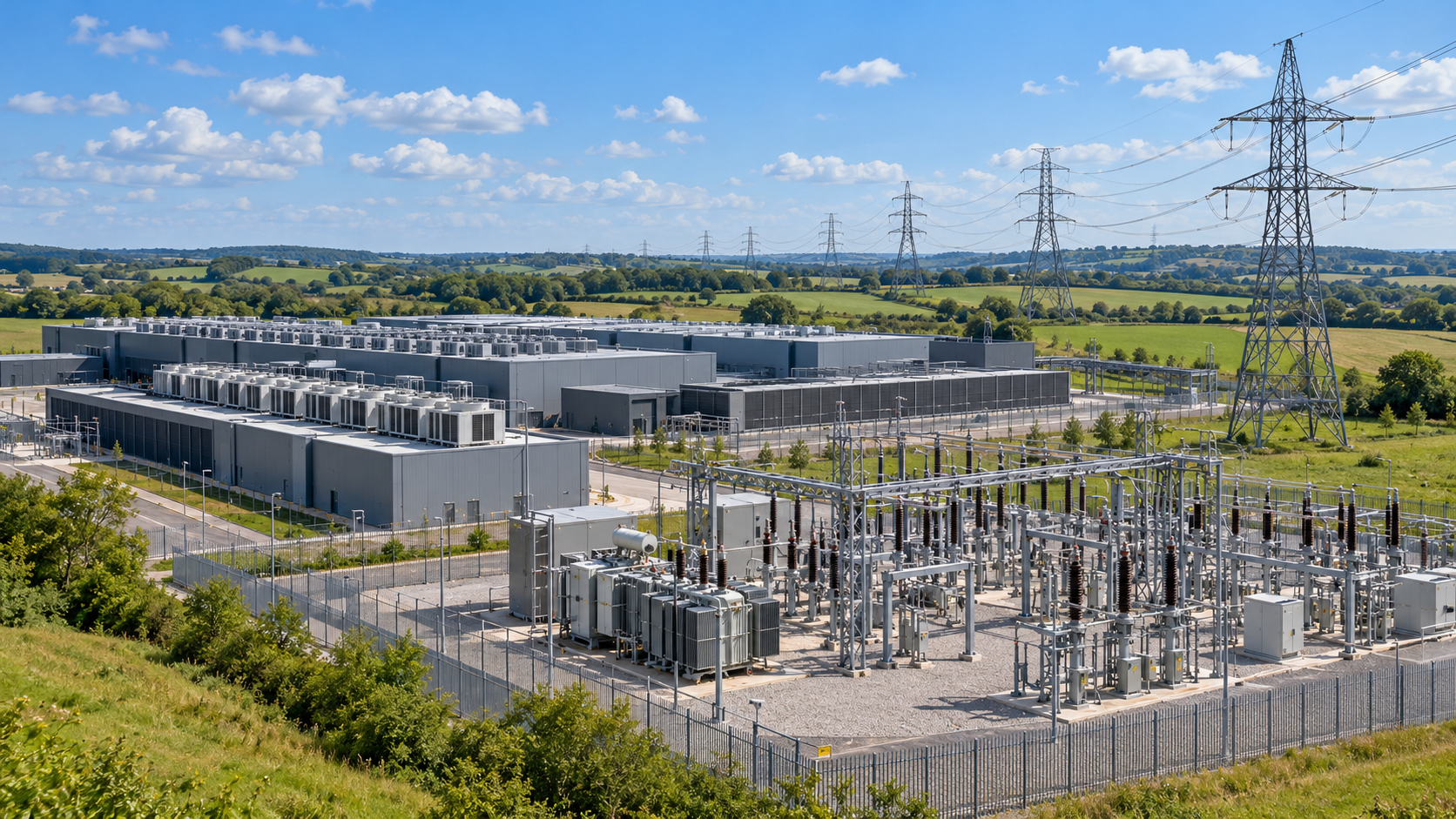
A major AI data center can be designed, financed, equipped with advanced processors, and supported by a global technology company.
But none of those commitments can guarantee that the facility will have electricity when it needs it.
That reality is becoming increasingly important as artificial intelligence drives demand for large concentrations of computing infrastructure.
In Britain, a planned data center in Loughton, Essex, has become a prominent example.
Microsoft has withdrawn from an agreement to anchor the facility being developed by Nscale, following reported delays in securing an electricity connection.
According to Reuters, grid electricity may not be available to the site until the 2030s—years later than the project’s original development timetable.
Microsoft has emphasized that the decision concerns one site and does not end its wider relationship with Nscale.
Nscale says it remains committed to the development and is exploring alternative power arrangements.
The precise contractual reasons for Microsoft’s withdrawal have not been publicly established in sufficient detail to attribute the decision exclusively to one factor.
Nevertheless, the reported electricity delays raise an important engineering question.
What happens when the infrastructure needed to supply an AI data center takes longer to build than the data center itself?
The answer may increasingly determine where major computing facilities are developed, how their contracts are structured, and which projects ultimately reach operation.
From a Major AI Commitment to an Electricity Bottleneck
Nscale first announced its Loughton development in January 2025 as part of a wider investment program in British AI infrastructure.
The company described a facility capable of supporting 50 megawatts of artificial intelligence and high-performance computing capacity, with the potential to scale its power allocation to 90 megawatts.
The original target was to bring the site online in the fourth quarter of 2026.
In September 2025, Nscale announced an expanded arrangement involving Microsoft, with plans to install approximately 23,000 NVIDIA GB300 GPUs at the site beginning in early 2027.
The facility was intended to support Microsoft’s Azure services.
The proposed development combined several elements essential to large-scale AI computing: specialized processors, advanced cooling, a dedicated data-center campus and a major customer commitment.
But the reported electricity connection timeline has become a serious obstacle.
According to reporting published in October 2026, sufficient grid electricity may not be available until the 2030s.
That represents a substantial mismatch between the project’s original operating schedule and the reported availability of electrical infrastructure.
It is important to distinguish the figures involved.
The announced 50 MW of computing capacity and the potential 90 MW power allocation are not interchangeable measurements of actual operating electricity demand.
Neither figure establishes how much electricity the facility would have consumed at a particular time.
What matters for the current investigation is the relationship between the proposed development schedule and the availability of dependable grid service.
A Grid Connection Is Not the Same as Available Electricity
Large electricity consumers often begin planning their grid connections years before construction is complete.
A developer may identify a site, request electrical capacity, negotiate connection arrangements and design the facility around an anticipated energization date.
But a proposed connection does not mean the requested electricity is already available.
The network operator must determine whether the existing system can accommodate the new load.
That assessment may involve transmission capacity, local substations, transformers, protection systems, voltage performance and the network’s ability to remain secure following equipment outages.
If the existing network cannot support the additional demand, reinforcement may be required.
New transformers may need to be manufactured and installed.
Substations may require expansion.
Transmission or distribution circuits may need upgrading.
Protection and control systems may need modification.
Some projects may require entirely new electrical infrastructure.
These works can take years.
And the schedule for the electricity connection may be controlled by different organizations from those responsible for building the data center.
A developer can accelerate construction of a computing facility without being able to accelerate every upstream electrical-network improvement on which that facility depends.
This is one of the defining challenges of large-load electrification.
Why Data Centers Are Different From Ordinary Load Growth
Electric utilities have always planned for changes in electricity demand.
Population growth, new factories, commercial developments and electrification all affect network requirements.
But large AI data centers can create unusually concentrated demand.
A single facility may require tens or hundreds of megawatts at one location.
Multiple proposed facilities in the same region can produce large cumulative connection requests.
The timing can also be difficult.
AI computing infrastructure is evolving rapidly.
Developers may seek to bring facilities into service on schedules driven by technology deployment, customer commitments and competitive market conditions.
Transmission and distribution infrastructure operate on a different development cycle.
Equipment procurement, permitting, engineering studies, construction outages and commissioning cannot always be compressed to match commercial schedules.
The result is a potential mismatch between two infrastructure systems.
The computing industry can commit to substantial new electrical demand before the power network has established when that demand can be served.
This does not mean every proposed data center will be built.
Nor does it mean all requested capacity will be needed simultaneously.
But the uncertainty complicates planning for both utilities and developers.
Britain’s Connection Queue Reveals the Scale of the Challenge
The Loughton case is unfolding against a much broader electricity-connection problem in Great Britain.
In July 2026, energy regulator Ofgem reported that demand-connection offers had increased from approximately 41 gigawatts in November 2024 to 125 gigawatts in June 2025.
Data-center proposals accounted for a substantial portion of the increase.
These figures do not represent 125 GW of operating demand.
They reflect capacity sought through the connection process, including projects that may be speculative, delayed or ultimately abandoned.
That distinction is important.
Utilities and network planners must prepare for credible future demand without treating every proposed project as certain to proceed.
If nonviable projects occupy connection-queue positions, they can complicate planning and delay developments that are ready to move forward.
But removing speculative applications does not automatically solve the physical infrastructure problem.
A viable data center may still require a new transformer, substation reinforcement or additional transmission capacity.
Ofgem has therefore been developing reforms that address both project credibility and the process of connecting new demand.
Its proposals include financial commitment requirements and milestones intended to demonstrate that developers are progressing toward construction.
The regulator has also identified the need to accelerate physical connections while preserving system security.
These reforms reflect a growing recognition that electricity-connection queues must distinguish serious infrastructure commitments from requests that may never materialize.
The Engineering Problem Behind the Queue
For power-system engineers, the central issue is deliverability.
A network may have adequate generating capacity across the wider electricity system but insufficient capacity at the location where a large customer wants to connect.
Conversely, a new transmission line may increase regional transfer capability while a local substation remains constrained.
Electrical capacity must be evaluated across the complete delivery path.
A large data center can be limited by several different conditions.
A transformer may lack sufficient capacity.
A transmission circuit may exceed its thermal rating under a required contingency.
Voltage performance may become unacceptable during disturbances.
Protection systems may require changes before the new load can be connected safely.
Or network reinforcement may be technically straightforward but delayed by equipment manufacturing and construction schedules.
The precise bottleneck at Loughton has not been established through publicly available connection studies reviewed for this investigation.
It would therefore be premature to identify a particular transformer, line or substation as the cause.
But the general engineering principle is clear.
The amount of electricity available to a new customer is determined by the capability of the complete network—not simply by the presence of nearby power lines.
When Electricity Timing Becomes a Commercial Risk
The Loughton development also illustrates how electrical infrastructure constraints can affect business decisions.
Large AI data centers require coordinated investments in buildings, cooling systems, electrical equipment, networking and computing hardware.
The value of those investments depends partly on when the facility becomes operational.
A delay of several months may be manageable.
A delay extending several years can create a much more serious problem.
Technology deployment schedules may change.
Customer requirements may evolve.
Equipment procurement may need to be rescheduled.
Financing assumptions may require revision.
A customer may decide that another location offers a more suitable operating timeline.
This creates a new dimension of infrastructure risk.
Electricity availability is not merely an engineering requirement to be resolved near the end of construction.
It can influence whether the commercial project proceeds in its original form.
The reported Microsoft–Nscale development does not establish that every AI data-center agreement will face similar difficulties.
But it demonstrates why electricity connection certainty deserves attention much earlier in the development process.
Can Alternative Power Solve the Problem?
Nscale has indicated that it is exploring alternative power arrangements for the Loughton project.
That raises another important question.
Could a large data center operate using generation located at or near the facility rather than relying entirely on a conventional grid connection?
Several possibilities exist.
A project might use dedicated generation, battery storage or a combination of local energy resources.
In some circumstances, these technologies could reduce dependence on particular network upgrades or provide additional operating flexibility.
But they do not eliminate the engineering challenges.
A large data center requires dependable electricity over extended periods.
Battery storage can shift energy and provide short-duration support, but its sustained output depends on available stored energy and a means of recharging.
Dedicated generation requires fuel, maintenance, emissions compliance, protection systems and reliable operation.
Hybrid systems require controls capable of coordinating multiple resources.
If a facility remains connected to the wider electricity network, its generation and load must also satisfy applicable interconnection and operating requirements.
Alternative supply arrangements may therefore offer useful options, but their feasibility depends on site-specific engineering, economics and regulation.
There is no universal substitute for a dependable electricity connection.
A New Measure of Infrastructure Readiness
The growing importance of electricity access suggests that large-load development should be evaluated through more than proposed megawatts and announced investment.
A project can have substantial financial backing and still lack a credible electricity delivery schedule.
A proposed site may have an attractive location but require years of upstream network reinforcement.
A signed commercial agreement may depend on electrical milestones that have not yet been achieved.
For utilities, developers and investors, several questions become essential.
Has the network operator confirmed the required connection capacity?
What infrastructure must be built before the facility can be energized?
Are the necessary permits, equipment and construction schedules aligned?
Can the network serve the load under applicable reliability and contingency requirements?
And how much uncertainty remains in the date when dependable electricity will actually be available?
These questions distinguish an announced data-center project from one with a credible path to operation.
They also point toward a broader change in infrastructure planning.
The ability to deliver electricity on schedule is becoming a strategic resource in its own right.
The Grid Is Becoming Part of the AI Investment Decision
The rapid expansion of artificial intelligence is creating demand for computing infrastructure at an extraordinary scale.
But computing infrastructure cannot develop independently of the electricity system.
Every major facility depends on physical networks, generating resources, transformers, substations and operating arrangements that must satisfy demanding reliability requirements.
The Microsoft–Nscale development is a reminder that those requirements can influence commercial outcomes.
It is also a reminder that the electricity industry faces a difficult balancing problem.
Utilities must plan for large new loads without assuming that every announced project will proceed.
Developers need credible connection dates before making irreversible commitments.
Regulators must protect existing customers while supporting viable infrastructure development.
And system operators must ensure that accelerating new connections does not compromise reliability.
The solution will require more accurate demand information, disciplined connection processes, timely network investment and better coordination between electricity providers and large-load developers.
Some projects may benefit from grid-enhancing technologies or upgrades to existing infrastructure.
Others will require major new transmission and distribution investment.
Still others may need to reconsider their locations or operating schedules.
The important change is that electrical infrastructure can no longer be treated as a secondary consideration in AI development.
For the next generation of large data centers, access to dependable power may determine not only how a facility operates, but whether it can be built on the timetable its customers require.
The computing revolution depends on an electricity network capable of keeping pace.
And increasingly, the speed of that network may shape the geography of the AI industry itself.