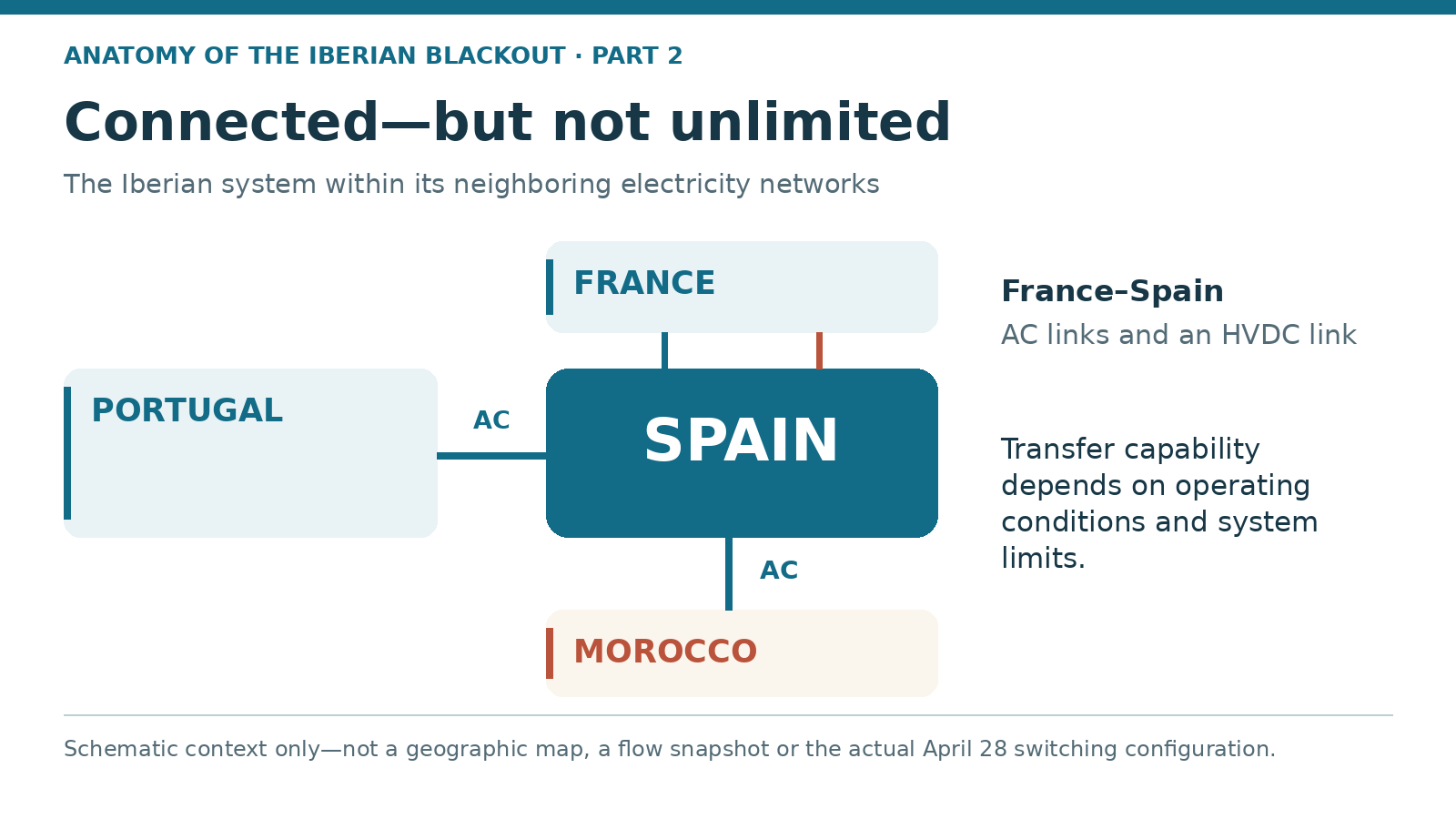
Schematic context only—not a geographic map, measured flow snapshot or actual April 28 switching configuration.
On April 28, 2025, the electricity systems of mainland Spain and Portugal collapsed in one of Europe’s most consequential power-system failures.
The final cascade unfolded in seconds.
But the electrical conditions that shaped the disturbance developed over a much longer period.
To understand the blackout, it is necessary to examine the system before the first major generation disconnections: how electricity was being produced and transferred, how the transmission network was configured, which resources were available to regulate voltage, and how operators responded to changing conditions.
The critical issue was not simply whether the Iberian Peninsula had enough generating capacity.
It was whether the interconnected system possessed sufficient effective voltage-control capability under the operating conditions that existed that day.
1. The Iberian Grid Within Continental Europe
Spain and Portugal operate an interconnected electricity system linked to the wider Continental European synchronous area through France.
The Iberian network also connects to Morocco.
These connections allow electricity to move between countries, support coordinated system operation and provide important resources during disturbances and restoration.
However, the existence of an interconnection does not mean that every neighboring system can provide unlimited support.
Transfer capability depends on transmission constraints, operating conditions, voltage stability, equipment ratings and the ability of the connected systems to remain synchronized.
The Iberian Peninsula’s electrical connection to the rest of Continental Europe is therefore an important part of its reliability architecture.
Before the April 28 incident, ENTSO-E reported that Spain’s international exchange programs were approximately:
- 1,000 MW of exports to France.
- 2,000 MW of exports to Portugal.
- 800 MW of exports to Morocco.
These figures describe scheduled exchanges before the incident, not a complete set of instantaneous measured power flows.
They nevertheless establish an important operating condition: Spain was scheduled to export electricity through several international connections.
The subsequent collapse was not simply a situation in which an isolated country suddenly ran out of generation.
It developed within an interconnected system whose electrical stability depended on generation controls, transmission conditions and coordinated operation.
2. Understanding the Transmission Network
The Spanish transmission system includes extensive 400 kV and 220 kV infrastructure connecting generating facilities, major substations, demand centers and international interconnections.
At these voltage levels, network behavior is strongly influenced by line loading, reactive-power flows, transformer operation and voltage-control equipment.
Transmission lines do more than transfer active power.
Their electrical characteristics also influence reactive-power balance.
Long high-voltage lines can generate capacitive reactive power, particularly when lightly loaded. Under certain operating conditions, this contributes to higher voltages.
Conversely, heavily loaded transmission paths can create substantial reactive-power requirements and voltage constraints.
The same network can therefore exhibit different voltage behavior depending on the amount and direction of electricity flowing through it.
This is why transmission topology matters.
Opening or closing a line, changing interconnector transfers, or altering generation dispatch can change the electrical conditions across multiple substations.
An operating action intended to address one problem can affect voltage elsewhere in the network.
The April 28 investigation illustrates the importance of considering these interactions.
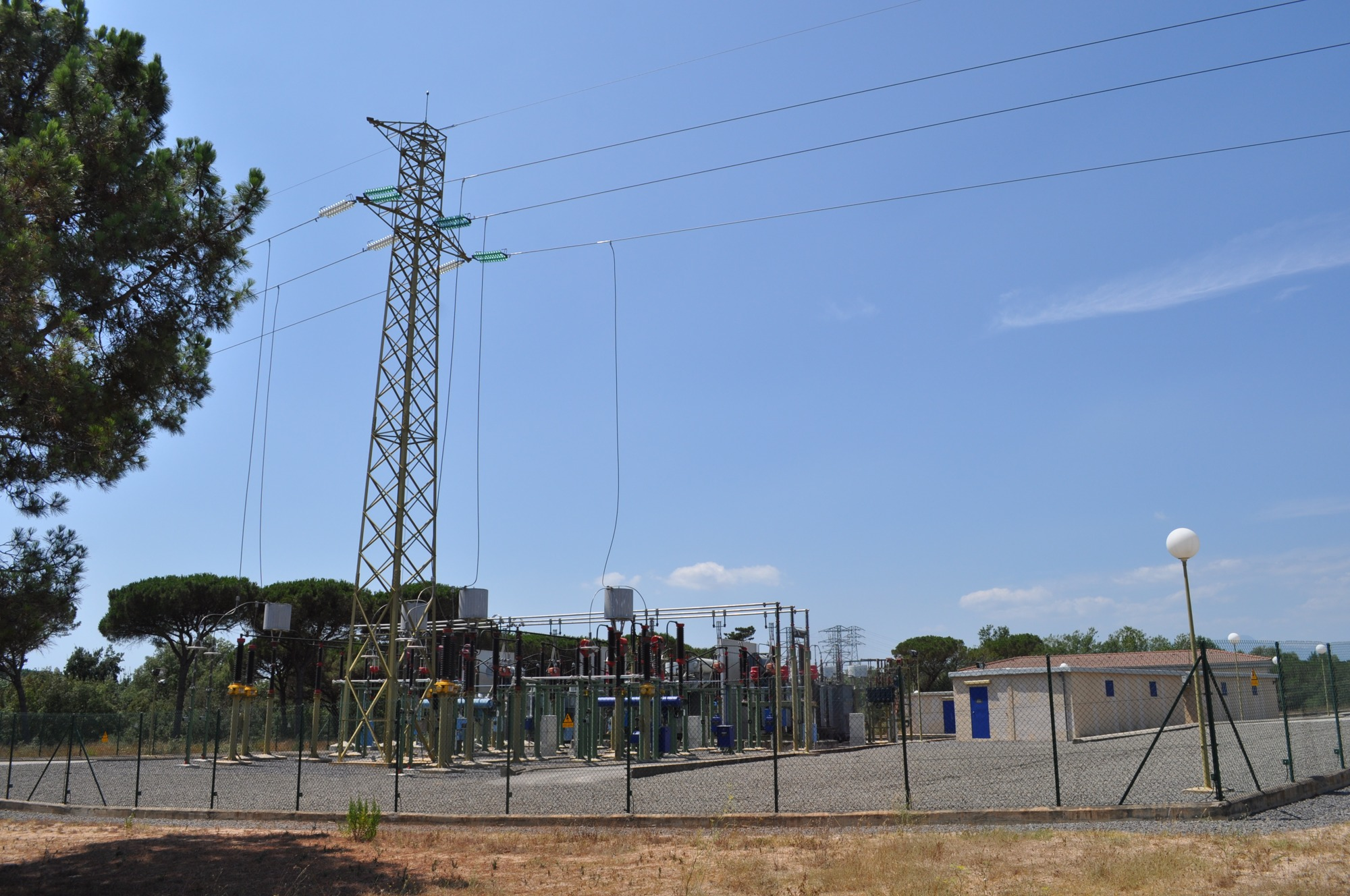
Sils substation, Catalonia, Spain, photographed in 2012. Photograph: Karsten Ratzke / Wikimedia Commons, CC0. Context image; not a record of the April 28, 2025 operating configuration.

3. A Changing Generation Mix
Spain’s generation portfolio includes nuclear, hydroelectric, thermal, wind, solar photovoltaic and solar-thermal resources.
These technologies differ not only in how they produce electricity but also in how they interact with the transmission system.
Traditional synchronous generators are physically coupled to the electrical system through rotating machines.
Their excitation systems can regulate terminal voltage by changing reactive-power output within the machines’ operating limits.
Inverter-based resources, including photovoltaic plants and many modern wind installations, use power-electronic converters to interface with the grid.
These converters can also provide reactive-power and voltage-control services when appropriately designed, configured and operated.
However, their actual contribution depends on control modes, equipment capability, operating limits, applicable grid requirements and coordination with the transmission-system operator.
The distinction is not that synchronous machines provide voltage support while inverters cannot.
Both technologies can contribute.
The important question is whether the resources connected to the system are delivering the voltage-control response required under the prevailing conditions.
A generating system can have adequate active-power production while lacking sufficient effective reactive-power response in critical locations.
4. Why Reactive Power Was So Important
Electricity systems must continuously manage both active and reactive power.
Active power performs useful work and supplies electrical demand.
Reactive power is associated with the electric and magnetic fields necessary for alternating-current operation and strongly influences voltage behavior.
When transmission voltage rises, the system may need additional reactive-power absorption.
When voltage falls, additional reactive-power injection may be required.
Voltage-control resources include synchronous generators, synchronous condensers, shunt reactors, capacitor banks, transformer tap changers and power-electronic equipment such as STATCOMs.
These devices are not interchangeable.
A shunt reactor can absorb reactive power and help reduce voltage, but its response depends on how it is switched or controlled.
A synchronous generator can vary reactive-power output through excitation control, subject to machine and operating limits.
A STATCOM can provide fast electronic reactive-power control within its rating and voltage-dependent capability.
The speed, location and control characteristics of these resources matter.
If voltage conditions deteriorate rapidly, a resource that requires several minutes to become available may be unable to address a disturbance developing in seconds.
The Iberian blackout exposed the importance of matching voltage-control capability to the speed of the system’s electrical dynamics.
5. The Voltage-Control Resources Scheduled for April 28
The Spanish government’s investigation identified an important issue in the scheduling of synchronous generating units for dynamic voltage control.
According to the government’s June 2025 findings, the system operator had scheduled 10 thermal generating plants on April 27 to provide voltage-control capability the following day.
One of those plants subsequently declared that it would not be available.
The government reported that the operator adjusted its scheduling arrangements but did not replace that unavailable plant during the central hours of April 28.
The government also stated that the final number of connected synchronous plants was the lowest recorded since the beginning of the year.
These findings raised questions about the amount of dynamic voltage-control capability available before the blackout.
However, the number of synchronous generating units alone does not establish whether a power system is secure.
The relevant engineering quantities include each unit’s location, reactive-power capability, operating point, voltage-control mode, response speed and interaction with other resources.
A smaller number of properly located and responsive units can provide different system support from a larger number operating under less favorable conditions.
The government’s conclusions must also be considered alongside the subsequent independent ENTSO-E investigation and the system operator’s own findings.
6. Voltage Conditions Before Noon
According to the Spanish government’s investigation, the system showed increasing voltage variability during the morning of April 28.
The government reported signs of instability beginning around 9:00 a.m., becoming more pronounced after approximately 10:30 a.m.
Measured voltages nevertheless remained within the applicable permitted limits during this earlier period.
This distinction is important.
A system can remain within its prescribed operating boundaries while exhibiting behavior that requires increased attention.
Voltage fluctuations do not necessarily mean that a blackout is imminent.
Their significance depends on the magnitude, duration, location, available control margins and underlying electrical mechanisms.
For operators, the challenge is determining whether observed changes represent ordinary operating variation or a developing condition that requires intervention.
The April 28 event demonstrates why maintaining acceptable voltage at a particular moment is not necessarily equivalent to maintaining adequate dynamic stability margins.
7. Oscillations Changed the Operating Conditions
Two periods of oscillatory behavior occurred before the collapse.
ENTSO-E’s final report documented an episode around 12:03–12:08 and another around 12:19–12:22.
Operators in Spain and France implemented measures to mitigate the oscillations.
These included changes affecting cross-border transfers, network configuration and operation of the France–Spain HVDC interconnection.
The interventions helped reduce the oscillatory behavior.
However, the measures also affected voltage conditions in the Iberian network.
This illustrates a fundamental feature of interconnected power-system operation.
Frequency stability, oscillation damping, transmission loading and voltage control are coupled through the network.
An action that improves damping can change active-power flows.
Those changes can affect reactive-power requirements and voltage.
The appropriate response therefore depends on evaluating the combined electrical consequences, not merely whether the original oscillation has diminished.
The detailed sequence of operator actions will be examined separately in Part 4.
8. The Difference Between Available Equipment and Effective Control
A transmission system may have reactors, capacitors, generating units and power-electronic devices installed across its network.
But installed equipment capacity is not the same as immediately available dynamic control capability.
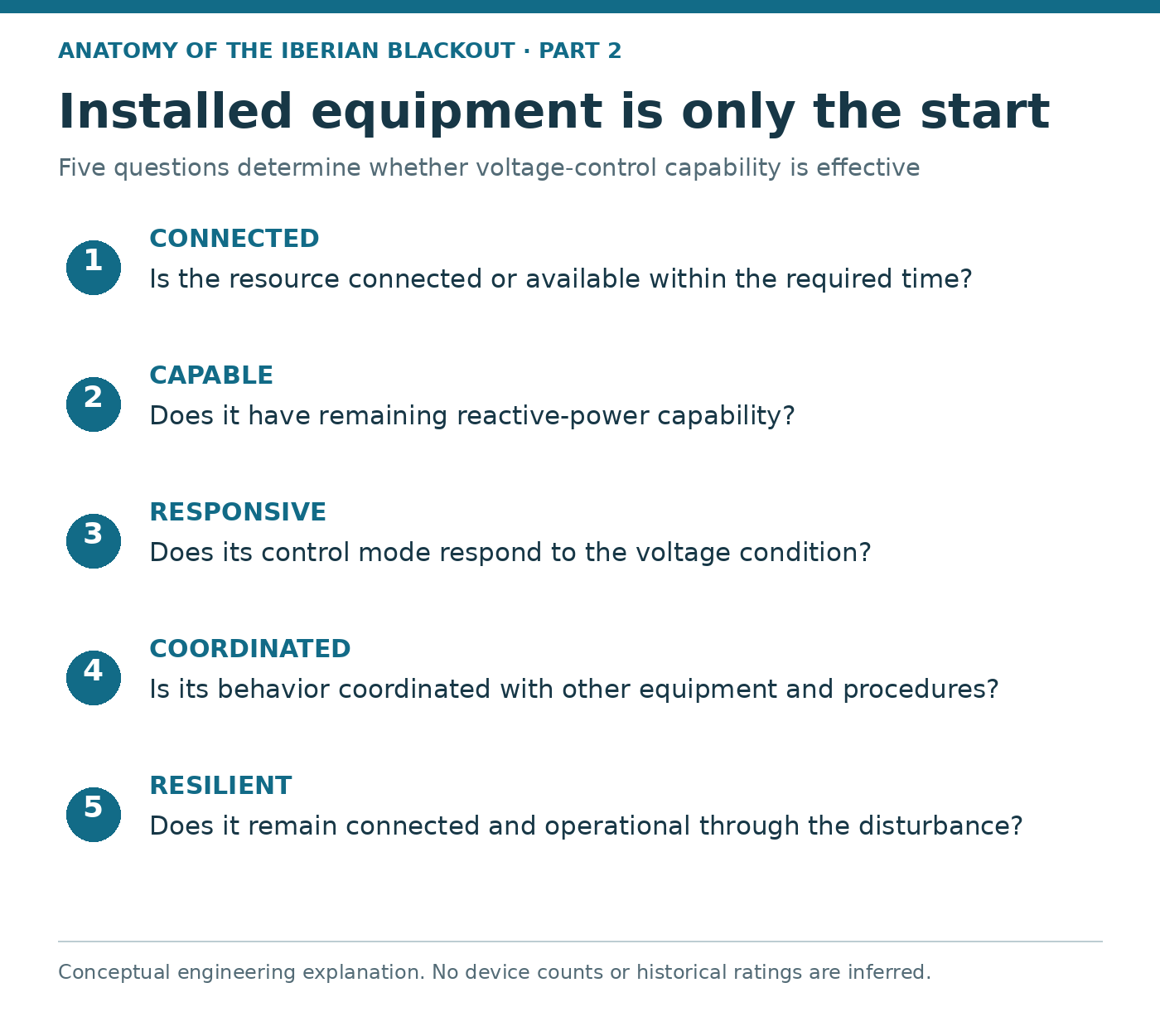
Several factors determine whether a resource can contribute when needed.
First, the equipment must be connected or capable of becoming available within the required time.
Second, it must have sufficient remaining reactive-power capability.
Third, its control mode must respond appropriately to the actual voltage condition.
Fourth, its response must be coordinated with other equipment and system operating procedures.
Finally, the resource must remain electrically connected and operational throughout the disturbance.
The Spanish government reported that some generating facilities expected to contribute to voltage regulation did not provide the required response.
Its investigation also described instances in which reactive-power behavior was contrary to what was needed to reduce voltage.
These are findings attributed to the government investigation, not an independent determination of liability by this publication.
The broader engineering lesson is that voltage-control adequacy cannot be established merely by counting installed devices or scheduled generating units.
Their actual performance is what matters.
9. What the Grid Looked Like Immediately Before the Cascade
ENTSO-E reported that the oscillations observed earlier in the day had subsided before the main incident.
At approximately 12:32, the system was not experiencing the same notable oscillatory behavior seen earlier.
The factual investigation also reported that monitored 400 kV voltages were below 420 kV at that time.
These observations are important because they distinguish the earlier operating disturbances from the subsequent rapid voltage escalation.
The system had not yet entered the final cascading sequence.
Nevertheless, its operating condition reflected the effects of earlier interventions, the prevailing generation dispatch and the voltage-control resources actually available.
The available public findings do not justify presenting a complete bus-by-bus network configuration, generator dispatch table or detailed switching diagram as though every element had been independently reconstructed here.
Such a reconstruction would require validated network-model data, time-aligned operating measurements and equipment-state records.
The important established finding is narrower but consequential: the system entered the final disturbance with voltage-control vulnerabilities that became critical as generation disconnections began.
10. Why the Pre-Event Configuration Matters
The Iberian blackout provides an important reminder that power-system reliability is not determined solely by installed generating capacity or reserve megawatts.
Electrical stability depends on the interaction of generation, transmission topology, reactive-power resources, control systems and protection.
A transmission network that operates securely under one configuration may have different stability margins after changes in power flows or switching states.
A generating unit capable of supporting voltage may provide little effective support if it is unavailable, operating in an unsuitable control mode or unable to respond quickly enough.
A protection system that correctly disconnects equipment under local conditions may contribute to a larger disturbance when many facilities respond similarly.
These relationships explain why the pre-event operating state deserves as much scrutiny as the final seconds of the blackout.
The event cannot be understood solely by examining the last breaker operation or the last generator to disconnect.
It requires understanding the electrical system that existed before the cascade began.
11. Lessons for Grid Planning and Operations
The first lesson is that dynamic voltage-control capability must be evaluated as a system-level requirement.
Generation adequacy and voltage-control adequacy are different engineering questions.
The second lesson is that the location and performance of reactive-power resources matter.
A megavar of capability in one part of the network may not provide the same benefit as a megavar located near a critical voltage-control area.
The third lesson is that operators need coordinated analysis of oscillation damping, network switching and voltage stability.
Corrective measures should be evaluated for their combined effects.
The fourth lesson is that resource capability must be demonstrated through appropriate testing, models and operating requirements.
Equipment specifications alone cannot establish the response that will occur during a disturbance.
The fifth lesson is that system studies must consider the changing behavior of an increasingly diverse generation fleet.
Synchronous machines, inverter-based resources, storage systems and electronically controlled transmission equipment can all contribute to reliable operation when their capabilities are properly coordinated.
12. Final Perspective
The Iberian electricity system did not collapse because the existence of renewable generation made reliable operation impossible.
Nor does the available evidence support treating a particular network configuration or individual operating decision as the sole explanation.
The April 28 blackout resulted from interacting electrical and operational factors.
Its pre-event conditions show why modern grid reliability requires more than adequate megawatt production.
It requires sufficient reactive-power capability, effective dynamic controls, coordinated network operation and protection systems that behave appropriately during rapidly changing electrical conditions.
The final cascade lasted only seconds.
Understanding why it became possible requires examining the hours that came before.
Next in the series:
Part 3 — The Final 90 Seconds: How the Iberian Grid Collapsed
A detailed engineering reconstruction of the generation disconnections, voltage escalation, protection operations, loss of synchronism and system-wide collapse.
Source note: ENTSO-E final investigation · ENTSO-E factual report · Government of Spain · Red Eléctrica operator perspective · ENTSO-E initial statement (9 May 2025).
Previous: Part 1 — Spain’s 2025 Blackout · Explore the series