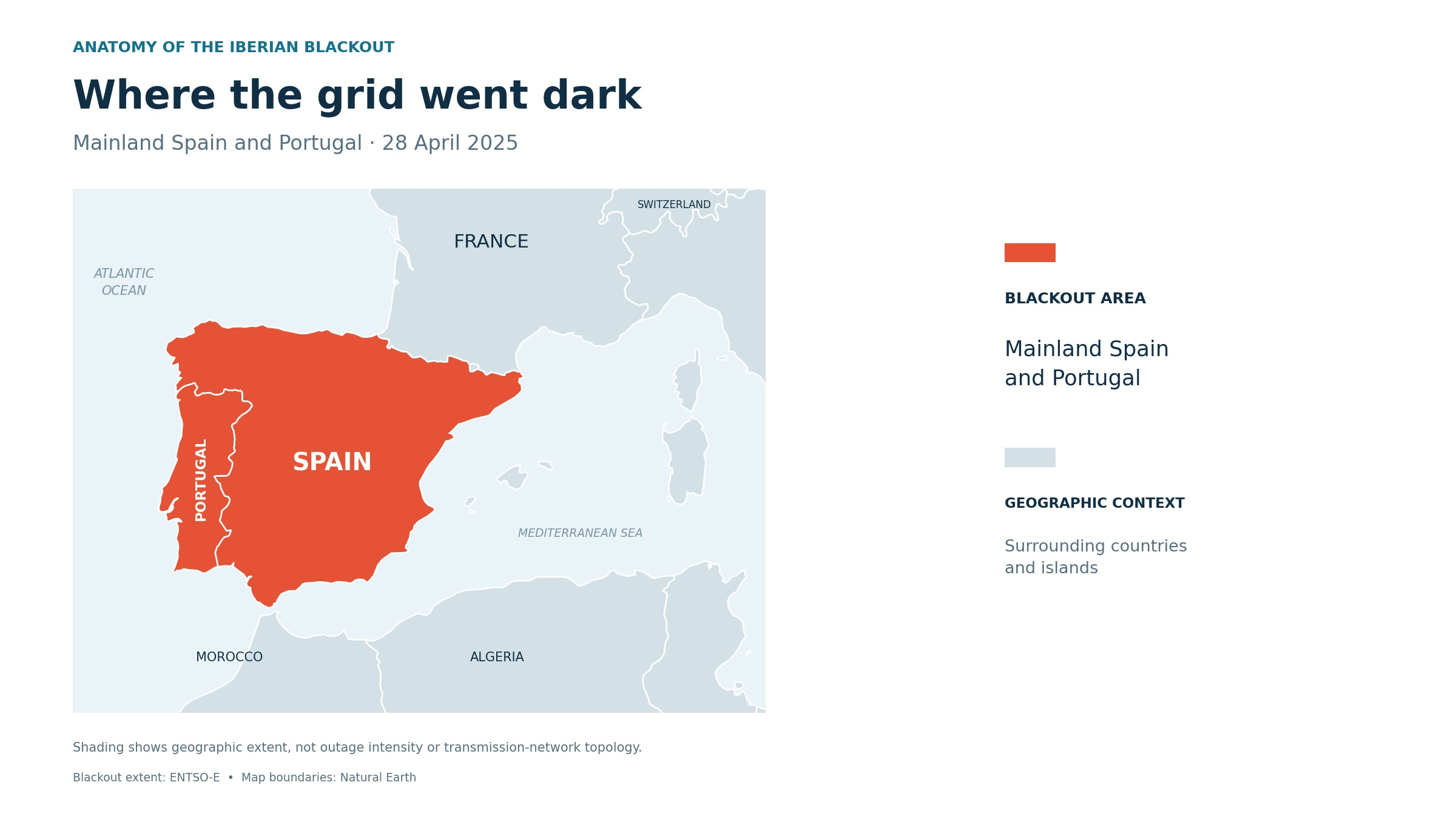
Mainland Spain and Portugal are highlighted as the blackout area. Shading indicates geographic extent, not outage intensity or transmission-network topology. Blackout extent: ENTSO-E; map boundaries: Natural Earth.
On April 28, 2025, one of Europe’s most significant electricity-system failures unfolded across the Iberian Peninsula.
At approximately 12:33 p.m. local time, the interconnected power systems of mainland Spain and Portugal collapsed. Electricity supplies disappeared across two countries, disrupting transportation, communications, businesses and essential services.
The blackout was extraordinary not only because of its geographic scale, but because of the electrical mechanism behind it.
This was not a conventional blackout initiated by the sudden loss of a large power station or transmission corridor.
Instead, the investigation by the European Network of Transmission System Operators for Electricity (ENTSO-E) identified a complex sequence involving power-system oscillations, voltage-control shortcomings, rapid generation reductions and cascading disconnections.
The event exposed a critical challenge for modern electricity systems: maintaining voltage stability as the generation mix, control technologies and operating characteristics of the grid evolve.
The Grid Before the Collapse
The Iberian electricity system operates as part of the Continental European synchronous area, with electrical connections to France and Morocco and extensive interconnections between Spain and Portugal.
Within Spain, electricity flows through a high-voltage transmission network connecting conventional generating stations, renewable resources, major demand centers and neighboring power systems.
On the morning of April 28, the system was operating with substantial renewable generation and a combination of other generation technologies.
But the quantity of electricity being generated was only one part of the operating picture.
Maintaining a stable transmission system also requires sufficient reactive-power capability to control voltage.
Generators, reactors, capacitors, transformers and power-electronic devices can all influence voltage, but their capabilities, control modes and response times differ.
The availability of these resources becomes particularly important when network loading changes or electrical disturbances develop.
According to the Spanish government’s subsequent investigation, the operator had scheduled thermal generating units to provide dynamic voltage control. One scheduled unit became unavailable, and the government later questioned whether sufficient voltage-control resources had been available during the critical operating period.
That finding would become part of a wider debate about system preparation, equipment performance and operational responsibility.
Warning Signs Before Noon
The blackout did not emerge without preceding disturbances.
The Spanish government’s investigation reported increasing voltage variability during the morning, although measured voltages remained within permitted limits.
At approximately 12:03 p.m., the system experienced an unusual oscillation.
Another oscillation occurred around 12:19 p.m.
Power-system oscillations are not inherently evidence of an impending blackout. Interconnected electricity systems routinely experience electromechanical and control-related oscillatory behavior, which operators monitor and manage.
However, oscillations can require corrective measures that alter network conditions.
The Spanish government reported that operators implemented established measures to mitigate the oscillations. Those measures were effective in reducing oscillatory behavior but also contributed to higher voltages.
This interaction illustrates an important operational challenge: an intervention that improves one aspect of system stability can change another operating condition.
The critical question is whether the remaining voltage-control resources can maintain adequate margins after those changes.
The Final Minutes
Beginning around 12:32 p.m., the system entered a rapidly deteriorating condition.
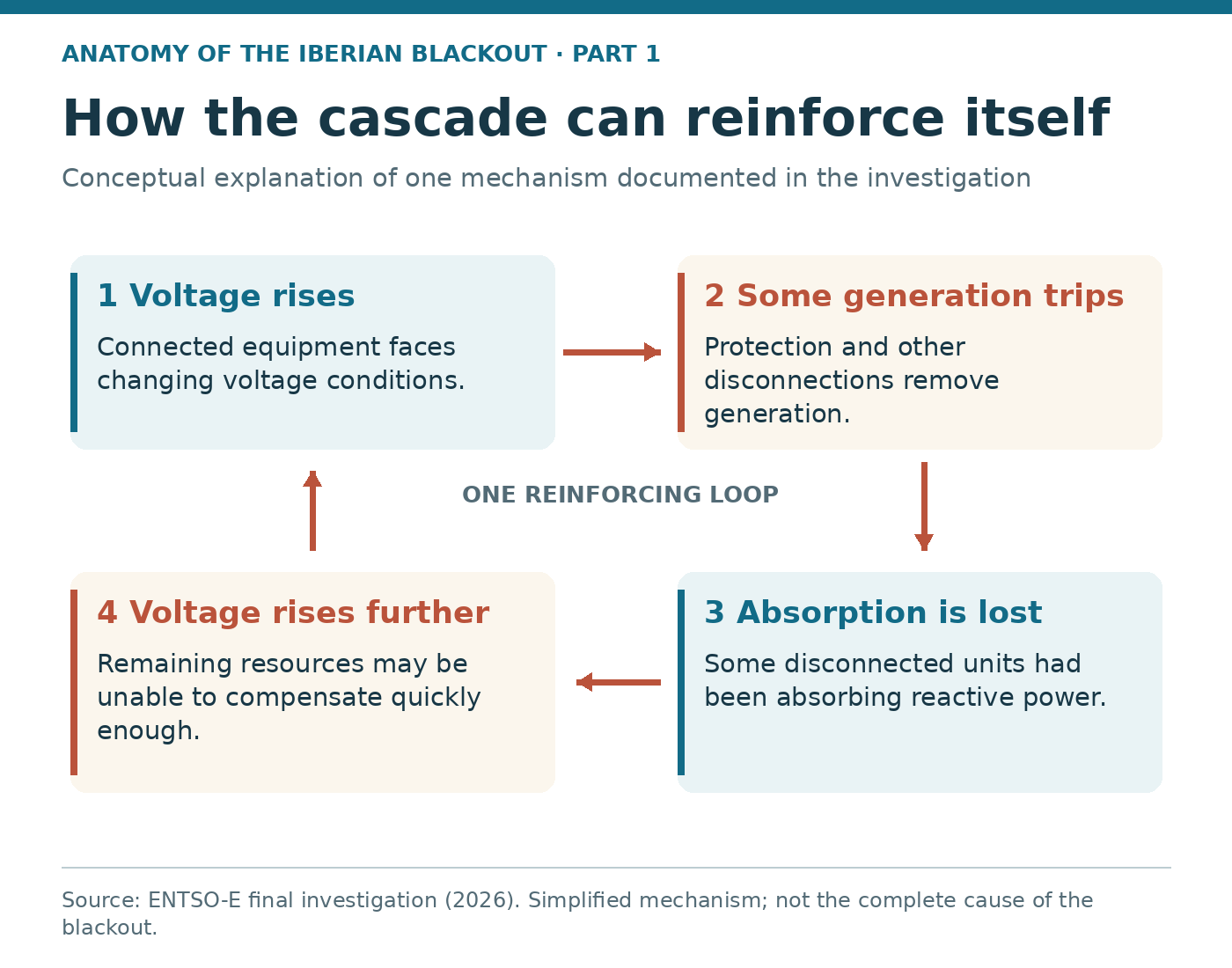
Voltage increases were accompanied by generation disconnections in Spain.
As generating facilities disconnected, the electrical balance of the network changed further. The loss of generating units that had been absorbing reactive power could remove an important contribution to limiting voltage.
Additional voltage increases then contributed to further generation disconnections.
A sequence of local disturbances developed into a system-wide cascade.
The Iberian system subsequently lost synchronism with the wider Continental European network.
Automatic system-defence mechanisms operated, but the disturbance could not be contained.
By approximately 12:33:30 p.m., the interconnected electricity systems of mainland Spain and Portugal had collapsed.
The sequence was remarkable for its speed.
A major interconnected power system moved from deteriorating but functioning conditions to widespread loss of supply in roughly a minute.
Why Voltage Matters
Public discussions of electricity-system reliability frequently focus on frequency and inertia.
These are essential aspects of power-system stability, but they are not the whole picture.
Frequency is closely associated with the balance between active-power generation and consumption.
Voltage depends on a more complex combination of reactive-power balance, network characteristics, equipment controls and operating conditions.
A system can experience dangerous voltage behavior even before frequency becomes the dominant concern.
Reactive-power absorption is particularly important when transmission voltages rise.
If the system cannot absorb sufficient reactive power, voltage can increase beyond the operating capability of connected equipment.
Protective systems may then disconnect generating facilities or other components to prevent equipment damage.
Those protective actions can be appropriate for individual installations while contributing to a larger system disturbance.
This creates a difficult engineering problem: protecting equipment locally while maintaining the stability of the interconnected network.
The Iberian blackout demonstrated how rapidly that problem can escalate.
A Failure With Multiple Contributing Factors
The ENTSO-E final investigation, published on March 20, 2026, concluded that the blackout did not have a single isolated cause.
Its findings identified interacting factors involving oscillations, shortcomings in voltage and reactive-power control, differing voltage-regulation practices, rapid reductions in generation output, generator disconnections and uneven stabilization capabilities.
The Spanish government’s earlier investigation likewise described a multifactorial event.
This distinction is essential.
It would be misleading to conclude that renewable generation alone caused the blackout.
It would also be misleading to dismiss the relevance of generator-control behavior, reactive-power capability or operational decisions.
The more useful engineering question is how all the components of the power system interacted—and why the available controls and protections were unable to prevent the cascade.
The Role of the System Operator
Transmission-system operators must continuously balance multiple reliability requirements.
They must maintain secure power flows, manage voltage and frequency, respond to disturbances and coordinate with neighboring systems.
On April 28, the Spanish operator took actions to address oscillations and voltage conditions.
The subsequent investigations raised important questions about the adequacy of available dynamic voltage-control capability, the performance of generating facilities and the consequences of operating decisions.
These issues must be examined in the context of the information and equipment available to operators at the time.
An action that appears inadequate with hindsight cannot automatically be judged without considering the operational constraints and observations that existed when the decision was made.
Similarly, a generating facility’s disconnection must be evaluated against its actual protection settings, applicable requirements and electrical conditions.
The blackout therefore demands a system-level investigation rather than a simplified assignment of blame.
How the Grid Was Restored
Following the collapse, transmission-system operators began the complex process of restoring electricity supply.
Restoration required coordination among the affected operators, neighboring power systems and generating facilities capable of supporting network re-energization.
Restoring a blacked-out power system is not simply a matter of restarting generation.
Operators must establish stable electrical islands or energization paths, manage voltage and frequency, reconnect transmission facilities, restore generation and progressively reintroduce demand.
Each stage must be coordinated to avoid creating a second instability.
The Iberian restoration demonstrated the importance of established emergency procedures and international transmission-system cooperation.
What the Blackout Teaches the Industry
The ENTSO-E investigation points toward several important lessons.
First, dynamic voltage control must be treated as a central reliability requirement.
Adequate megawatt capacity does not necessarily guarantee adequate voltage-control capability.
Second, generator performance and protection settings must be coordinated with system-level requirements.
A generating unit’s local control behavior can have consequences beyond its connection point.
Third, operators need better visibility into changing electrical conditions.
Voltage trends, reactive-power margins, oscillations and the behavior of distributed resources must be monitored with sufficient accuracy and speed.
Fourth, corrective actions must be assessed for their interactions.
Oscillation mitigation, network switching, generation scheduling and voltage control cannot always be treated as independent operational problems.
Finally, the changing grid requires updated operating practices and regulatory frameworks.
As electricity systems incorporate more power-electronic resources, their technical capabilities must be integrated into coordinated reliability requirements.
A Warning for the Future Grid
The Iberian blackout was not simply a failure of one generating technology or one operating decision.
It was a demonstration of how complex interactions among generation, transmission, voltage control, protection and operational practices can overwhelm an interconnected power system.
The most important lesson is that reliability depends on more than having enough electricity generation.
It also depends on whether the entire system can remain electrically stable as conditions change.
For engineers and system operators around the world, April 28, 2025 offers an unusually important case study.
Understanding the blackout requires reconstructing the grid as it existed before the event, examining the decisions made during the developing disturbance and identifying the engineering measures that could reduce the risk of a similar failure.
That is the purpose of this investigative series.
Source note: ENTSO-E — Final investigation · ENTSO-E — Factual report · Government of Spain — Government investigation · Red Eléctrica — Operator account (supplementary operator perspective)
Next in the series
Part 2 — The Grid Before the Blackout: Generation, Topology and Voltage Control
An engineering examination of the Iberian system’s pre-event configuration, generation mix, transmission interconnections, voltage-control resources and operating conditions.