POWER ELECTRONICS SUPERCYCLE · PART 7 OF 9
For more than a century, electric-grid protection has relied on a fundamental characteristic of rotating generators: when a short circuit occurs, they produce a substantial increase in current that protective devices can detect and use to isolate the fault.
That characteristic helped shape the modern protection system.
Overcurrent relays, distance protection, breaker coordination, short-circuit calculations, and operating procedures were developed around the predictable electrical behavior of synchronous machines.
But the power system is changing.
Solar generation, battery energy storage systems, modern wind turbines, and other inverter-based resources are becoming increasingly important sources of electricity. HVDC converters and other power-electronic technologies are also transforming how power moves across the network.
Unlike synchronous generators, these devices do not necessarily deliver large fault currents determined primarily by rotating-machine physics. Their responses are shaped by semiconductor limits, control algorithms, and operating requirements. PNNL’s review of inverter fault-current behavior describes how manufacturer-specific controls and settings produce different fault signatures.
The result is one of the most consequential engineering challenges of the Power Electronics Supercycle.
The electric grid is gaining new capabilities to control electricity, but the protection systems responsible for keeping it safe must learn to recognize a different kind of electrical behavior.
A Protection System Built Around Rotating Machines
Traditional power systems were dominated by large synchronous generators.
When a short circuit occurred, the electromagnetic characteristics of those machines generally produced fault currents substantially higher than normal operating currents.
That difference gave protection engineers a useful signal.
Relays could measure current and voltage, determine whether abnormal conditions existed, and initiate breaker operations to isolate the affected equipment.
Several protection methods became fundamental to reliable grid operation:
- Overcurrent protection: Detects excessive current and initiates protective action.
- Distance protection: Uses measured voltage and current to estimate apparent impedance and identify faults within designated protection zones.
- Differential protection: Compares currents entering and leaving protected equipment or zones.
- Breaker coordination: Ensures protective devices operate selectively to isolate faults while minimizing unnecessary interruptions.
- Fault detection algorithms: Identify abnormal electrical conditions using measured quantities and established protection logic.
These methods remain essential.
However, their performance depends on assumptions about the electrical system, including fault-current magnitude, direction, sequence components, and the behavior of connected generation.
As synchronous generation is displaced or supplemented by inverter-based resources, some of those assumptions must be reconsidered.
The Inverter Changes the Fault Response
A solar inverter or battery inverter does not respond to a short circuit in the same way as a synchronous generator.
Its electrical output is produced through semiconductor switching and regulated by control systems.
During a fault, an inverter may limit its current to protect power-electronic components. Depending on its design, control mode, and applicable grid requirements, it may also adjust current injection, prioritize voltage support, change operating behavior, or disconnect under specified conditions.
This creates a fundamental difference.
A conventional synchronous generator can initially contribute several times its rated current to a short circuit.
An inverter typically operates within much tighter current limits, although its actual fault contribution varies with equipment design and control strategy.
A fault that once produced an unmistakable increase in current may produce a much smaller or differently shaped electrical response in a converter-dominated system.
That change affects more than relay sensitivity.
It can alter fault detection, directional decisions, protection coordination, and the assumptions used to evaluate system behavior during disturbances.
The challenge is not that traditional protection suddenly becomes obsolete.
It is that protection systems must be evaluated against the characteristics of the resources now connected to the network.
Why Lower Fault Current Matters
The transition toward inverter-based generation creates several interconnected protection challenges.
The application matters. Transmission-line protection, distribution feeder coordination, and protection of islanded microgrids operate under different network conditions and communications constraints. A scheme that works well in one setting should not be assumed suitable for another.
During an unbalanced fault, the magnitude and phase angle of an inverter’s negative-sequence current depend on its controls. Directional protection that uses these quantities must therefore be evaluated against the actual inverter response. Current magnitude alone does not describe the full protection challenge.
Relay Sensitivity
Overcurrent protection depends on distinguishing abnormal fault conditions from acceptable operating conditions.
When fault-current contribution becomes limited, that distinction can become more difficult.
Engineers may need to distinguish among normal operating currents, high-impedance faults, and faults supplied primarily by current-limited converters.
Protection settings that performed adequately in a synchronous-generator-dominated system may require reassessment.
Protection Coordination
Protection systems are designed to operate selectively.
Ideally, the device closest to a fault isolates the affected section while the remainder of the system stays energized.
Changing generation patterns can alter the magnitude and direction of current flowing through protection devices.
Inverter control modes and operating conditions can introduce additional variability.
Consequently, coordination studies must increasingly consider the behavior of connected converters rather than relying exclusively on conventional fault-current assumptions.
Short-Circuit Calculations and Equipment Ratings
Short-circuit studies support the selection and evaluation of breakers, transformers, switchgear, and substation equipment.
As generation portfolios change, engineers must update the models used to estimate fault levels and evaluate equipment duties.
Lower fault current does not automatically eliminate equipment-rating concerns. Different system configurations can produce different fault contributions, and protection performance must still be verified.
The essential requirement is that calculations accurately represent the power system being studied.
Grid Restoration
Protection challenges also extend into restoration.
Blackstart and islanded operation can produce electrical conditions that differ substantially from those of an interconnected grid supported by large synchronous generators.
Converter current limits, control behavior, and changing system strength can affect fault detection and coordination during restoration.
Protection must therefore remain dependable not only during normal interconnected operation but also as the network is rebuilt.
The Rise of Digital Protection
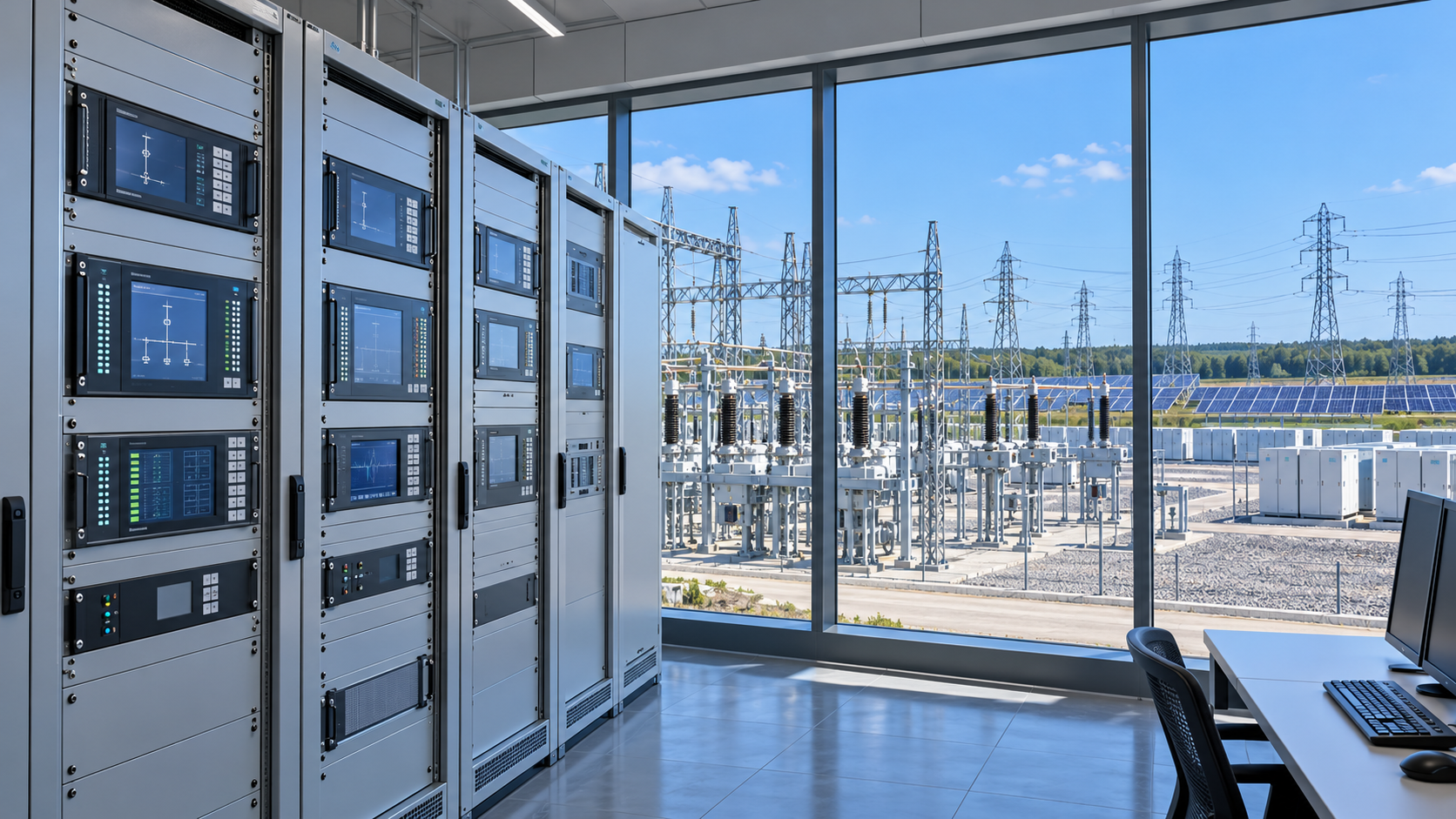
As electrical behavior becomes more complex, utilities are increasingly examining advanced measurement, communications, and protection technologies.
Potential capabilities include:
- Digital protective relays with more sophisticated algorithms
- High-speed communications between substations
- Adaptive protection settings
- Wide-area monitoring and protection
- Synchrophasor-based applications
- Digital substation architectures
- Real-time system monitoring
- Advanced disturbance detection and analytics
These technologies can provide information beyond what an individual relay observes locally.
For example, communication-assisted protection may compare measurements from different terminals of a transmission line.
Adaptive schemes may adjust settings when system configurations change.
These approaches involve tradeoffs. PNNL’s review of protection for IBR-rich systems identifies cost, communications, model dependence, complexity, and testing requirements as important barriers to deployment at distribution-system scale. Adaptive protection is an application-dependent option rather than an automatic next step for every network.
Wide-area monitoring can help operators recognize developing disturbances across multiple parts of the network.
However, increased reliance on digital systems introduces its own engineering requirements.
Communications reliability, timing accuracy, cybersecurity, interoperability, and failure management become increasingly important.
The future of protection is not simply replacing conventional relays with more software. It is developing protection architectures that remain dependable as both the electrical system and its supporting information systems become more complex.
Synchrophasors and the Value of Wide-Area Visibility
Phasor Measurement Units, or PMUs, provide time-synchronized measurements that can help engineers observe power-system behavior across large geographic areas.
These measurements can include voltage and current phasors, frequency, and other quantities derived from synchronized electrical measurements.
Their value becomes particularly important as the grid experiences more complex interactions among generators, converters, transmission equipment, and large electrical loads.
Synchrophasor applications can support the identification and analysis of:
- Power-system oscillations
- Abnormal frequency behavior
- Disturbance propagation
- Islanding conditions
- Developing instability
- Interactions among geographically separated resources
PMUs are already valuable for wide-area monitoring and disturbance analysis.
Their potential role in protection is also important, although the suitability of synchrophasor-based protection depends on application-specific requirements for measurement performance, communications, and operating speed.
Not every protective function should depend on wide-area communications.
Local protection must continue to perform essential duties even when supporting information systems are unavailable.
The engineering opportunity lies in combining dependable local protection with the additional awareness provided by synchronized measurements.
When Detailed EMT Studies Are Needed
Traditional power-system studies often use simplified representations of equipment and system dynamics.
These approaches remain valuable for many planning and operating studies.
However, converter-dominated networks can exhibit fast control interactions that require more detailed modeling.
Electromagnetic transient simulation, commonly called EMT simulation, allows engineers to investigate phenomena that may not be adequately represented in conventional positive-sequence dynamic studies.
Important applications include:
- Fast inverter-control behavior
- Converter interactions
- Weak-grid performance
- Fault response and recovery
- Protection-system behavior
- Control instability
- Interactions among multiple inverter-based resources
Detailed EMT models can represent fast electrical and control-system behavior, with the appropriate modeling fidelity depending on the study objective.
As inverter penetration increases, EMT analysis is becoming an increasingly important complement to conventional transmission-planning and interconnection studies.
This represents a significant change in engineering practice.
A system may appear acceptable under one class of simplified study while still requiring detailed investigation of converter controls and fast interactions.
The challenge is no longer only determining whether the network has sufficient electrical capacity. Engineers must also understand how its increasingly sophisticated control systems behave together.
Grid-Forming Inverters Introduce New Possibilities—and New Questions
Grid-forming inverters represent an important development in the transition toward converter-rich power systems.
Unlike conventional grid-following controls, which generally synchronize to an existing voltage waveform, grid-forming controls are designed to establish or regulate voltage and frequency according to their control objectives.
This capability may support improved operation in weak networks and electrical islands.
Potential applications include voltage support, disturbance response, system stabilization, and restoration.
However, grid-forming capability does not automatically solve protection challenges.
Grid-forming inverters remain subject to semiconductor current limits and equipment-specific control behavior.
Their response to faults must be understood and coordinated with the protection system.
Engineers must evaluate whether existing protection methods remain effective and whether new schemes are required.
The broader lesson is that grid-forming technology and protection engineering must evolve together.
A converter may provide valuable voltage and frequency support while still presenting fault-current characteristics that differ from those of a synchronous generator.
Utility Planning Is Entering a New Phase
Transmission planners and protection engineers are increasingly required to evaluate a wider range of interactions.
These include inverter fault contribution, dynamic stability, converter-control behavior, protection coordination, communications dependencies, and cybersecurity.
Historically, a central interconnection question was:
How much generation can connect at this location?
That question remains important.
But it is increasingly accompanied by another:
How will these converters interact with the surrounding power system—and how will the system detect and isolate faults when they occur?
The answer may depend on inverter controls, grid strength, operating configuration, protection settings, and the behavior of other nearby resources.
This requires closer coordination among transmission planners, protection engineers, equipment manufacturers, system operators, and interconnection-study teams.
Protection can no longer be treated as an isolated engineering activity performed after the broader system design is complete.
It must be considered alongside the controls and operating characteristics of the modern grid.
The Next Investment Cycle in Grid Protection
The transformation of protection systems has implications for technology development and infrastructure investment.
From an engineering perspective, potential areas of growing demand include advanced protective relays, digital substations, PMU systems, grid-monitoring platforms, real-time simulation software, cybersecurity solutions, disturbance analytics, and specialized engineering services.
Software and analytics may become increasingly valuable as utilities seek to interpret more complex system behavior.
Advanced modeling tools will also be important as utilities and developers evaluate new inverter-based projects.
But the opportunity extends beyond selling individual devices.
The industry will need integrated solutions that combine accurate models, dependable measurements, communications, protection logic, and validated engineering practices.
Investment in these capabilities will depend on utility modernization programs, reliability requirements, demonstrated performance, and the economics of deployment.
The engineering need is clear even where the timing and scale of commercial adoption remain uncertain.
This is an assessment of potential engineering demand, not a measured forecast of market size or company revenue.
Protecting the Next Generation of the Electric Grid
The electric grid is becoming more dynamic, more distributed, and more dependent on digitally controlled equipment.
The protection systems developed for the twentieth-century power system were built around electrical behavior dominated by large rotating machines.
That foundation remains valuable.
But the growing role of inverters requires protection engineers to revisit assumptions that once seemed fundamental.
Fault currents may be smaller.
Current direction and composition may depend on converter controls.
Protection coordination may change with operating conditions.
System interactions may occur over faster timescales.
And restoration may increasingly depend on resources whose fault behavior differs from conventional generators.
Meeting these challenges will require a combination of established protection principles and new engineering capabilities.
Digital relays, synchronized measurements, communications, adaptive algorithms, and detailed simulation will all have roles to play.
But their value will depend on how reliably they are integrated into the power system.
The Power Electronics Supercycle is not only changing how electricity is generated, converted, and transmitted.
It is changing how engineers recognize when something has gone wrong—and how the grid responds before a local failure becomes a wider disturbance.
The next generation of grid protection will need to be as sophisticated as the power system it is designed to protect.
Previous in the Power Electronics Supercycle:
Part 6 — Silicon Carbide: The Semiconductor Revolution Powering the Future Grid
Explore the Power Electronics Supercycle series
Next in the Power Electronics Supercycle:
Part 8 — Who Wins? Companies and Technologies Positioned for the Power Electronics Supercycle