POWER ELECTRONICS SUPERCYCLE · PART 6 OF 9
For most people, the transformation of the electric grid is visible in enormous physical infrastructure.
Transmission lines cross hundreds of miles.
HVDC converter stations occupy acres of land.
Battery plants contain thousands of cells.
Solar farms and wind plants stretch across the landscape.
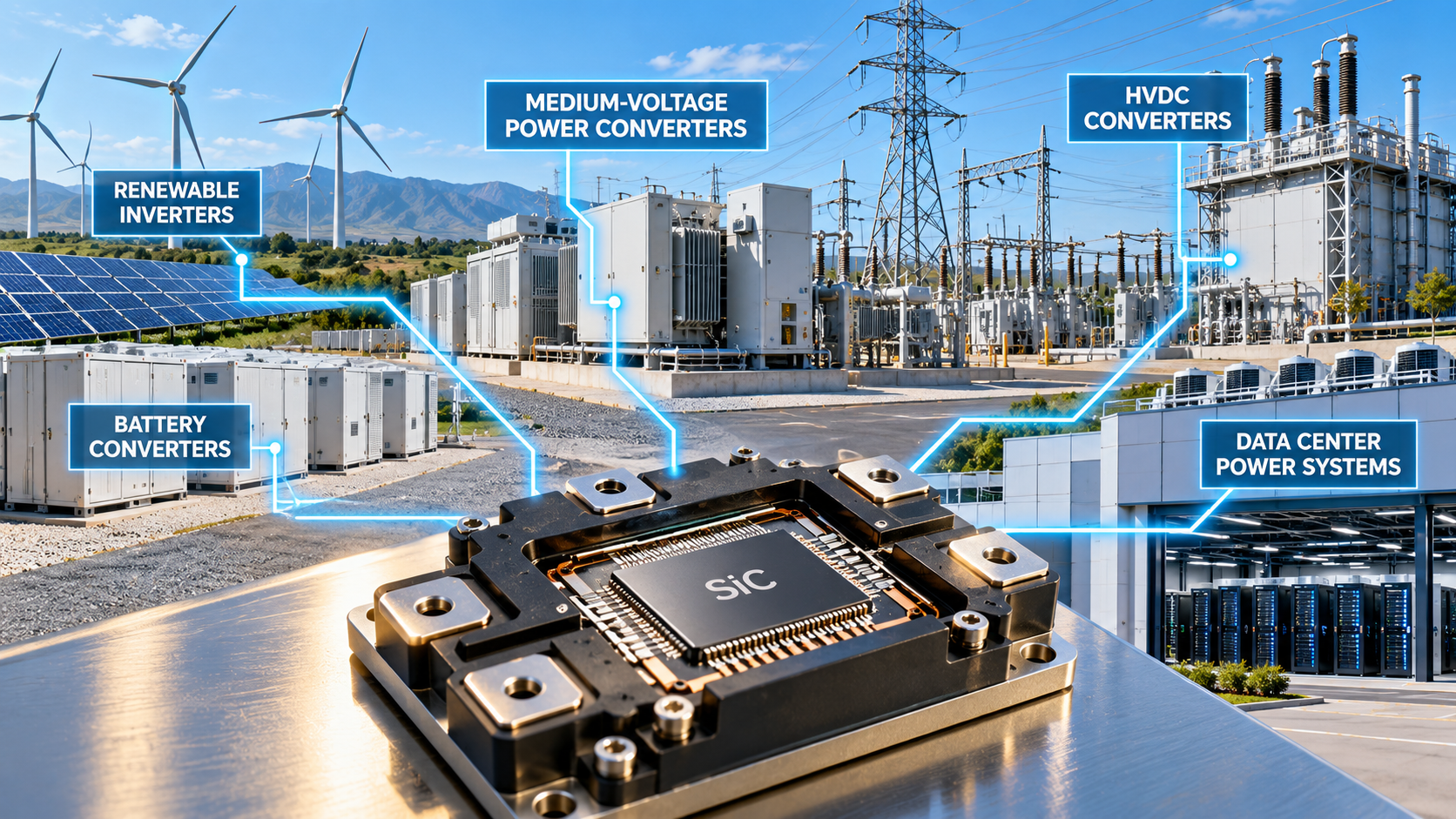
But inside nearly every one of these technologies is a much smaller component that helps determine what the entire system can do:
the power semiconductor.
Every inverter, STATCOM, battery converter, solar inverter and voltage-source converter depends on semiconductor devices switching electrical current under precise control.
For decades, silicon devices have provided the foundation for this transformation.
Now another semiconductor material is moving steadily into higher-power applications.
Silicon carbide.
And its importance goes far beyond simply making converters more efficient.
The Grid Is Becoming a Network of Power Converters
Traditional AC power systems were built primarily around electromagnetic machines.
Generators converted mechanical energy into electricity.
Transformers changed voltage.
Motors converted electrical energy back into mechanical work.
Those devices remain fundamental.
But a growing portion of the modern power system interfaces with the grid through power-electronic converters.
Solar generation requires inverters.
Battery storage requires bidirectional converters.
Modern wind turbines use increasingly sophisticated power electronics.
STATCOMs use converters to control reactive power and voltage.
Voltage-source HVDC systems use enormous converter assemblies to transform AC into DC and back again.
Data centers contain layers of power conversion between the utility connection and computing hardware.
Power electronics therefore increasingly sit between energy sources, electrical networks, and electrical loads.
At the center of those converters are semiconductor switches.
That makes semiconductor technology an increasingly important constraint on what future grid equipment can achieve.
Silicon Built the Power-Electronics Revolution
Silicon remains extraordinarily important.
Devices including diodes, MOSFETs, insulated-gate bipolar transistors, or IGBTs, and thyristors have enabled decades of progress in power conversion.
They continue to dominate numerous high-power applications.
Modern HVDC illustrates the point.
Although silicon carbide is being investigated for future HVDC converter architectures, silicon semiconductor devices remain the state of the art in today’s transmission-scale HVDC converters.
The transition therefore should not be described as:
Silicon is disappearing and silicon carbide is replacing it.
A more accurate description is:
Engineers are introducing SiC where its material properties create sufficient system-level advantages to justify changing established converter architectures.
And those advantages become especially interesting as voltage, switching frequency, efficiency, and power-density requirements increase.
Why Silicon Carbide Is Different
Silicon carbide belongs to a class of materials known as wide-bandgap semiconductors.
Its physical properties allow power devices to operate differently from conventional silicon devices.
Depending on device design and application, SiC can enable:
- higher blocking voltages,
- lower switching losses,
- higher switching frequencies,
- operation at higher junction temperatures,
- smaller passive components,
- reduced cooling requirements,
- and greater converter power density.
Those improvements matter because a converter is a system.
Change the semiconductor switch and engineers may be able to redesign other parts of the converter around it.
Inductors may become smaller.
Filters may change.
Cooling requirements may decrease.
Converter stages may be simplified in some architectures.
Equipment footprint and weight can potentially fall.
The semiconductor therefore affects much more than the semiconductor itself.
Efficiency Becomes Significant at Scale
A fraction of a percentage point in efficiency may sound insignificant.
At grid scale, it may not be.
Power converters can process megawatts—or eventually much more—continuously.
Every conversion loss becomes heat.
That heat must be removed.
Cooling equipment consumes space, energy, and capital.
Thermal stress also affects component design and reliability.
Across a large electrical system, seemingly small improvements in efficiency can therefore become significant when multiplied across enormous amounts of continuously processed power.
This is one reason semiconductor efficiency matters far beyond the chip.
SiC Is Moving Up the Voltage Ladder
One of the most important developments is occurring at medium voltage.
Most conventional power-electronic equipment connects to medium-voltage networks through transformers and other equipment that provides voltage transformation and isolation.
High-voltage SiC devices create opportunities for different architectures.
Researchers have been developing SiC-based converters capable of operating directly at medium-voltage levels, including experimental systems in the approximately 10-to-15-kV class.
Potential applications include medium-voltage-to-DC conversion, solid-state transformers, and back-to-back grid interconnections.
Oak Ridge National Laboratory and collaborators, for example, have demonstrated a 13.8-kV transformerless grid-connected converter using 10-kV SiC MOSFETs.
These experiments point toward a potentially important evolution.
Instead of placing conventional transformers and lower-voltage converters together, some future equipment may perform more of the voltage transformation and power-flow control through high-voltage power electronics.
That could eventually change the architecture of portions of the distribution grid.
A Power-Electronic Grid Node
Consider what a medium-voltage back-to-back converter could do.
Instead of two AC networks being connected through conventional passive infrastructure, a controlled converter could sit between them.
Power flow could be regulated.
Sections of the network could potentially operate asynchronously.
Distributed resources could be coordinated more flexibly.
DC resources such as batteries, solar generation, or charging infrastructure could potentially be integrated through different conversion architectures.
Research into medium-voltage SiC converters is examining precisely these types of applications, along with converter controls and interactions with distribution systems.
This begins to resemble something more sophisticated than an inverter.
It resembles a programmable electrical node.
That is potentially one of SiC’s more consequential grid applications.
Smaller Equipment Could Change Substation Design
The physical consequences could also become substantial.
Research programs developing megawatt-scale medium-voltage SiC converters are exploring whether higher-voltage semiconductor devices can reduce losses while dramatically decreasing converter size and weight compared with conventional architectures.
The exact gains will depend on topology, voltage, insulation, cooling, filtering, and application.
But the direction matters.
Substations traditionally contain large transformers, switchgear, reactors, capacitors, and other electromagnetic equipment.
If high-voltage power electronics can perform some functions with smaller equipment, engineers gain new options for:
- constrained substations,
- urban installations,
- industrial campuses,
- renewable interconnections,
- microgrids,
- and data-center power systems.
That does not mean transformers disappear.
It means the design space expands.
What About HVDC?
This is where careful distinction is important.
SiC is frequently discussed as a future technology for HVDC.
But that does not mean today’s major HVDC expansion is already a SiC expansion.
Contemporary high-power HVDC systems remain predominantly based on established silicon semiconductor technologies.
Research is investigating whether high-voltage SiC devices could reduce converter losses, increase device or submodule voltage capability, and potentially change converter complexity in future architectures.
The frontier, however, is advancing.
Development programs are pushing high-voltage SiC MOSFETs and power modules toward future medium-voltage DC and HVDC applications.
That is an important signal.
SiC is attempting to move from lower- and medium-voltage applications upward into increasingly demanding grid equipment.
Whether it ultimately captures a large portion of transmission-class conversion will depend on much more than semiconductor performance.
Cost, reliability, packaging, fault behavior, manufacturability, supply chains, and decades-long utility operating requirements will matter.
Faster Switching Comes With Engineering Costs
Silicon carbide is not a free performance upgrade.
The same fast switching transitions that make SiC attractive can create difficult engineering problems.
High rates of voltage change can increase electromagnetic interference.
Insulation systems must tolerate demanding electrical stresses.
Gate drivers must operate reliably in electrically noisy environments.
Parasitic inductance and capacitance become increasingly important.
Protection must react quickly enough to protect expensive semiconductor devices.
High-voltage SiC converter research has identified insulation design and noise immunity among the important engineering challenges associated with medium-voltage conversion.
Packaging is another critical issue.
The semiconductor may be measured in millimeters.
But realizing its capabilities requires redesigning much of the equipment around it.
Switching Faster Does Not Automatically Make the Grid Faster
Another distinction is important.
A semiconductor capable of switching faster can enable higher converter bandwidth and new converter architectures.
But that does not automatically mean a power system should—or will—respond at the semiconductor’s maximum switching speed.
Grid behavior is governed by the entire system:
semiconductors → converter topology → controls → protection → filters → equipment limits → network physics
Grid-forming behavior, voltage regulation, and disturbance response are ultimately determined by this complete chain.
SiC expands what engineers can design.
It does not eliminate the need to design the control system correctly.
That distinction becomes increasingly important as the grid becomes more dependent on software-controlled converters.
Data Centers Create Another SiC Opportunity
The relationship between SiC and AI infrastructure is somewhat different from its role in transmission.
A modern data center contains multiple stages of power conversion.
Utility power must eventually reach processors operating at extremely low DC voltages and enormous current densities.
Between those points may sit transformers, UPS systems, rectifiers, DC buses, power supplies, battery systems, and voltage regulators.
Every conversion stage creates losses and heat.
As computing density rises, power density becomes a major architectural constraint.
Wide-bandgap semiconductors can therefore matter not merely because a data center consumes a great deal of electricity, but because the facility must repeatedly convert that electricity efficiently inside a limited physical and thermal envelope.
The semiconductor revolution and the AI infrastructure buildout are therefore beginning to intersect.
Manufacturing Becomes Part of Grid Infrastructure
The Power Electronics Supercycle also has a supply-chain dimension.
A grid increasingly dependent on converters becomes increasingly dependent on:
- semiconductor wafers,
- device fabrication,
- power modules,
- advanced packaging,
- gate drivers,
- thermal-management systems,
- capacitors,
- magnetics,
- sensors,
- control electronics,
- and specialized manufacturing capability.
This creates an important connection between semiconductor manufacturing and electric-grid infrastructure.
The supply chain behind power electronics can influence equipment cost, availability, manufacturing scale, and the pace at which new converter technologies reach the grid.
That suggests another emerging Grid Perspective signal:
Power-semiconductor manufacturing capability is becoming increasingly relevant to electric-grid infrastructure strategy.
The Semiconductor Inside the Supercycle
The Power Electronics Supercycle can easily be understood through its largest equipment.
HVDC stations.
STATCOMs.
Battery plants.
Solar inverters.
Grid-forming converters.
But those systems are ultimately constructed from layers of smaller technologies.
At the bottom of that stack sits the semiconductor switch.
Silicon built the first several generations of modern high-power conversion and will remain essential for years to come.
Silicon carbide expands the engineering frontier.
Its near-term importance is particularly visible in high-efficiency and medium-voltage applications, while researchers are pushing the technology toward progressively higher voltages and power levels.
If that progression continues, the consequences could extend far beyond lower converter losses.
It could affect the physical size of grid equipment.
The architecture of substations.
How DC resources connect to AC networks.
How distribution systems exchange power.
And eventually how some of the largest converters on the power system are constructed.
The Power Electronics Supercycle is therefore not only a story about more converters being installed on the grid.
It is also a story about what is happening inside those converters.
And one of the most consequential changes is occurring inside devices measured not in miles or acres—
but in millimeters.
Previous in the Power Electronics Supercycle:
Part 5 — STATCOMs, SVCs, and the New Age of Voltage Control
Explore the Power Electronics Supercycle series
Next in the Power Electronics Supercycle:
Part 7 — Protection Challenges in Inverter-Dominated Power Systems