POWER ELECTRONICS SUPERCYCLE · PART 4 OF 9
For most of the electric grid’s history, alternating current has been the foundation of bulk power transmission.
That remains true. High-voltage AC networks will continue to form the backbone of power systems around the world.
But another transmission technology is taking on a larger role.
High-voltage direct current—HVDC—is increasingly being used to move very large amounts of electricity across long distances, connect asynchronous power systems, transmit power through long underground and subsea cables, and connect remote generation to major load centers.
The technology itself is not new. Commercial HVDC systems have operated for decades.
What is changing is the scale of deployment, the capabilities of modern converter technology, and the number of grid problems for which HVDC is being considered.
In the United States, the 3,000-MW SunZia transmission system became fully operational in June 2026, moving power roughly 550 miles from New Mexico toward Arizona. The 1,250-MW Champlain Hudson Power Express also entered commercial operation in 2026 after construction of approximately 339 miles of underground and underwater transmission between the Canadian border and New York City.
Across the Atlantic, Britain is advancing another generation of large subsea HVDC projects. Eastern Green Link 3 alone is planned as approximately 690 kilometers of transmission, including about 580 kilometers offshore.
These are not isolated engineering projects.
They are part of a broader shift in how power systems move and control electricity.
HVDC is becoming an increasingly important part of the Power Electronics Supercycle.
Why AC Transmission Has Limits
Alternating-current transmission is extraordinarily effective.
Transformers make it relatively straightforward to raise voltage for efficient bulk transmission and lower it again for distribution. AC networks also interconnect naturally into large meshed systems.
But AC transmission has physical characteristics that become increasingly important over very long distances and particularly with long underground or subsea cables.
Long AC lines and cables involve reactive-power behavior and charging current. For sufficiently long cable connections, these characteristics can consume part of the cable’s current-carrying capability and complicate voltage management.
HVDC behaves differently.
After electricity is converted from AC to DC, power can be transmitted without the same AC charging-current behavior. At the receiving end, another converter transforms the DC power back into AC.
The converter stations are expensive and complex, so HVDC is not automatically the better solution.
Its advantages depend on the application: distance, power level, cable or overhead construction, network configuration, controllability requirements, and the characteristics of the systems being connected.
For the right project, however, those economics and electrical characteristics can become compelling.
The Converter Station Is the Heart of an HVDC System
An HVDC project is much more than a transmission line.
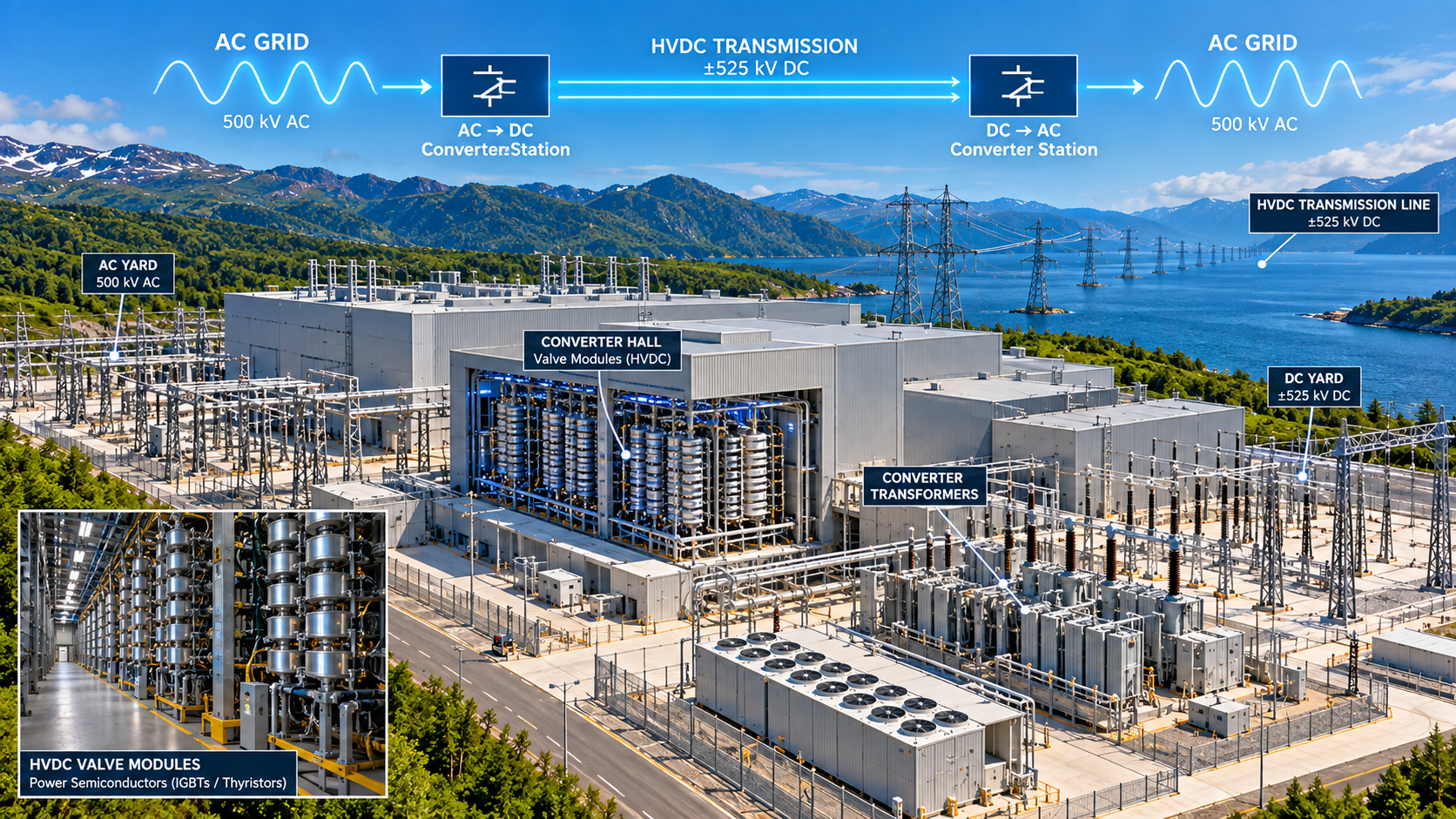
At each end sits one of the most sophisticated pieces of equipment in the power system: the converter station.
Its job is fundamental.
AC → DC → transmission → DC → AC
Inside the station, converter valves, transformers, reactors, filters, protection systems, cooling systems, controls, and communications operate together to control the transfer of enormous quantities of electrical power.
This is where HVDC intersects directly with the Power Electronics Supercycle.
Modern converter valves contain large numbers of semiconductor switching devices controlled by sophisticated digital systems. Instead of relying only on the passive electrical behavior of conductors and transformers, the transmission system can actively control power flow through converter control.
As converter ratings increase, the scale of the power electronics is increasing with them.
In August 2026, GE Vernova announced a VSC valve platform designed to support transmission of more than 3 GW at ±525 kV. Hitachi Energy, meanwhile, reported manufacturing a 750-MVA VSC transformer for China’s Gansu–Zhejiang ±800-kV project.
Power electronics are therefore moving far beyond the interfaces of individual solar, wind, and battery plants.
They are becoming part of the transmission system itself.
LCC and VSC: Two Different HVDC Architectures
Modern HVDC systems generally fall into two broad converter families.
Line-Commutated Converter HVDC, or LCC-HVDC, is a mature technology that has long been used for extremely large bulk-power transfers.
LCC systems use thyristor-based converter valves and rely on the surrounding AC system for commutation. They remain highly effective for transmitting very large quantities of power between strong AC systems.
But another architecture has become increasingly important.
Voltage-Source Converter HVDC, or VSC-HVDC, uses controllable semiconductor switching devices and provides substantially greater control flexibility.
VSC systems can independently control active and reactive power within equipment limits, operate with weaker AC systems than traditional LCC installations, and are particularly attractive for cable connections, offshore systems, and applications where compact converter stations or greater controllability are important.
The distinction matters because the growth of VSC-HVDC expands what a transmission link can do.
The converter is not simply transferring megawatts.
Its control system can influence voltage, reactive power, and the dynamic behavior of the connected AC systems.
That makes HVDC increasingly relevant not only to transmission capacity, but also to grid control.
SunZia Shows How Large VSC-HVDC Has Become
SunZia provides a striking example.
The project uses a ±525-kV bipolar VSC-HVDC system capable of transferring up to 3,000 MW across roughly 550 miles between New Mexico and Arizona.
The project connects large-scale wind generation in New Mexico with demand centers farther west.
But its significance goes beyond renewable-energy integration.
SunZia demonstrates that VSC technology has moved into the multi-gigawatt, long-distance transmission class historically associated more strongly with conventional bulk-power HVDC.
That changes the range of transmission problems engineers can consider solving with controllable converter-based infrastructure.
HVDC Can Bring Large Blocks of Power Directly to Constrained Load Centers
The Champlain Hudson Power Express illustrates another use case.
Rather than using an overhead transmission corridor, CHPE runs approximately 339 miles underground and underwater, including long sections through Lake Champlain and the Hudson and Harlem Rivers.
At its southern end, a converter station in Queens converts the DC power back to AC for injection into the New York City grid.
The system can deliver 1,250 MW from Québec into New York City and entered commercial operation in 2026.
That architecture highlights one of HVDC’s strategic advantages.
Large amounts of electricity can be moved through corridors where conventional overhead transmission may be difficult to build.
As electricity demand grows in major metropolitan areas and large new loads appear in constrained parts of the grid, the ability to bring substantial power into specific locations may become increasingly valuable.
HVDC does not eliminate the need for local AC transmission.
But it can create new pathways through which bulk power reaches that network.
Offshore Transmission Is Driving Another Wave of HVDC
The offshore grid presents an especially strong case for HVDC.
As offshore generation moves farther from shore and individual projects become larger, long subsea AC connections become increasingly challenging because of cable charging current and reactive-power requirements.
HVDC avoids that particular limitation.
Europe is therefore building a growing portfolio of large offshore and subsea HVDC links.
Britain’s planned Eastern Green Link 3 illustrates the scale involved. Major contracts announced in March 2026 cover a roughly 690-kilometer HVDC link, including approximately 580 kilometers offshore, connecting Scotland and England. Hitachi Energy is supplying the converter stations and NKT the cable system.
Projects like this begin to blur the traditional distinction between a transmission line and a controllable power-electronic system.
The cables carry the energy.
The converters determine how that energy interacts with the AC networks at either end.
HVDC Creates New Control Capabilities
One of HVDC’s most important characteristics is controllability.
The power transferred over an HVDC link can be actively regulated rather than being determined primarily by AC network impedances and phase angles.
Depending on converter technology and system design, HVDC controls can contribute to functions such as:
- active-power regulation,
- reactive-power control,
- AC-voltage support,
- oscillation damping,
- frequency-support functions,
- controlled power exchange between asynchronous systems,
- and restoration support.
These capabilities can make HVDC strategically useful in grids containing large amounts of inverter-based generation.
But they also introduce an important engineering reality.
The behavior of the transmission asset increasingly depends on control systems and software.
That is the same transition occurring elsewhere in the Power Electronics Supercycle.
More Controllability Also Means More Modeling
A converter capable of responding rapidly to grid conditions must be represented accurately in system studies.
That becomes increasingly important when multiple converter-based resources operate electrically close to one another.
HVDC converters can interact with wind plants, solar facilities, battery systems, STATCOMs, and other converter-connected equipment.
Some interactions may not be represented adequately in simplified positive-sequence models.
Electromagnetic-transient studies can therefore become important for evaluating converter controls, weak-grid conditions, and fast interactions.
NERC has been expanding its attention to EMT modeling and model quality for converter-dominated power systems. Its EMT working-group scope explicitly includes HVDC systems and FACTS devices among the technologies relevant to this work. In February 2026, FERC also approved NERC modeling standards that include responsibilities associated with HVDC facilities.
The transmission system is becoming more controllable.
It is also becoming more dependent on the accuracy of its models.
The Next Step May Be Multi-Terminal HVDC
Most existing HVDC systems are essentially point-to-point links.
Power enters a converter at one end, travels across the DC connection, and exits through another converter.
But a more ambitious architecture is possible.
Multi-terminal HVDC could connect several converter stations to a shared DC network.
Instead of individual point-to-point links, future systems could begin to resemble DC transmission networks capable of connecting multiple generation areas, load centers, and AC systems.
That possibility is particularly relevant to offshore transmission.
It is also technically difficult.
Protection of DC networks, fault interruption, converter coordination, control architecture, interoperability, and equipment cost all become more complicated as the system evolves beyond two terminals.
The U.S. Department of Energy is now explicitly targeting this challenge. Its 2026 DC-GRIDS program supports development of more compact and cost-effective DC transmission converters, including high-performance modular valves for multi-terminal HVDC systems and updated converter-substation technologies.
That is an important signal.
The research frontier is beginning to move from building individual HVDC links toward considering more networked DC infrastructure.
HVDC Is Also Becoming a Manufacturing Story
An HVDC expansion requires much more than transmission rights-of-way.
It requires:
- converter valves,
- high-voltage power semiconductors,
- converter transformers,
- reactors,
- submarine and underground cables,
- cooling systems,
- protection and control platforms,
- communications,
- specialized engineering,
- installation vessels and cable-laying capability,
- testing facilities,
- and long-term service expertise.
These are specialized industrial capabilities.
Eastern Green Link 3’s major converter and cable agreements alone total nearly £3 billion, illustrating the scale of the equipment and engineering supply chain behind a single large project.
As HVDC deployment expands, manufacturing capacity and engineering capability may therefore become as strategically important as project development.
The Power Electronics Supercycle is not merely creating demand for more semiconductor devices.
It is creating demand for entire industrial systems built around them.
HVDC Does Not Replace the AC Grid
It is easy to take the HVDC expansion story too far.
The future power system is not likely to become an all-DC transmission network.
AC transmission remains deeply embedded in the structure of modern power systems and offers enormous advantages for interconnected regional networks.
HVDC is better understood as an increasingly important complement.
AC networks can provide broad interconnected transmission.
HVDC corridors can move large blocks of power between selected locations with precise controllability.
The two systems can work together.
This mirrors a larger theme of the Power Electronics Supercycle.
The transition is not simply replacing old technologies with new ones.
It is creating hybrid electrical systems in which conventional equipment and increasingly sophisticated power-electronic systems operate together.
The Transmission System Is Becoming an Active Participant
For much of grid history, transmission infrastructure could be thought of primarily as the network that carried electricity between generation and load.
That description is becoming incomplete.
Modern HVDC systems can control the direction and magnitude of power flow, interact dynamically with AC grids, provide voltage and reactive-power support, connect asynchronous systems, and potentially become building blocks for future multi-terminal networks.
At the same time, their behavior increasingly depends on semiconductor devices, control algorithms, software, communications, and detailed models.
That makes HVDC much more than a story about building longer transmission lines.
It is part of a larger transformation in which the infrastructure that moves electricity is becoming increasingly controllable, programmable, and dependent on power electronics.
The global HVDC expansion is therefore another piece of the same transition reshaping generation, storage, and grid stability.
The Power Electronics Supercycle is reaching into the transmission system itself.
Previous in the Power Electronics Supercycle:
Part 3 — Why AI Data Centers Are Reshaping Grid Planning
Explore the Power Electronics Supercycle series
Next in the Power Electronics Supercycle:
Part 5 — STATCOMs, SVCs, and the New Age of Voltage Control