POWER ELECTRONICS SUPERCYCLE · PART 2 OF 9
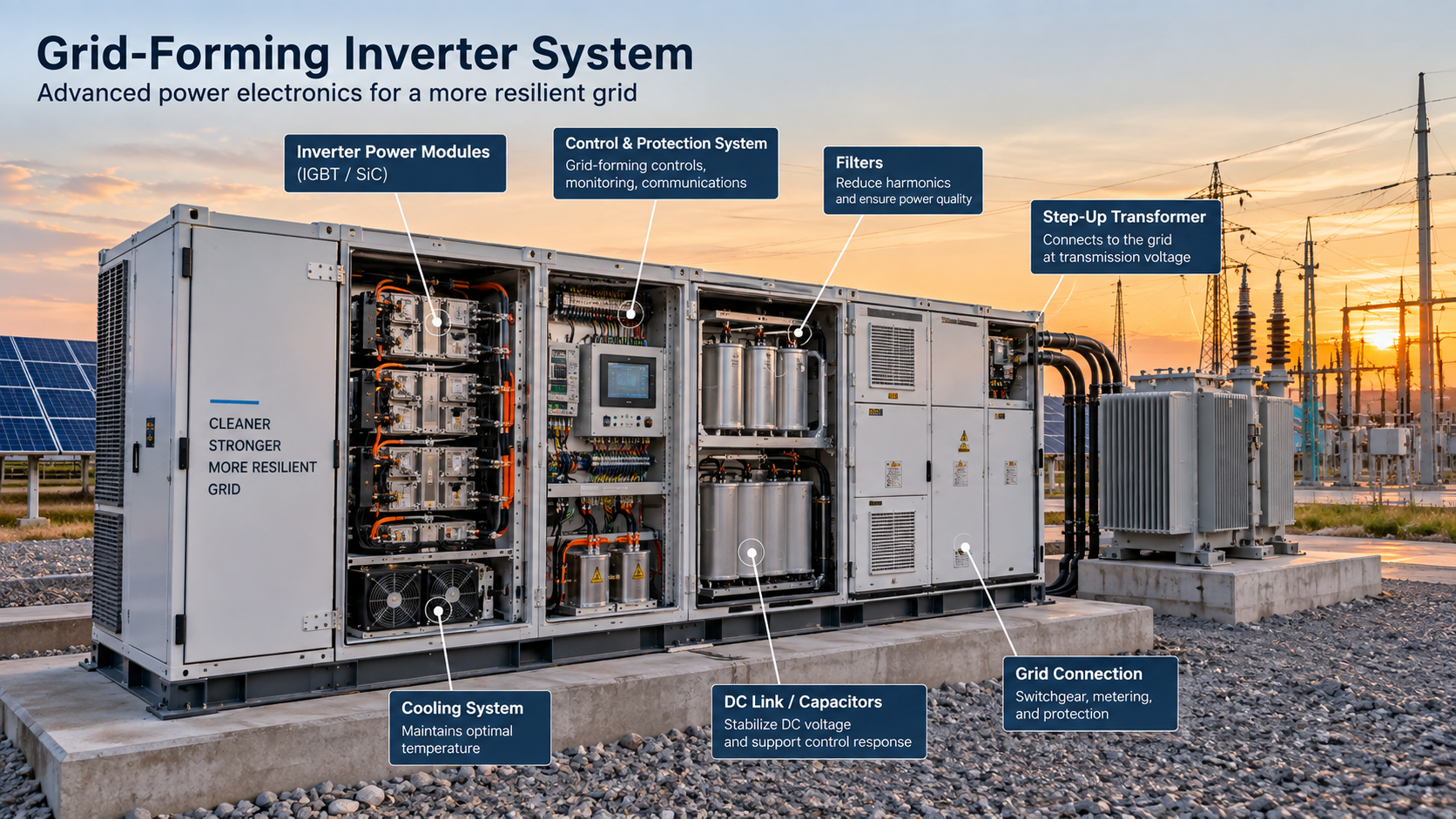
Grid-forming inverters are emerging as a critical technology for power systems with growing shares of inverter-based resources. Unlike conventional grid-following controls, they can establish voltage and frequency references and support stable operation in weaker grid conditions.
For more than a century, large rotating generators have done more than produce electricity. Through their physical characteristics and control systems, synchronous machines have helped establish system voltage and frequency, contributed inertia and fault current, and provided many of the fundamental behaviors on which power-system stability has traditionally depended.
As synchronous generation retires and inverter-based resources supply a larger share of electricity, that long-standing foundation begins to change. The central engineering question is no longer simply how much renewable generation the grid can accommodate, but how the system will maintain stable voltage, frequency, and dynamic performance when fewer rotating machines are online.
Grid-forming inverters are emerging as one answer to that challenge. Rather than depending entirely on an existing grid waveform, they can establish and regulate their own voltage waveform and respond actively to changes in system conditions. That distinction could make them an increasingly important part of maintaining stability in power systems with high levels of inverter-based generation and storage.
Why Traditional Inverters Are No Longer Enough
Most solar plants and battery energy storage systems installed over the past decade use grid-following inverters. These devices measure the voltage already present on the grid and synchronize their output to that waveform, commonly using a phase-locked loop. They perform well when connected to a sufficiently strong electrical system with stable voltage and frequency references.
As synchronous generation declines, however, the electrical environment can become more challenging. Lower system strength, reduced fault-current contribution, and a growing concentration of inverter-based resources can make conventional grid-following controls more difficult to coordinate and, in some conditions, more susceptible to adverse interactions.
In simple terms, grid-following inverters are designed to operate relative to an electrical reference that already exists. As fewer synchronous machines remain online, relying on other equipment to provide that reference becomes a more important system-level consideration.
Enter the Grid-Forming Inverter
Grid-forming inverters change that relationship.
Rather than simply following an existing voltage waveform, a grid-forming inverter controls its terminal voltage in a way that allows it to establish a voltage waveform and contribute to the electrical reference used by the surrounding system.
That capability allows properly designed grid-forming resources to provide functions that have traditionally been associated with synchronous generation, including voltage regulation, rapid active and reactive power response, frequency support, operation in weak electrical networks, and coordinated power sharing with other resources.
Grid-forming controls can also support applications such as islanded microgrids and, when the complete plant is designed appropriately, black-start and system-restoration functions.
The distinction is important. Grid-forming technology does not turn an inverter into a physical synchronous generator. It instead uses power electronics, stored or available energy, measurement systems, and high-speed controls to reproduce selected grid-supporting behaviors that rotating machines historically provided through a combination of electromagnetic physics, stored kinetic energy, and generator controls.
Software Is Becoming Part of the Power System
This transition represents a deeper change in the architecture of the electric grid.
In a conventional power system, many important dynamic characteristics originate from the physical properties of large rotating machines. In a converter-dominated system, an increasing portion of system behavior depends on control algorithms implemented inside power-electronic equipment.
Grid-forming controllers continuously measure electrical conditions and adjust voltage, phase, active power, and reactive power according to their control strategy and operating limits.
That means control design is becoming increasingly important to power-system stability.
Two inverter systems with similar power ratings and semiconductor hardware can behave differently during a disturbance because of differences in control architecture, tuning, current limiting, protection logic, and interaction with surrounding equipment.
As the grid becomes more dependent on power electronics, understanding the software and control systems inside those devices becomes increasingly important to understanding the behavior of the grid itself.
Virtual Synchronous Machines
One approach to grid-forming control is the Virtual Synchronous Machine, or VSM.
A VSM uses control algorithms designed to reproduce selected dynamic characteristics of synchronous machines. Depending on the implementation, these controls can provide inertia-like response, frequency-power behavior, voltage regulation, and other characteristics intended to make the converter interact with the grid in a machine-like manner.
But virtual inertia is not identical to the kinetic energy stored in the rotating mass of a conventional turbine-generator.
A synchronous generator inherently stores kinetic energy in its rotating components. An inverter must obtain energy from an available source—such as a battery, renewable-energy resource, or DC-link system—and its response remains constrained by the energy source, converter rating, current limits, and control strategy.
The distinction matters because grid-forming control is not simply a software replacement for every physical characteristic of a synchronous machine.
It is an engineered method of providing specific grid-support functions through a fundamentally different technology.
Where Grid-Forming Technology Is Emerging
Grid-forming technology has moved beyond laboratory research and is increasingly being demonstrated and deployed in real power systems.
Battery energy storage is particularly well suited to many grid-forming applications because batteries can rapidly absorb or inject power while the inverter controls its AC-side electrical behavior.
Utilities, system operators, manufacturers, and researchers are evaluating grid-forming controls across a growing range of applications, including utility-scale battery energy storage, renewable generation, weak-grid connections, remote and islanded systems, critical-infrastructure microgrids, and system-restoration applications.
The technology may become particularly valuable in regions where large amounts of inverter-based generation operate electrically far from strong synchronous generation.
In those systems, grid-forming capability is not simply another inverter feature. It can become part of the architecture used to maintain system strength and stable operation.
The Fault-Current Problem
One of the most important differences between inverter-based resources and synchronous generators appears during electrical faults.
Conventional synchronous generators can produce substantial short-circuit current because of their electromagnetic characteristics. Protection systems have historically relied on these fault-current characteristics to detect and isolate abnormal conditions.
Power-electronic converters operate differently.
Semiconductor devices have strict current limits, so inverter controls generally must constrain current during severe disturbances. A grid-forming inverter therefore cannot simply reproduce the fault-current behavior of a large synchronous generator.
As inverter penetration increases, protection philosophies may need to evolve alongside generation technology.
Utilities may increasingly depend on combinations of improved inverter controls, differential protection, communications-assisted schemes, traveling-wave methods, advanced relays, and other protection strategies designed for systems in which traditional assumptions about fault current no longer always apply.
The Multi-Inverter Stability Challenge
Another challenge appears when grid-forming technology scales from individual installations to large interconnected systems.
A future transmission network could contain hundreds or thousands of converters from different manufacturers, operating with different control architectures and connected through electrical networks with widely varying strength.
Each device may be stable when tested independently.
The more difficult question is what happens when all of them interact.
Control systems can interact through the electrical network across multiple timescales. Under certain conditions, those interactions can contribute to oscillations, control instability, or unexpected responses following disturbances.
This makes interoperability and coordination increasingly important.
The engineering problem is no longer simply whether one inverter can form a stable voltage waveform. It is whether large populations of power-electronic devices can collectively produce stable system behavior across a wide range of operating conditions.
Why EMT Modeling Is Becoming More Important
These interactions are also changing how engineers study the grid.
Traditional positive-sequence transient-stability tools remain essential for large-scale power-system planning, but some converter-driven phenomena occur at timescales or involve control details that those models are not designed to represent.
Electromagnetic transient, or EMT, simulation provides a much more detailed representation of converter controls, network electromagnetic behavior, switching-related phenomena, and fast interactions between devices.
As inverter penetration rises, utilities and system operators are increasingly using EMT studies alongside traditional planning tools for applications where detailed converter behavior materially affects the result.
That creates another consequence of the power-electronics transition: the computational model of the grid must evolve along with the physical grid.
The industry will need not only more sophisticated equipment, but better models, validated control representations, greater computing capability, and engineers capable of interpreting increasingly complex dynamic behavior.
Grid-Forming Inverters Are Part of a Larger Technology Shift
Grid-forming technology therefore represents more than a new control mode for batteries or renewable plants.
It is one component of a much larger transformation in how electrical energy is generated, transmitted, controlled, and stabilized.
The same transition is increasing the importance of advanced power semiconductors, utility-scale battery systems, HVDC converters, STATCOMs and other FACTS devices, digital protection systems, high-speed communications, synchrophasor measurements, and real-time simulation platforms.
These technologies increasingly interact with one another.
A battery equipped with grid-forming controls may support a weak transmission system. That system may also contain HVDC converters, renewable plants, STATCOMs, conventional generators, and sophisticated protection systems—all responding to the same disturbance within different timescales.
This is why the rise of grid-forming technology belongs within the broader Power Electronics Supercycle.
The transformation is not simply about replacing one type of generation with another.
It is about changing the underlying technology through which the power system establishes, controls, and protects its electrical state.
The Grid Will Be Hybrid
Grid-forming inverters are unlikely to eliminate synchronous machines.
The more plausible future is a hybrid grid.
Conventional generators, renewable resources, batteries, synchronous condensers, HVDC systems, FACTS devices, and multiple classes of grid-following and grid-forming converters will operate together across the same interconnected network.
The engineering challenge will be making these technologies behave as one coordinated power system.
That requires more than deploying additional hardware. It requires validated models, appropriate performance requirements, interoperable controls, improved protection strategies, detailed system studies, and a better understanding of interactions that may not have existed in the synchronous-machine-dominated grid.
The transition therefore changes the role of the power-system engineer as much as it changes the equipment.
Future grid stability will increasingly depend on understanding the intersection of power-system physics, power electronics, control theory, protection, communications, and software.
And that may ultimately be the most consequential aspect of grid-forming technology.
The grid is not losing physics.
It is gaining another layer of engineered behavior on top of it.
Previous in the Power Electronics Supercycle:
Part 1 — The Biggest Transformation of the Electric Grid Since AC Power
Explore the Power Electronics Supercycle series
Next in the Power Electronics Supercycle:
Part 3 — Why AI Data Centers Are Reshaping Grid Planning