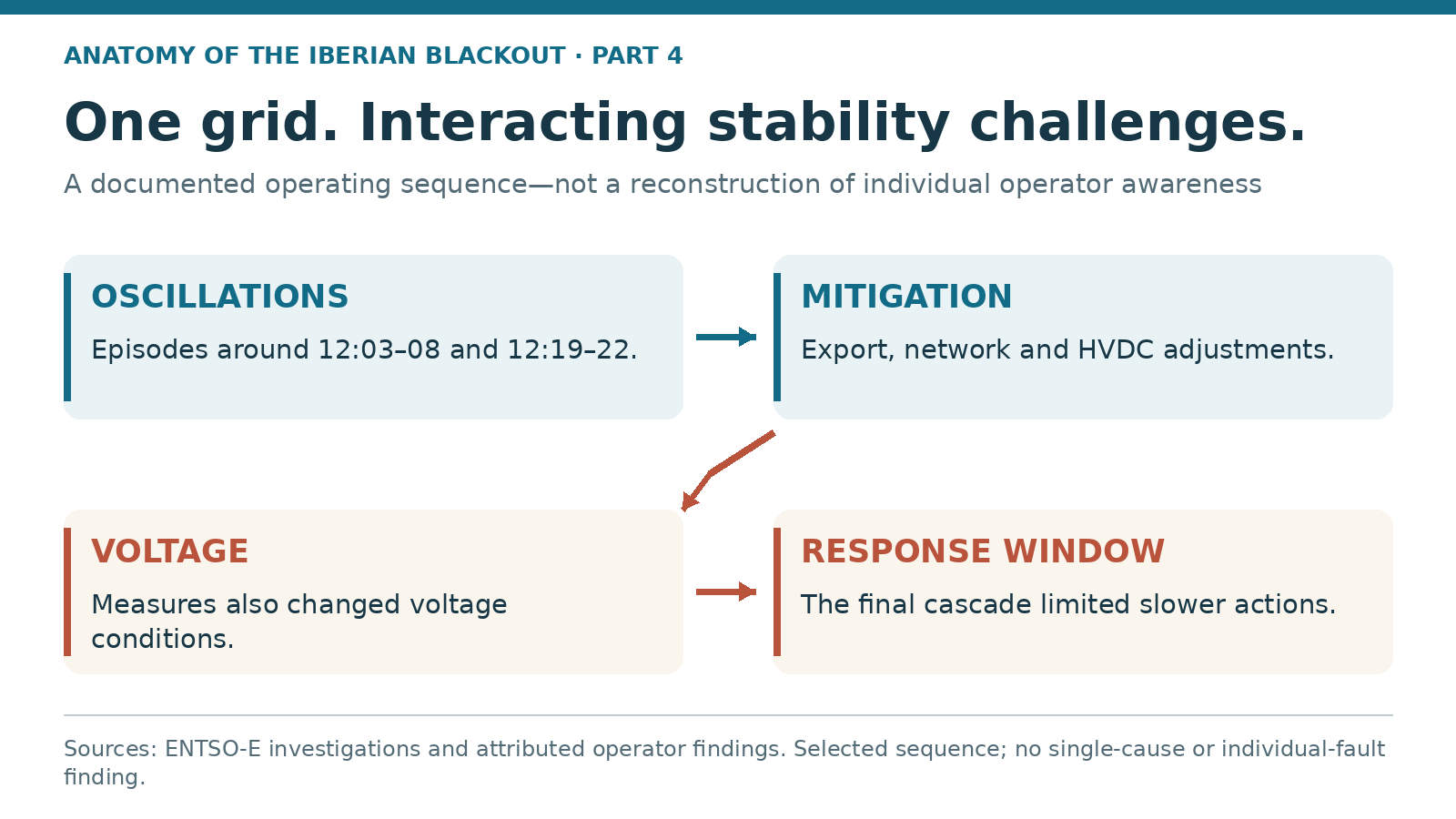
Selected documented operating sequence—not a reconstruction of individual operator awareness or a single-cause finding.
At 12:33 p.m. on April 28, 2025, the electricity systems of mainland Spain and Portugal collapsed.
The final sequence was extraordinarily fast.
Generation output fell, generating facilities disconnected, transmission voltages increased sharply, frequency deteriorated and the Iberian Peninsula lost synchronism with Continental Europe.
But the operational story began well before those final seconds.
Throughout the morning, transmission-system operators were managing a changing generation mix, international electricity exchanges, voltage-control requirements and unusual oscillatory behavior.
They had to maintain several forms of electrical stability simultaneously.
Actions taken to reduce oscillations could affect power flows and voltage. Equipment used to manage voltage could operate at different speeds. Generating units scheduled for voltage regulation did not necessarily deliver identical dynamic responses.
The April 28 blackout therefore raises a difficult question.
What did operators do before the collapse, and what does the investigation reveal about the limits of the tools and operating practices available to them?
The answer requires separating documented actions from conclusions reached only after the event.
1. The Control Room’s Fundamental Responsibility
A transmission-system operator must maintain the secure operation of an interconnected electricity network.
That responsibility involves far more than matching generation and consumption.
Operators must monitor system frequency, transmission voltages, active and reactive power flows, equipment availability, stability margins and international exchanges.
They must also ensure that sufficient resources are available to respond when conditions change.
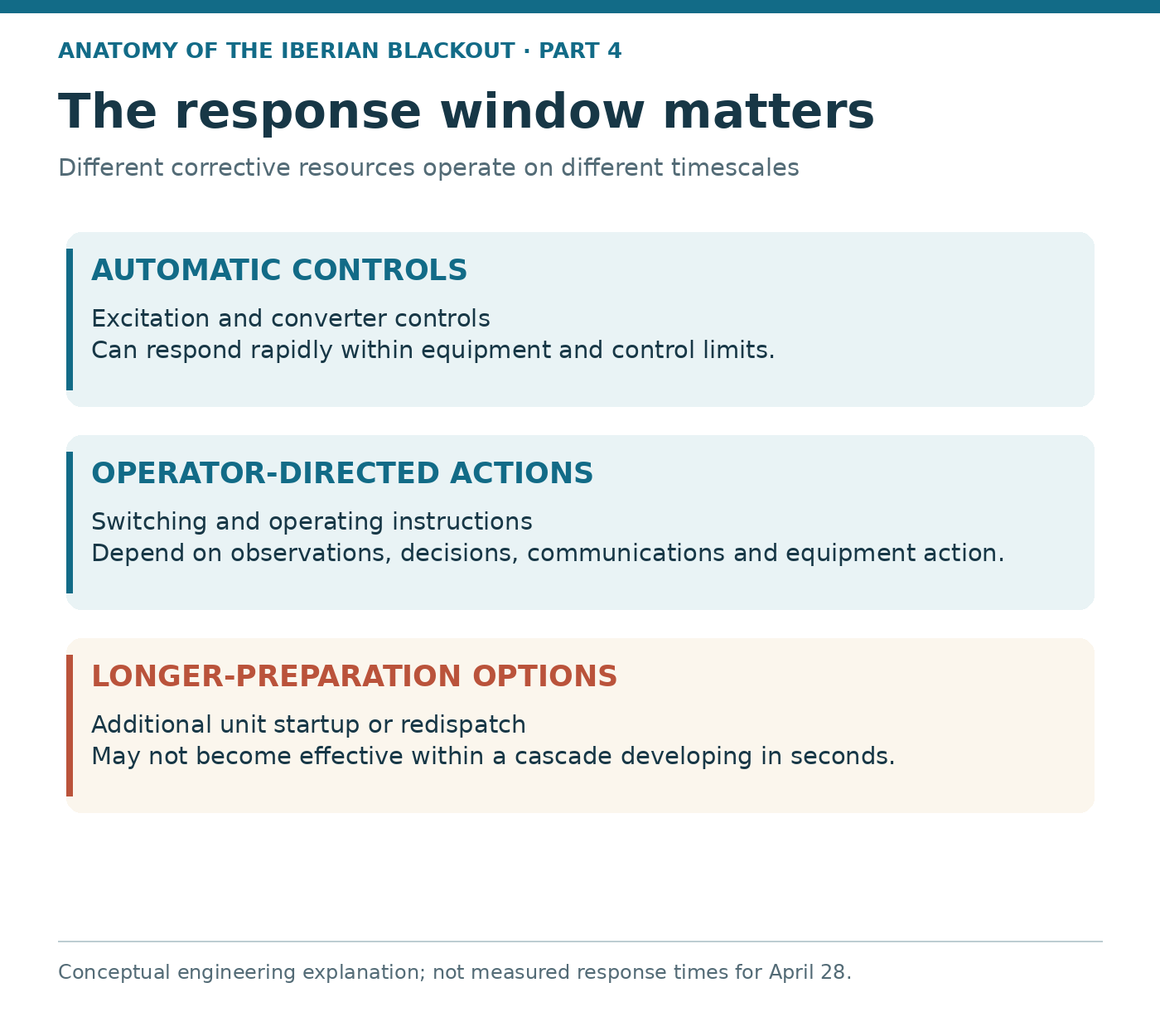
Some corrective actions are automatic.
Others require operator decisions, equipment switching, changes to generating-unit instructions or coordination with neighboring transmission-system operators.
These actions have different response times.
A generator’s excitation system may respond rapidly to voltage changes.
A shunt reactor may need to be switched.
Changing scheduled international power transfers can require redispatch or balancing actions.
Starting an additional generating unit may take much longer.
The speed of the developing disturbance therefore determines which operational options remain practical.
2. Preparing the System for April 28
Voltage-control capability is an essential part of daily system preparation.
Generators can supply or absorb reactive power within their operating limits.
Shunt reactors absorb reactive power and help control high transmission voltages.
Transformer controls, network switching and power-electronic equipment can also influence voltage conditions.
The operator must consider not merely whether this equipment exists, but whether it is available, appropriately located and capable of responding to expected operating conditions.
The Spanish government’s June 2025 investigation raised questions about the scheduling and availability of synchronous generating units providing dynamic voltage regulation.
According to the government, ten thermal generating plants had been scheduled for voltage-control service for April 28.
One scheduled unit subsequently became unavailable.
The government reported that the scheduling response left questions about the adequacy of dynamic voltage-control resources during the central hours of the day.
These findings are relevant because the ability to absorb reactive power can become particularly important when transmission voltages rise.
However, counting scheduled generating units is not sufficient to determine system security.
Their location, operating points, reactive-power limits, control modes and actual performance also matter.
The subsequent ENTSO-E investigation identified broader gaps in voltage and reactive-power control, demonstrating that the issue extended beyond a simple count of available generators.
3. The Morning Voltage Profile
According to Red Eléctrica’s June 2025 operator report, voltage conditions were relatively stable overnight.
During the morning, the operator observed greater voltage variability as electricity demand, generation and international transfers changed.
The operator’s report described voltage variations that remained within the relevant operating limits.
These observations require careful interpretation.
An increase in voltage variability does not automatically indicate an imminent blackout.
Transmission voltages routinely change with generation dispatch, network loading and reactive-power flows.
However, greater variability can increase the importance of monitoring, coordination and the availability of effective voltage-control resources.
The critical distinction is between a system remaining within prescribed voltage limits and a system retaining sufficient dynamic margin to withstand additional disturbances.
The April 28 event ultimately demonstrated why that distinction matters.
4. The First Major Oscillation
Around 12:03 p.m., the Iberian electricity system experienced a significant oscillatory episode.
ENTSO-E’s later investigation identified the first major episode as occurring approximately between 12:03 and 12:08.
The oscillation had a dominant frequency of approximately 0.63 Hz and primarily affected Spain and Portugal.
Oscillations involve repeated variations in electrical quantities such as power flows, voltage, frequency or rotor-angle relationships.
They can arise from different mechanisms, including interactions between generating equipment, control systems and the interconnected transmission network.
An oscillation does not necessarily mean that the system is about to collapse.
But a sufficiently pronounced or poorly damped oscillation can require immediate corrective action.
The operators’ first objective was to reduce the oscillatory behavior and restore more secure conditions.
5. The Measures Taken to Dampen Oscillations
ENTSO-E’s factual investigation documented several types of operational intervention by the relevant transmission-system operators.
These included reducing exports from Spain to France, coupling internal transmission lines in southern Spain and changing the operating mode of the France–Spain HVDC interconnection.
Red Eléctrica’s own report provides additional detail about its operating response.
According to that report, measures following the first oscillation included coupling 400 kV transmission lines to reduce network impedance, reducing scheduled exports to France and changing the HVDC link to constant-power operation.
The operator also described changes involving shunt reactors during periods when oscillations were accompanied by lower voltages.
The objective of these actions was to improve oscillation damping and manage the immediate electrical disturbance.
The measures reduced the oscillatory behavior.
But they also changed the electrical conditions under which the network subsequently operated.
This interaction became central to the investigation.
6. Why Oscillation Mitigation Could Increase Voltage
Transmission-system stability involves multiple interconnected physical processes.
Changing active-power flows can alter the loading of transmission lines.
Those changes affect reactive-power balance and voltage.
Coupling transmission lines can change network impedance and the distribution of power flows.
Changing international exchanges can reduce loading on particular transmission paths.
Switching a shunt reactor changes the amount of reactive power absorbed from the system.
Consequently, a measure that improves oscillation damping can also affect voltage.
ENTSO-E’s factual report concluded that the oscillation-mitigation measures contributed to higher voltage conditions in the Iberian network.
This does not mean that mitigating the oscillations was inherently the wrong objective.
Oscillations can themselves threaten secure system operation.
The engineering challenge is to ensure that an action taken to improve one stability condition does not leave the system without sufficient capability to manage another.
The blackout exposed the importance of coordinated oscillation and voltage-control strategies.
7. The Second Oscillation and Further Interventions
A second major oscillatory episode occurred around 12:19–12:22.
ENTSO-E identified it as an inter-area oscillation with a dominant frequency of approximately 0.21 Hz, associated with the Continental European East–Centre–West mode.
Inter-area oscillations involve the dynamic interaction of geographically separated parts of an interconnected power system.
They can affect transmission exchanges and system frequency over large regions.
Operators again implemented measures to improve damping.
The operator’s June 2025 report described additional adjustments involving transmission-line configuration and scheduled exports.
It reported reductions in export exchanges with France and Portugal as part of the response.
The same report explained that these measures tended to increase voltage because they reduced transmission loading and affected reactive-power absorption.
By approximately 12:22, the second major oscillation had subsided.
The operational problem was therefore changing.
The immediate oscillation had been reduced, but voltage management had become increasingly important.
8. The Role of Shunt Reactors
Shunt reactors are used to absorb reactive power and control high transmission voltages.
Their importance is especially evident in high-voltage networks where line capacitance can contribute to voltage increases.
When voltages are low, disconnecting a reactor can help relieve downward voltage pressure.
When voltages are high, connecting additional reactors can increase reactive-power absorption.
The difficulty is that these actions may require switching operations and coordination with other voltage-control resources.
Red Eléctrica’s June 2025 report described reactor disconnections during the oscillatory episodes, when voltage reductions were observed.
It also described subsequent efforts to connect reactors as voltage conditions changed.
The important engineering issue is the transition between these operating conditions.
Equipment that was appropriately disconnected to address a low-voltage condition may need to be returned to service when voltage rises.
The available response time becomes critical.
A system in which important voltage-control actions depend on manual switching may have less flexibility during a rapidly developing disturbance than one equipped with sufficient fast, coordinated dynamic control.
This is an engineering implication of the documented operating sequence, not a finding that any particular operator deliberately failed to act.
9. The Limits of Generator Voltage Regulation
Generating facilities are important sources of voltage-control capability.
But their actual response depends on technology, control configuration and operating requirements.
Synchronous generators can adjust reactive-power output through their excitation systems within equipment limits.
Inverter-based generators can also provide reactive-power control, but their response depends on the capabilities and control modes required and enabled at the connection point.
Some generating facilities may operate under fixed power-factor requirements rather than continuously regulating voltage in response to changing network conditions.
Under fixed power-factor operation, a reduction in active-power output can also reduce reactive-power absorption.
That relationship matters when transmission voltage is rising.
If generating units reduce active power and simultaneously absorb less reactive power, the change can contribute to higher network voltage.
ENTSO-E’s final investigation identified differences in voltage-regulation practices and gaps in reactive-power control among the factors contributing to the blackout.
The implication is that voltage-control adequacy cannot be judged solely by the installed megawatt capacity of the generation fleet.
The dynamic behavior of connected resources is equally important.
10. What Operators Could See—and What Remains Unknown
Transmission-system operators use supervisory control systems, state estimation, disturbance monitoring and other tools to observe grid conditions.
Phasor measurement units can provide high-resolution information about oscillations and electrical dynamics.
Red Eléctrica’s report described the use of monitoring systems to identify oscillatory behavior during the morning.
However, the existence of a measurement in a post-event investigation does not establish that every operator saw that measurement in real time.
A complete reconstruction of control-room awareness would require detailed records of alarms, screen displays, communications, operating instructions and the timing of decisions.
The public investigations provide substantial information about system measurements and operating actions.
They do not justify inventing a complete minute-by-minute account of what each individual operator personally observed or believed.
This limitation is important when evaluating the adequacy of decisions.
Retrospective investigators can combine measurements from many sources that may not have been available in the same form during the event.
The distinction between information available in real time and information assembled after the blackout must be preserved.
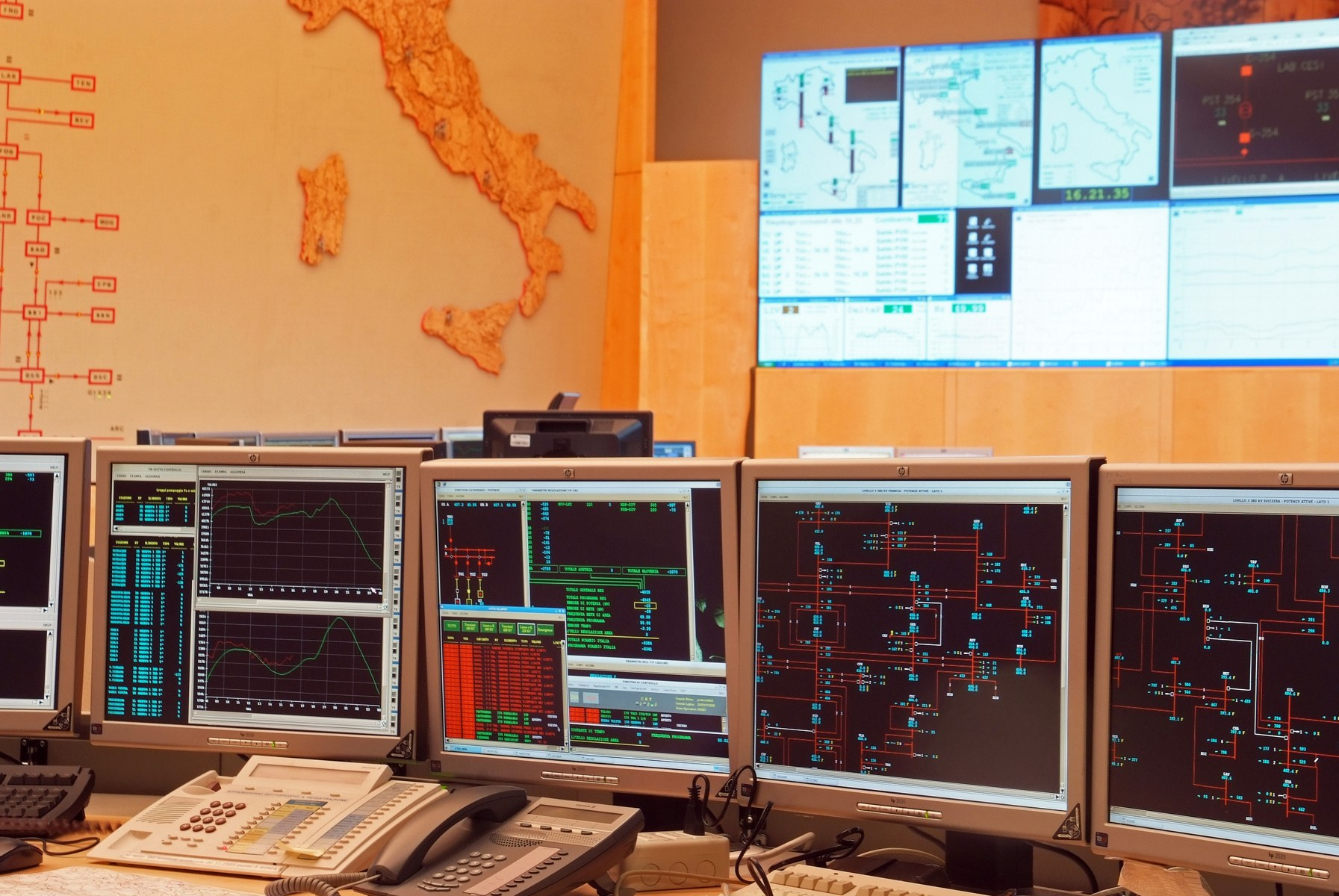
Terna’s National Control Center in Italy, photographed in 2010. Photo: Terna S.p.A. / Wikimedia Commons, CC BY-SA 3.0. Resized for publication under the same license. Context photograph; not the Red Eléctrica control room or a record of April 28, 2025.

11. The Narrowing Window for Corrective Action
After the second oscillation subsided, operators faced changing voltage conditions.
Corrective options could include reactive-power adjustments, reactor switching, generator instructions, changes to network configuration and other established operating measures.
But those options do not operate on the same timescale.
Some equipment can respond automatically within fractions of a second.
Other actions depend on communications, dispatch decisions or mechanical switching.
Still others require longer preparation or startup times.
When the final cascade began around 12:32, the time available for effective intervention became extremely limited.
Generation-output reductions and disconnections were followed by rapid voltage increases and additional trips.
Within roughly a minute, the disturbance progressed toward loss of synchronism and widespread system collapse.
No manually coordinated response can be assumed capable of stopping a cascade that develops faster than the action can be implemented.
This makes pre-event system preparation, automatic controls and protection coordination essential.
12. What the Final Investigation Concluded
ENTSO-E’s March 2026 final investigation did not attribute the blackout to a single isolated operating action.
Instead, it identified a combination of interacting factors.
These included oscillations, gaps in voltage and reactive-power control, differences in voltage-regulation practices, rapid reductions in generation output, generator disconnections and uneven stabilization capabilities.
The investigation also identified the need for improved operational practices, system monitoring, coordination and information exchange.
Those findings are more useful than a simplified narrative that blames a single operator decision.
The actions taken to damp oscillations were part of a broader sequence involving network conditions, generator behavior and available voltage-control resources.
Understanding that sequence is necessary for developing effective reliability improvements.
13. The Difference Between an Operational Error and a System Weakness
A power-system disturbance can reveal several different types of shortcomings.
An individual operating action may be inconsistent with an established procedure.
A procedure may be followed correctly but fail to account for an unusual combination of conditions.
Equipment may not deliver the performance expected by the operator.
A regulatory framework may permit operating modes that provide insufficient dynamic support under certain circumstances.
These possibilities require different corrective measures.
The Iberian investigation identified interactions among operating practices, equipment behavior and voltage-control requirements.
It would therefore be premature to interpret every adverse electrical consequence as proof of an individual operating error.
Equally, it would be inappropriate to assume that following existing procedures necessarily means the overall system was adequately protected.
A rigorous investigation must evaluate both the actions taken and the engineering framework within which those actions occurred.
14. What Future Control Rooms Need
The blackout offers several lessons for the design and operation of modern transmission control centers.
First, oscillation damping and voltage management must be coordinated.
Operators need to understand how actions that improve damping will affect reactive-power balance and voltage margins.
Second, dynamic voltage-control resources must be available before a rapidly developing disturbance.
A system cannot rely exclusively on equipment that requires lengthy manual intervention.
Third, generating facilities must provide the control behavior required by system conditions.
Reactive-power capability, operating modes and protection settings should be coordinated with transmission-system needs.
Fourth, monitoring systems must help operators interpret interactions among different stability mechanisms.
Observing an oscillation or voltage trend is only the beginning. Operators also need actionable information about system margins and the likely consequences of corrective measures.
Fifth, cross-border coordination remains essential.
An interconnected system can experience disturbances that require simultaneous actions by multiple transmission-system operators.
These are engineering implications consistent with the final investigation’s recommendations, not claims that every measure would independently have prevented the April 28 blackout.
15. A Broader Lesson About Modern Grid Operation
The Iberian blackout demonstrates that power-system reliability depends on the interaction of physical equipment, automatic controls, operating procedures and human decisions.
Operators were managing a complex network with changing generation and transmission conditions.
They took actions to address observed oscillations.
Those actions had consequences for voltage.
As the system entered the final disturbance, generation reductions and disconnections interacted with insufficiently effective voltage regulation.
The result was a cascade that developed too quickly for slower corrective measures to contain.
The central lesson is not that control-room decisions are unimportant.
It is that control-room decisions must be supported by a system designed to remain stable across multiple interacting disturbances.
Reliable operation requires adequate dynamic resources, appropriate equipment behavior, well-coordinated procedures and timely information.
The April 28 blackout showed what can happen when those elements do not provide sufficient collective resilience.
Next in the series:
Part 5 — Why the Defences Failed: Protection, Reactive Power and Restoration
An engineering examination of generator protection, voltage-control capability, emergency defence systems and the restoration of the Iberian electricity network.
Source note: ENTSO-E final investigation · ENTSO-E factual report · Red Eléctrica operator report (hosted copy) · Final-report announcement · Government of Spain.
Previous: Part 3 — The Final 90 Seconds · Explore the series