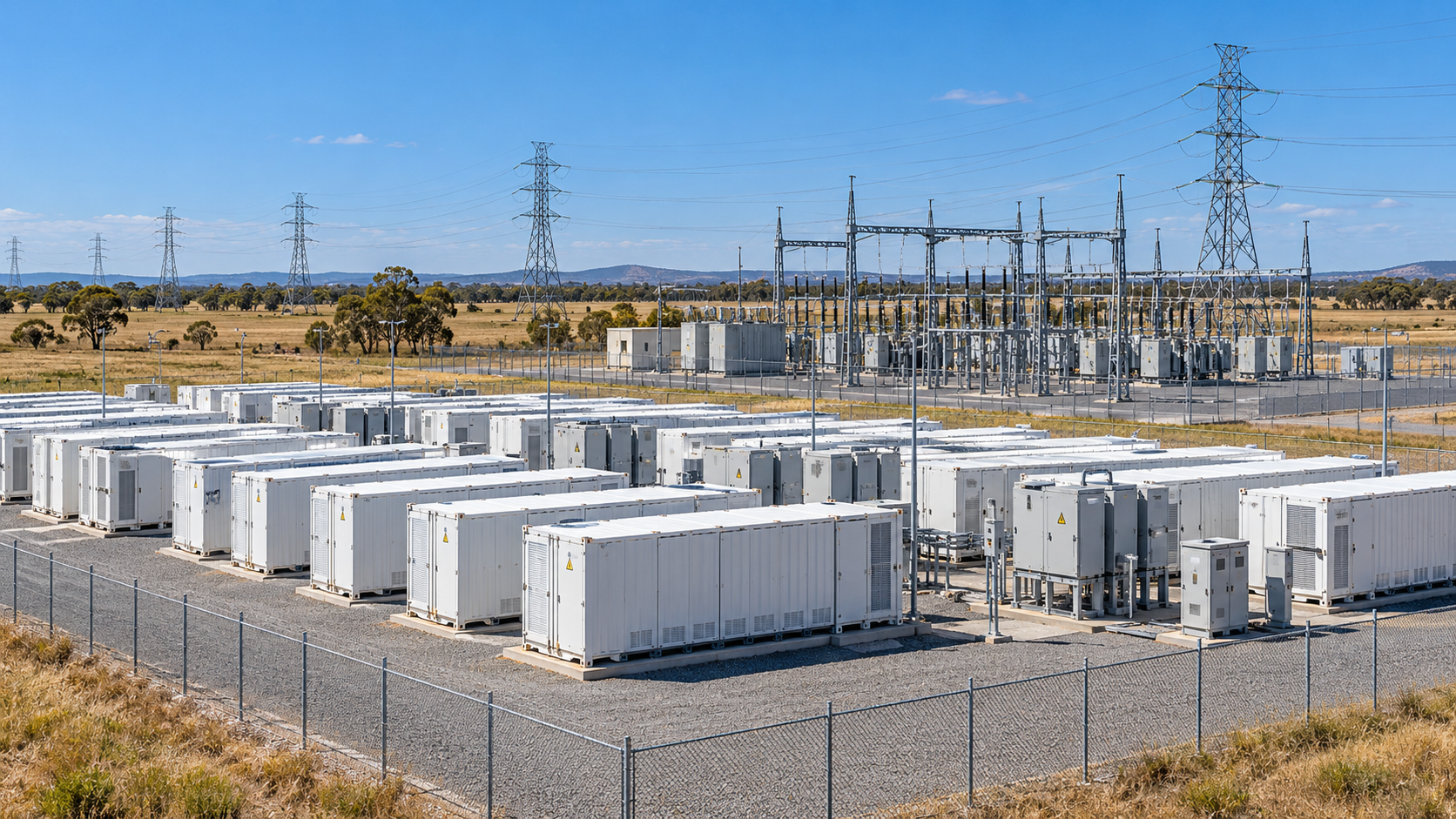
Editorial illustration of battery storage and grid infrastructure; not an identified project.
Grid-scale batteries supplied more evening electricity than gas-fired generation in Australia’s National Electricity Market during the September quarter of 2026, according to AEMO’s Quarterly Energy Dynamics report.
Between 4 p.m. and 9 p.m., batteries accounted for 8.0% of total supply, compared with 5.1% from gas. AEMO identifies this as the first quarter in which batteries exceeded gas during that period. The comparison covers the NEM, rather than every Australian electricity system.
The report also records increased movement of battery energy from daytime charging into evening discharge. Renewable sources supplied 44.3% of total NEM generation over the quarter; that quarterly share is a separate measure from the evening battery contribution.
Why it matters for grid operations
The result illustrates the distinction between installing storage and using it to shift energy into a recurring demand period. Energy dispatch provides an operating measure of what batteries supplied, while nameplate power and energy ratings describe equipment capability.
Reliability assessment must also consider state of charge, storage duration, inverter controls and the electrical conditions at each connection. A larger energy contribution does not demonstrate that batteries have replaced every frequency, voltage, protection or restoration function associated with synchronous generation.
What to watch next
Subsequent dispatch data and technical performance assessments will help show how consistently storage contributes when conditions are stressed. The Power Electronics Supercycle examines the converter and control questions behind that integration.