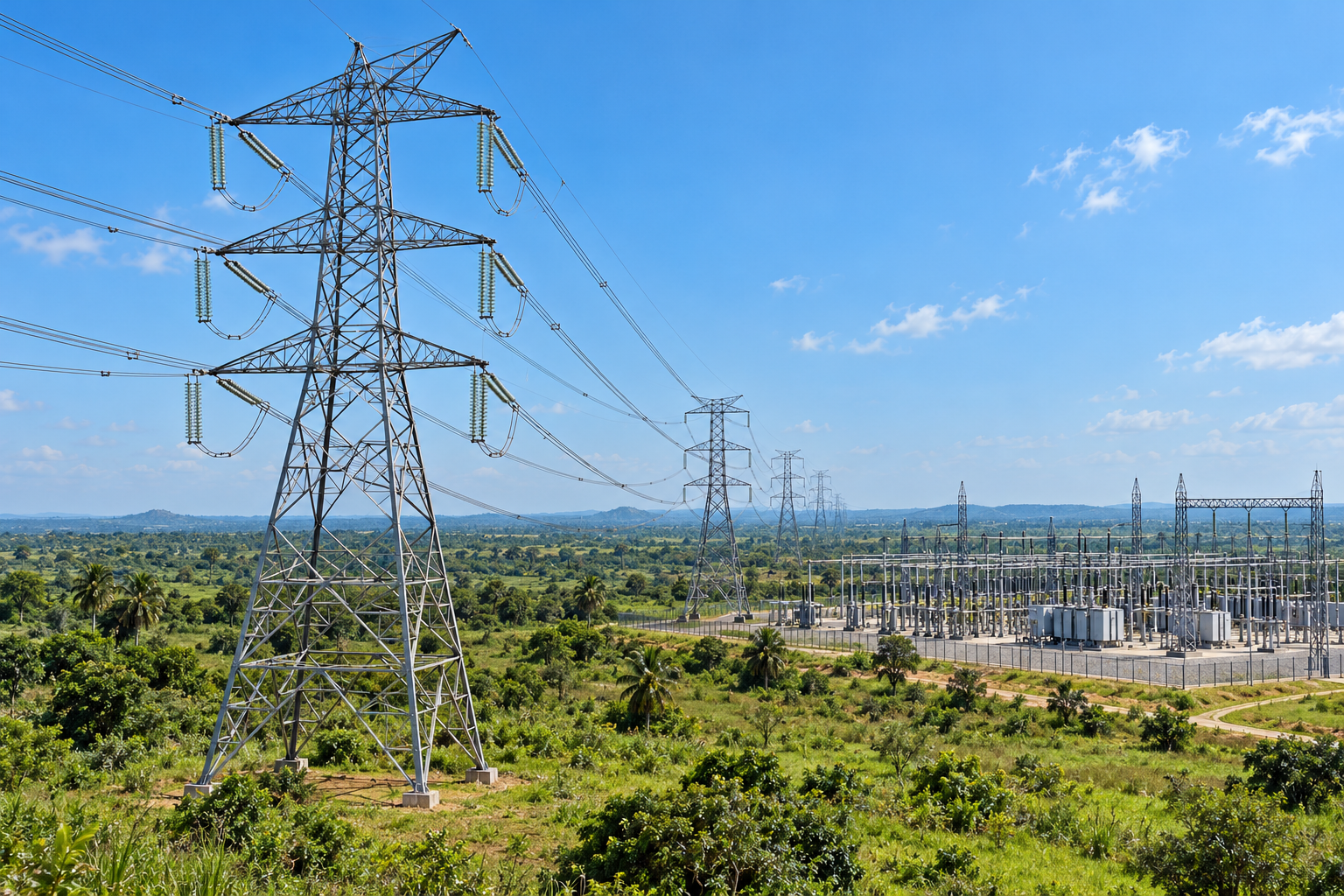
Editorial illustration of high-voltage transmission infrastructure; not a photograph of the October 19 disturbance.
Multiple trips on Nigeria’s 330-kV transmission network coincided with a dramatic fall in reported electricity generation. The system operator says the disturbance was partial, raising an important engineering question about what the numbers reveal—and what they do not.
On the morning of October 19, 2026, Nigeria’s electricity grid was reporting approximately 3,840 megawatts of generation.
By 1 p.m., that figure had fallen to just 476.70 megawatts.
The difference was extraordinary.
More than 3,360 megawatts separated the two readings, representing a decline of approximately 87.6%.
Electricity outages were reported in parts of the country, while several major generating stations showed no output on the national grid.
Yet Nigeria’s system operator rejected reports that the entire electricity system had collapsed.
The Nigerian Independent System Operator, or NISO, said multiple trips occurred on the country’s 330-kilovolt transmission network at approximately 12:40 p.m. The disturbance, it said, affected only a section of the network.
Working with the Transmission Company of Nigeria, the operator subsequently implemented corrective measures and reported that normal grid operations had been restored.
The incident presents a question that extends beyond Nigeria.
How can a power system experience such a dramatic reduction in reported generation without necessarily suffering a complete nationwide collapse?
Answering that question requires understanding what happens inside an interconnected electricity network when transmission lines, generating stations and protection systems respond to a disturbance.
It also requires distinguishing what is known from what has not yet been established.
A Sharp Decline in Electricity Generation
The first indication of the disturbance came through operational generation figures.
Data attributed to NISO’s monitoring portal showed approximately 3,840 MW of generation at 7 a.m.
Around 12:40 p.m., multiple trips occurred on the 330-kV transmission network.
By 1 p.m., reported generation had fallen to 476.70 MW.
Several major power stations, including Egbin, Jebba, Shiroro and Kainji, were reported to have no output on the grid at that time.
Other facilities continued generating electricity.
These observations establish that a severe disruption occurred.
But they do not, by themselves, establish the sequence of electrical events.
The 3,840 MW and 476.70 MW readings were taken six hours apart.
Although the sharp decline was reported to have begun around the time of the transmission disturbance, the difference between those readings should not be interpreted as a precisely measured instantaneous generation trip.
Determining the actual sequence would require higher-resolution operating records showing how individual generators, transmission lines and substations responded.
That distinction is essential to a credible technical investigation.
Why Transmission Disturbances Can Affect Generation
Nigeria’s 330-kV transmission network forms a major part of the country’s bulk electricity system.
It connects generating stations with substations and other parts of the network, allowing electricity to move between regions.
The system depends on continuous coordination between generation and demand.
When a transmission line experiences a fault, protective relays may command circuit breakers to disconnect the affected equipment.
That action is intended to isolate the fault and prevent damage.
But disconnecting a major transmission element can change the electrical conditions across the surrounding network.
Power that previously flowed through one corridor may be redistributed onto other lines.
Voltage conditions can change.
Generating stations may experience altered electrical loading.
If the disturbance is severe enough, additional protection systems may operate.
In an interconnected network, a disturbance originating at one location can therefore have consequences elsewhere.
This does not mean that every transmission trip produces a cascade.
Power systems are designed to withstand many individual equipment outages.
The outcome depends on the network configuration, the amount of power being transferred, available operating reserves, protection settings and the severity of the initiating event.
In Nigeria’s October 19 incident, NISO confirmed multiple trips on the 330-kV network.
However, the specific lines involved, the initiating event and the sequence of subsequent operations have not been established in the public information reviewed.
It would be premature to conclude that a particular line fault caused a cascading failure.
A Partial Disturbance Can Still Be Severe
The term grid collapse is often used broadly in public reporting.
In power-system engineering, the distinction between a partial disturbance and a complete system collapse matters.
A complete collapse generally involves loss of stable electrical operation across the entire interconnected system.
A partial collapse or disturbance may affect only certain areas or electrical sections, while other portions of the network continue operating.
A severe disturbance can also cause a network to separate into electrically isolated sections, sometimes called islands.
Some islands may remain stable if their generation and demand can be balanced.
Others may experience frequency or voltage conditions that cause additional equipment to disconnect.
Whether this occurred in Nigeria on October 19 is not yet known.
NISO specifically stated that the incident affected only part of the grid.
The continued output of some generating stations is consistent with the possibility that portions of the electricity system remained energized.
But it does not independently establish the precise extent of the disturbance.
A generation total alone cannot show which transmission sections remained connected, which customers lost electricity or whether the network separated into islands.
Those questions require detailed operating records.
A system can avoid a complete nationwide collapse while still experiencing a major reliability event.
That is why both the operator’s classification and the magnitude of the reported generation decline deserve careful examination.
The Role of Frequency and Generator Protection
One of the most important variables during a major grid disturbance is system frequency.
In a synchronized alternating-current network, frequency reflects the dynamic balance between electrical generation and consumption.
When generation becomes insufficient relative to demand, frequency tends to decline.
When generation exceeds demand, frequency tends to rise.
Large imbalances can produce rapid frequency changes.
Generating units and other electrical equipment have protection systems designed to respond when operating conditions move outside acceptable limits.
Under severe conditions, those protections may disconnect equipment to prevent damage.
This can create a difficult situation.
If generation disconnects while the system is already experiencing a shortage, the imbalance can become more severe.
Additional units may then disconnect.
Under some circumstances, the process can contribute to a cascading disturbance.
Nigeria’s electricity regulator has previously described the importance of frequency control and generator protection in maintaining grid stability.
But the publicly available account of the October 19 event does not establish that frequency instability caused the observed generation decline.
No verified event-specific frequency trace, rate-of-change record or generator protection sequence was available in the materials reviewed.
Frequency instability is therefore a mechanism that investigators should examine—not a confirmed explanation.
What Protection-System Records Could Reveal
A complete technical investigation would begin with the sequence of events.
Which transmission element tripped first?
What protection relay operated?
Was the initiating event a short circuit, equipment failure or another abnormal condition?
Did neighboring transmission elements trip because of faults, overloads or protection operations?
Which generating units disconnected, and what conditions caused their protection systems to operate?
The answers would help establish whether the event was confined to a particular electrical region or propagated through a larger portion of the system.
Protection relays and disturbance recorders can provide valuable evidence.
They may record voltage and current waveforms, fault indications, breaker operations and timestamps.
System-control records can show changes in generation, frequency and power flows.
Together, these records can help engineers reconstruct the sequence of events.
Accurate time synchronization is particularly important.
If events occur within seconds of one another, their order may determine whether an equipment trip was the initiating cause or a consequence of an earlier disturbance.
This is why a list of disconnected power stations is not sufficient to identify the root cause.
A generating unit that stopped producing electricity may have responded correctly to an abnormal grid condition.
Alternatively, a protection or control problem may have contributed to the event.
Only the underlying records can distinguish those possibilities.
Why Generation Data Alone Can Be Misleading
The reported fall in generation is the most striking numerical feature of the incident.
But generation data must be interpreted carefully.
A system-wide total is a useful indicator of how much electricity is being produced by generating stations reporting to the monitoring system.
It is not a complete representation of the electrical network.
It does not show the geographic distribution of interrupted demand.
It does not reveal whether individual transmission corridors remain energized.
It does not identify the condition of every substation.
And it does not necessarily capture electricity supplied through independent or captive generation outside the reported grid total.
Measurement and communication systems also have limitations.
If telemetry becomes unavailable during a disturbance, operators must distinguish missing measurements from actual changes in equipment output.
There is no verified evidence that a telemetry problem explains Nigeria’s October 19 generation figures.
Nevertheless, confirming measurement integrity is a normal part of reconstructing a major event.
The important point is that the severity of a power-system disturbance cannot be established from one metric alone.
A credible assessment combines generation records with frequency, voltage, network topology, protection operations and interrupted customer load.
Restoration Is More Than Restarting Generation
Following the disturbance, NISO reported that it had worked with the Transmission Company of Nigeria to stabilize the network and restore normal operations.
That is an important operational development.
Restoring a disturbed electricity system can involve several coordinated actions.
Operators may need to verify the condition of transmission equipment.
Disconnected lines and substations may require inspection or testing before re-energization.
Generating stations must be synchronized or returned to service under suitable electrical conditions.
Voltage and frequency must remain within acceptable operating limits.
Customer demand may need to be restored progressively to avoid creating additional instability.
The exact restoration sequence depends on the nature of the disturbance.
The public information reviewed does not provide a detailed timeline showing when each affected generating station or customer area returned to service.
Nor does the operator’s announcement that the grid had returned to normal operation establish that every customer immediately regained electricity.
Transmission-system restoration and complete customer-service restoration are related but distinct milestones.
For an engineering investigation, both should be measured.
Nigeria’s Wider Reliability Challenge
The October 19 event occurred against a background of recurring concerns about the reliability of Nigeria’s interconnected electricity system.
The Nigerian Electricity Regulatory Commission has previously documented major system disturbances, including a full collapse in September 2025.
That history makes the latest incident significant.
But previous disturbances should not be treated as proof that the same failure mechanism occurred again.
Each event requires its own technical reconstruction.
Power-system reliability depends on several interacting capabilities.
Transmission infrastructure must be able to carry required power flows.
Generating stations must operate reliably.
Protection systems must isolate faults selectively.
System operators need accurate real-time information.
Frequency and voltage control must remain effective across changing operating conditions.
And restoration procedures must allow the network to recover safely when disturbances occur.
Improving one of these capabilities does not automatically solve problems in the others.
A stronger transmission network may reduce exposure to certain outages, but it does not eliminate generator protection or frequency-control challenges.
Better monitoring may improve situational awareness, but it cannot substitute for adequate physical infrastructure.
Reliable operation requires coordinated improvements across the entire system.
The Engineering Questions That Remain
The October 19 disturbance leaves several important questions unanswered.
The first is the initiating event.
The second is the sequence of transmission and generation trips.
The third is the electrical extent of the disturbance.
The fourth is the relationship between the reported generation decline and the amount of customer load actually interrupted.
The fifth is whether protection systems and operating procedures performed as intended.
These questions are answerable in principle.
They require the appropriate operational records and a detailed engineering investigation.
Until those findings are available, any definitive explanation of the event would be speculative.
That does not diminish the significance of what has already been reported.
The reduction in generation was substantial.
Multiple transmission trips occurred.
Several major generating stations showed zero output.
Electricity supply was disrupted in parts of the country.
And the system operator reported successful restoration while rejecting the characterization of a complete national collapse.
Together, those facts describe a serious power-system disturbance whose underlying mechanism remains unresolved.
The Difference Between Reporting an Outage and Understanding One
Major electricity disturbances often produce dramatic headlines.
A grid collapses.
Generation disappears.
Cities lose power.
Those descriptions can convey the seriousness of an event, but they do not necessarily explain what happened inside the electrical system.
Power-system engineering requires a more precise account.
A transmission fault is not the same as a generator trip.
A generator trip is not the same as interrupted customer load.
A partial network disturbance is not necessarily a complete system collapse.
And a large change in reported generation does not, by itself, establish the cause or geographic extent of an event.
Nigeria’s October 19 disturbance illustrates why those distinctions matter.
The available evidence supports the conclusion that a major disruption occurred on the high-voltage network, accompanied by an extraordinary decline in reported generation.
It does not yet establish the initiating failure or the full sequence of events.
The most important unanswered question is not simply how much generation disappeared.
It is what happened across the interconnected system that allowed such a large disturbance to develop—and what the operational evidence reveals about preventing a recurrence.