POWER ELECTRONICS SUPERCYCLE · PART 3 OF 9
Artificial intelligence is rapidly becoming one of the most consequential new drivers of electricity demand in the United States.
The challenge is not simply the amount of electricity data centers consume. Increasingly, grid planners must consider where these very large loads connect, how quickly they arrive, how they behave during disturbances, and what transmission, generation, substations, and control infrastructure must be built around them.
For the electric power industry, AI is therefore becoming much more than a technology story.
It is becoming a grid-planning problem.
A New Class of Electrical Load
Utilities have traditionally built long-term forecasts around relatively predictable combinations of residential growth, commercial activity, industrial development, electrification, and weather.
The rapid expansion of data centers is changing those assumptions.
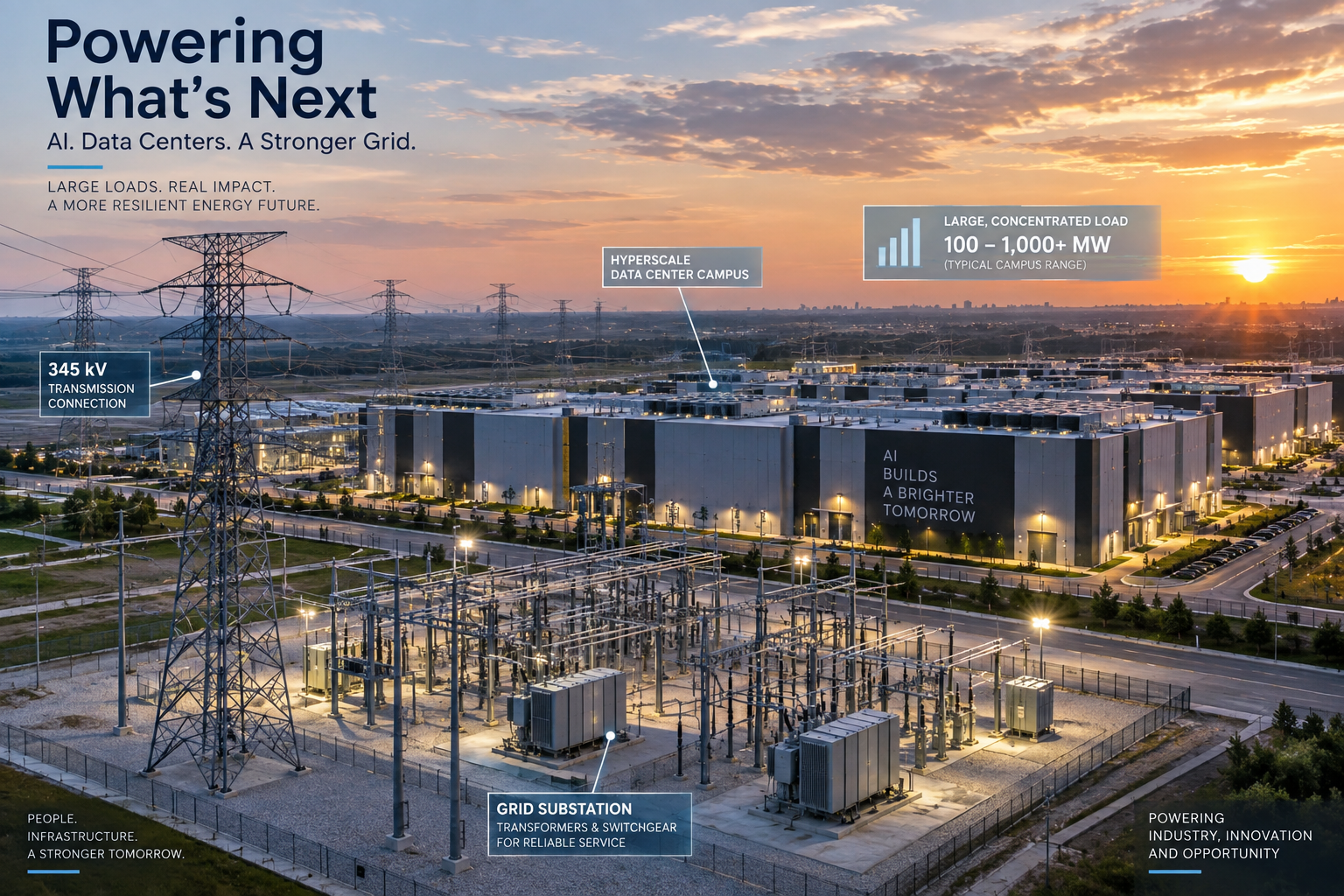
Modern computing campuses can concentrate very large amounts of electrical demand at individual locations. Inside them, servers and accelerators are supported by cooling systems, networking equipment, uninterruptible power supplies, power-conversion equipment, and other infrastructure that ultimately connects the digital workload to the electric grid.
The aggregate numbers are becoming significant.
The U.S. Department of Energy and Lawrence Berkeley National Laboratory estimate that data centers consumed about 4.4% of U.S. electricity in 2023. Updated projections indicate that their share could approach roughly one-tenth or more of U.S. electricity consumption by the end of the decade, although the range remains highly uncertain.
That uncertainty matters.
Not every announced data center will be built, and nominal project capacity does not necessarily translate directly into simultaneous peak demand. Project timing, utilization, onsite generation, storage, operational flexibility, and changing computing efficiency can all affect the actual load ultimately seen by the grid.
For planners, the challenge is therefore two-sided: prepare for potentially enormous demand growth without assuming that every announced megawatt will materialize exactly as proposed.
The Problem Is Increasingly Locational
National electricity consumption tells only part of the story.
Data centers tend to cluster.
That concentration can produce much larger effects on individual utilities and transmission regions than national averages suggest.
PJM, for example, has said that data-center development is driving unprecedented demand growth across parts of its footprint. Texas is simultaneously developing new processes specifically for connecting very large loads to the ERCOT system.
This changes the planning question.
The issue is no longer simply whether the country can produce enough electricity for expanding digital infrastructure.
It is whether sufficient generation, transmission capacity, transformers, substations, reactive support, and other infrastructure can be available at the locations and on the timelines where that demand appears.
Transmission Becomes Part of the Data-Center Buildout
A large computing campus cannot operate on generation capacity alone.
Power must reach it.
Depending on location and system conditions, connecting a major new load can require new or expanded substations, transformers, transmission facilities, switching equipment, protection systems, and upstream network reinforcements.
Transmission constraints can therefore become a major factor in determining where large data centers can connect and how quickly projects can reach full operation.
The issue has become significant enough to reshape federal and regional interconnection policy.
In June 2026, the Federal Energy Regulatory Commission directed all six regional grid operators under its jurisdiction to justify or reform tariff provisions governing the connection of data centers and other large energy users. ERCOT has separately established a batch study process for qualifying large loads of 75 MW and above so that multiple proposed connections can be evaluated together against available grid capability.
These developments signal an important change.
Large-load interconnection is becoming a distinct grid-planning discipline rather than simply another customer connection request.
Power Electronics Sit Between AI and the Grid
The connection between artificial intelligence and the Power Electronics Supercycle becomes particularly visible inside the data center itself.
Electricity entering a modern computing facility passes through multiple stages of transformation and control before reaching processors.
Depending on the facility architecture, these systems can include uninterruptible power supplies, rectifiers, AC/DC and DC/DC converters, battery systems, power distribution equipment, variable-speed motor drives, and increasingly sophisticated digital controls.
Power electronics provide efficiency, controllability, power quality management, and continuity of service.
But at very large scale, they also change how the facility interacts dynamically with the grid.
Converter controls, protection settings, UPS behavior, transfer schemes, and equipment ride-through characteristics can influence whether a facility remains connected during a transmission disturbance—or disconnects rapidly from the power system.
That behavior is becoming a bulk-system reliability issue.
When the Load Itself Becomes a Contingency
One of the most important developments since the original version of this article is the growing evidence that large computational loads cannot always be modeled simply as passive demand.
Their behavior during grid disturbances matters.
NERC has documented events in which large amounts of data-center load disconnected nearly simultaneously following transmission disturbances. PJM reported that nearly 4,000 MW of data-center load disconnected during a July 2026 event in northern Virginia.
When several gigawatts of demand suddenly disappear, generation momentarily exceeds load.
System frequency can rise.
Transmission voltages can rise.
Grid operators must then rebalance the system rapidly.
ERCOT has identified a related concern involving voltage ride-through capability among large computational loads. Its 2026 assessment found groups of large loads whose behavior could potentially produce load-loss levels exceeding the threshold ERCOT identified for maintaining frequency stability following a disturbance.
This creates a planning problem that looks very different from traditional load forecasting.
A sufficiently large cluster of data centers can itself become a credible system contingency.
Ride-Through Is Becoming a Grid Requirement
This changes the engineering conversation around data-center reliability.
Historically, data-center electrical design focused heavily on protecting computing equipment from disturbances originating on the utility system.
That remains important.
But as facilities become larger, the grid increasingly needs the data center to behave predictably during those same disturbances.
A facility designed to transfer immediately to backup power during a voltage depression may protect its computing workload while simultaneously removing hundreds of megawatts from the grid.
If many facilities respond similarly, their individual protection decisions can aggregate into a bulk-power-system event.
Voltage and frequency ride-through requirements, UPS behavior, protection settings, backup generation, transfer schemes, and coordination between facility and utility protection therefore become increasingly interconnected.
The boundary between data-center reliability and grid reliability is beginning to blur.
Monitoring the New Load
AI computing may introduce another challenge: load behavior at timescales that conventional planning has not historically emphasized.
The U.S. Department of Energy and the North American Synchrophasor Initiative have highlighted the potential for synchronized computing activity to produce measurable oscillations in electrical demand.
That does not mean every AI data center will create harmful grid oscillations.
It does mean utilities increasingly need better visibility into how these facilities behave.
Traditional supervisory measurements may not capture every phenomenon of interest. Phasor measurement units provide high-speed synchronized observations of power-system dynamics, while even higher-resolution point-on-wave measurements can reveal faster electrical behavior.
The implication extends beyond data centers.
As both generation and demand become increasingly power-electronic and digitally controlled, grid monitoring must evolve alongside them.
Utilities Must Rethink Large-Load Planning
The planning challenge therefore extends well beyond adding generation.
Utilities and system operators increasingly need to consider large-load forecasting, transmission capability, resource adequacy, voltage stability, frequency response, reactive power requirements, disturbance ride-through, protection coordination, dynamic models, power quality, and high-resolution monitoring as interconnected parts of the same problem.
Model quality is particularly important.
If planners do not accurately represent how large computational loads respond during faults, voltage excursions, frequency events, or rapid changes in computing activity, simulations may fail to reproduce the behavior operators eventually encounter on the real system.
NERC’s growing focus on large loads reflects this concern.
The industry is moving toward a world in which planners need substantially more information about the internal electrical behavior of major loads than they historically required from conventional commercial customers.
Flexibility Could Change the Equation
Large data centers do not necessarily have to remain inflexible loads.
Battery storage, backup generation, workload management, onsite energy systems, and other technologies may eventually allow some facilities to modify their grid demand under defined conditions.
EPRI is actively studying this possibility through its DCFlex initiative, including how flexible data-center designs could help utilities integrate more load while maintaining reliability.
The potential is significant.
A data center capable of reducing or shifting some demand during constrained periods could impose a very different planning burden than an equally large facility requiring uninterrupted maximum grid supply under every condition.
But flexibility should not simply be assumed.
Its value depends on what loads can actually be adjusted, for how long, how quickly, under what contractual conditions, and with what consequences for computing operations.
For grid planners, verified flexibility may ultimately matter almost as much as nameplate demand.
A New Infrastructure Cycle
The expansion of data centers is reinforcing investment across a much broader electrical ecosystem.
New demand can require additional generation and transmission, but also transformers, switchgear, substations, protection and control equipment, battery systems, power semiconductors, cooling infrastructure, monitoring systems, and engineering services.
This helps explain why the AI infrastructure boom is closely connected to the Power Electronics Supercycle.
The computing hardware may receive most of the attention, but every processor ultimately depends on an electrical system capable of delivering tightly controlled power continuously and at enormous scale.
As computing infrastructure grows, the physical grid supporting it must grow and evolve with it.
AI Is Becoming a Power-System Story
Artificial intelligence is usually discussed as software, algorithms, chips, and computing capacity.
From the perspective of the electric grid, that description is incomplete.
AI increasingly has a physical infrastructure footprint measured in megawatts, substations, transformers, transmission capacity, converters, backup systems, and grid studies.
That footprint is forcing utilities and system operators to confront questions that would have seemed unusual for a commercial load only a few years ago:
How much demand will actually materialize?
Where will it connect?
Can the transmission system deliver the power?
How will thousands of power-electronic devices behave during a disturbance?
What happens if several gigawatts of computing load disconnect simultaneously?
And could some of that enormous load eventually become a controllable grid resource rather than simply a new source of demand?
These are no longer theoretical questions.
They are becoming part of everyday power-system planning.
The digital economy is not separate from the electric grid.
It is becoming one of the forces reshaping it.
Previous in the Power Electronics Supercycle:
Part 2 — Grid-Forming Inverters: Rebuilding the Functions Once Provided by Synchronous Machines
Explore the Power Electronics Supercycle series
Next in the Power Electronics Supercycle:
Part 4 — Inside the Global HVDC Expansion Boom